Ghost Neutrinos Detected: Reactor Antineutrino Signal Persists After Shutdown
Double Chooz detects lingering antineutrinos from shut‑down reactors and nearby spent fuel, revealing measurable emissions after power stops.
Scientists working at the Chooz B nuclear power plant in northern France have now confirmed that antineutrinos continue to be emitted even after both reactors are shut down. The finding, reported in Physical Review Letters on 4 August 2026, is based on 17.2 days of live data collected with the Double Chooz near detector while the plant’s cores were offline.
Reactor‑origin antineutrinos trace the radioactive decay of fission products within nuclear fuel. Once fission ceases, long‑lived isotopes keep decaying for months or years, generating a faint antineutrino flux that typically amounts to less than one percent of the signal observed during normal operation.
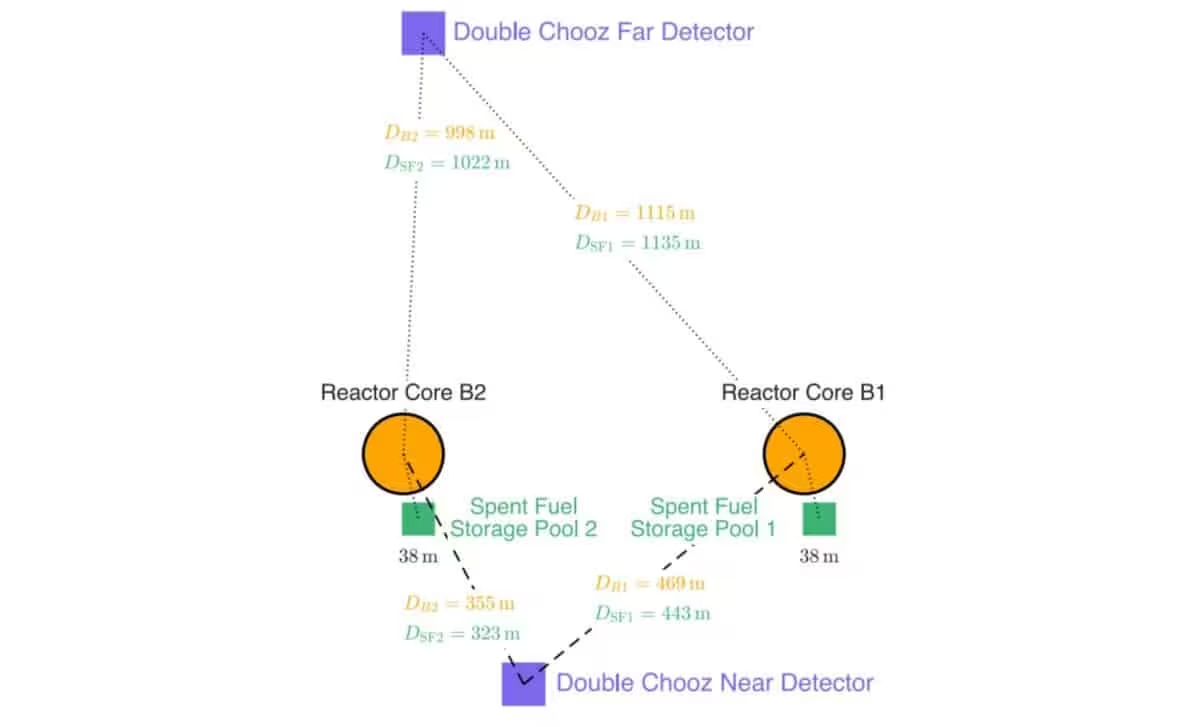
Because antineutrinos interact only rarely with matter, detecting them requires a large volume of liquid scintillator that converts the rare interactions into observable light. The Double Chooz near detector, positioned roughly 400 metres from the two reactor cores, is close enough to capture the weak emission that follows a shutdown.
Detectable Antineutrino Emission Persists After Reactor Shutdown
The collaboration examined four distinct shutdown intervals in 2017 when both Chooz B reactor units were offline for refueling or maintenance. Those periods spanned a total of 24.4 days, leaving 17.2 days of usable live time for the near detector after accounting for detector dead time.
During that window the near detector recorded 106 ± 18 residual antineutrino candidate events in the 1–3 MeV energy range after background subtraction. The prediction based on detailed reactor modeling was 88 ± 7 events, yielding a statistical excess of 5.9 σ. Prior to background removal, 244 events were observed in the same energy interval.
The measured excess is concentrated at low energies, matching the model’s expectation that 98.7 % of the post‑shutdown antineutrino flux falls below 3 MeV.
The average residual flux at the near detector corresponds to roughly 3.6 × 10⁸ particles cm⁻² s⁻¹ above the 1.8 MeV inverse‑beta‑decay threshold. Of this, about 2.0 × 10⁸ cm⁻² s⁻¹ originates from fuel remaining in the reactor cores, while 1.6 × 10⁸ cm⁻² s⁻¹ is attributed to the spent‑fuel pools.
The far detector, situated approximately 1.05 km from the cores, also saw an excess, recording 27 ± 13 events in the 1–3 MeV band versus a predicted 14 ± 1. The greater distance reduced both the event rate and the statistical significance.
Distinct Contributions From In‑Core Fuel and Spent‑Fuel Pools
The residual antineutrino signal does not arise from a single source. Fuel assemblies that remain inside the shut‑down reactors dominate the first hours after shutdown, when relatively short‑lived fission products are still decaying. In contrast, assemblies stored in cooling pools provide a longer‑lasting component because their varied cooling histories keep them radioactive for years.
According to the study, 56 % of the integrated residual signal over the examined periods is linked to the reactor cores, while 44 % originates from the spent‑fuel pools. These fractions were derived from detailed simulations that tracked the irradiation and cooling histories of individual fuel assemblies [doi].

Within the 1–3 MeV window, the model attributes about 54 % of the predicted flux to praseodymium‑144 and roughly 38 % to rhodium‑106, with smaller contributions from additional isotopes. Over longer timescales, yttrium‑90 becomes increasingly dominant, accounting for more than 90 % of the residual flux after a decade.
The observed energy spectrum aligns closely with the calculated shape; above 3 MeV neither detector shows a notable excess, consistent with expectations that high‑energy residual contributions are minimal.
Implications for Reactor‑Off Monitoring
These results provide the first direct experimental confirmation that antineutrino detectors can sense the lingering activity of nuclear fuel after a reactor ceases operation. The current sensitivity is sufficient to capture the overall residual signal and to identify large changes in fuel inventory, although it cannot yet detect the diversion of a small number of fuel assemblies.
By establishing a measured baseline for reactor‑off conditions, the study lays groundwork for future investigations into spent‑fuel monitoring and non‑proliferation applications.
This article has been fact checked for accuracy, with information verified against reputable sources. Learn more about us and our editorial process.
Last reviewed on .
Article history
- Latest version
Reference(s)
- Abrahão, T.., et al. “First Measurement of Neutrino Emissions from Spent Nuclear Fuel by the Double Chooz Experiment.” Physical Review Letters, vol. 137, no. 6, August 4, 2026 American Physical Society (APS), doi: 10.1103/dr26-j19g. <https://doi.org/10.1103/dr26-j19g>.
Cite this page:
- Posted by Zara Tariq