Astronomers Capture Stunning New Images of Two Planets Forming in Deep Space
Astronomers have captured an extraordinary, never-before-seen glimpse of two young planets forming within the remnants of their cosmic birthplace.
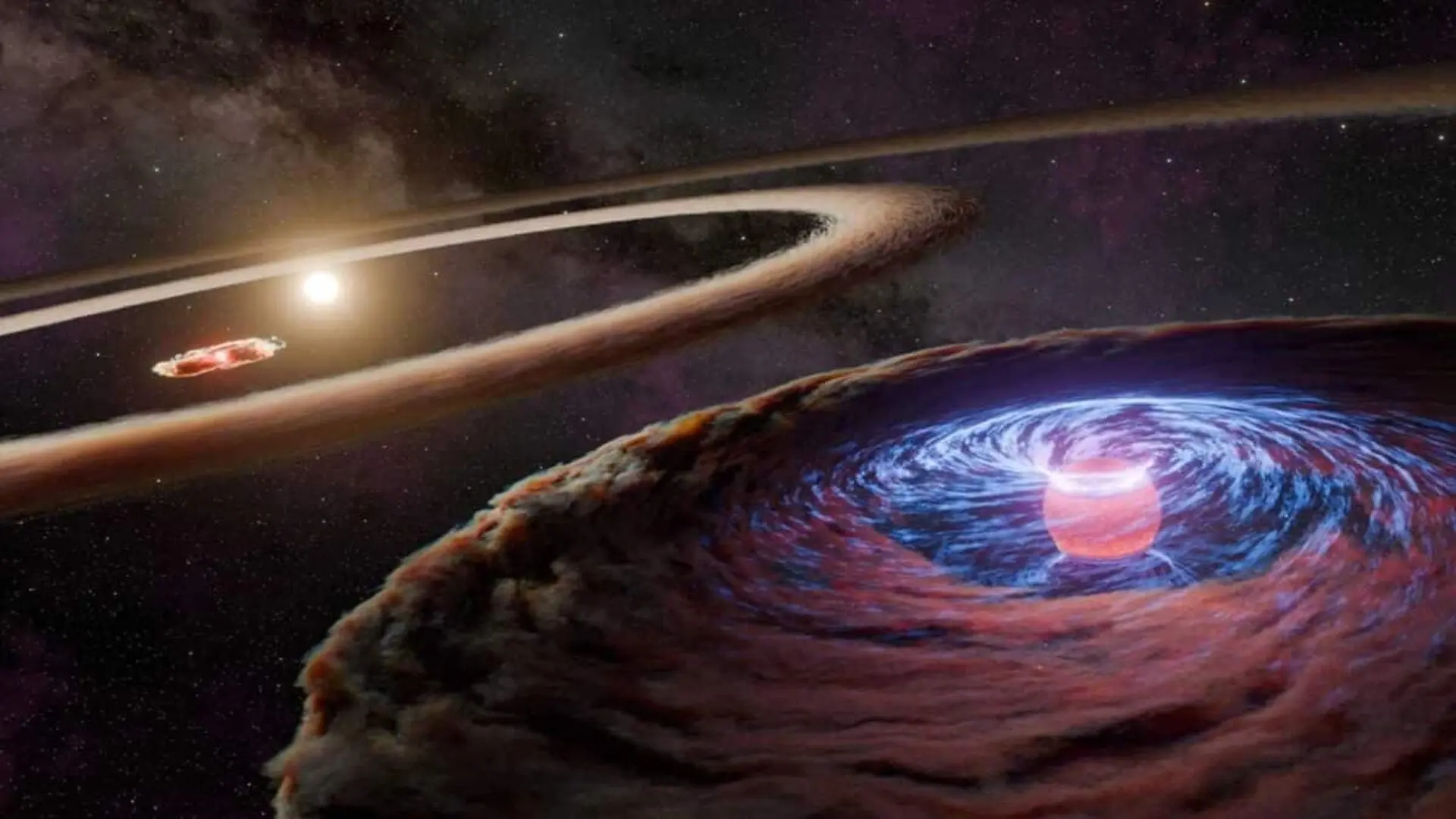
Astronomers have secured an unprecedented look at a planetary nursery in action, capturing high-resolution images of two young worlds emerging from the swirling clouds of dust and gas surrounding the star system WISPIT 2. These new observations, made possible by the Atacama Large Millimeter/submillimeter Array (ALMA), provide a rare, real-time glimpse into the complex physical interactions between developing planets and their natal environments.
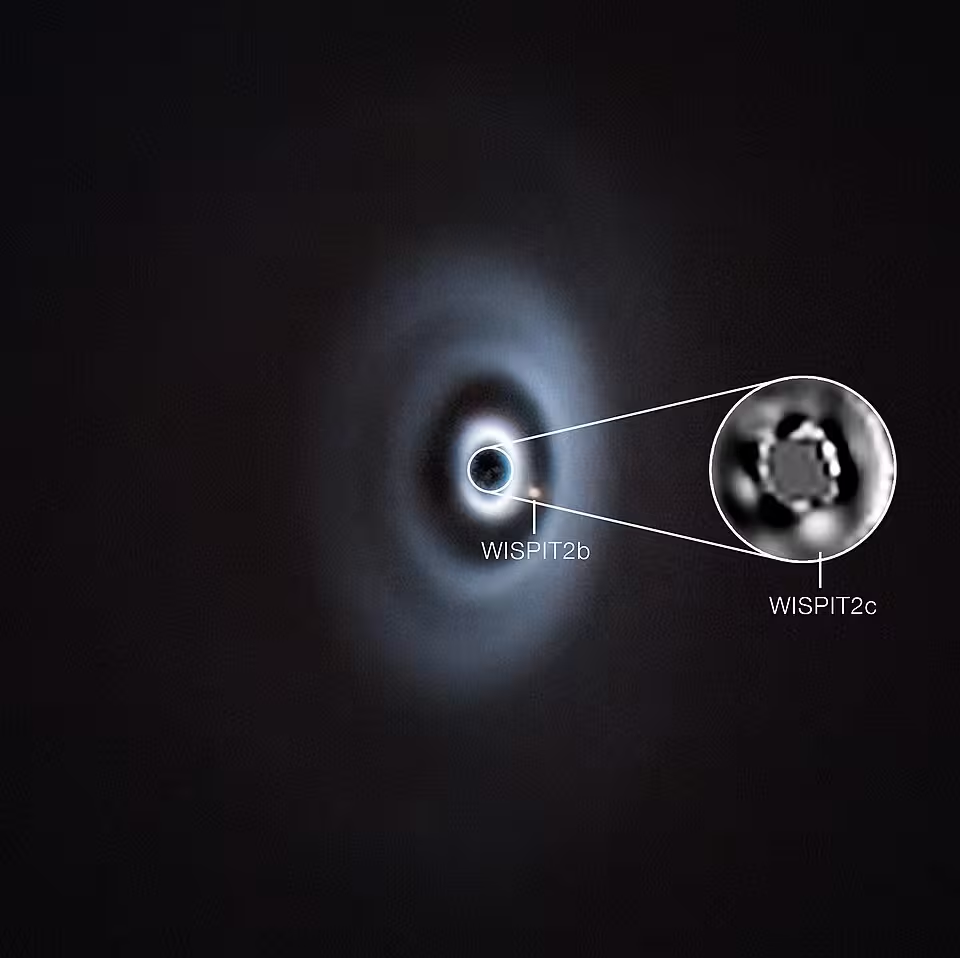
Located approximately 437 light-years away, the WISPIT 2 system is a relative infant in cosmic terms, boasting an age of roughly 5.4 million years. Encircling its central binary stars is a protoplanetary disk—a vast, rotating ring of material that serves as the raw ingredient for planet formation. Within this disk, researchers have pinpointed two distinct protoplanets, designated WISPIT 2b and WISPIT 2c, which are currently carving out their own unique paths through the surrounding debris.
Distinct Environmental Signatures of Two Developing Worlds
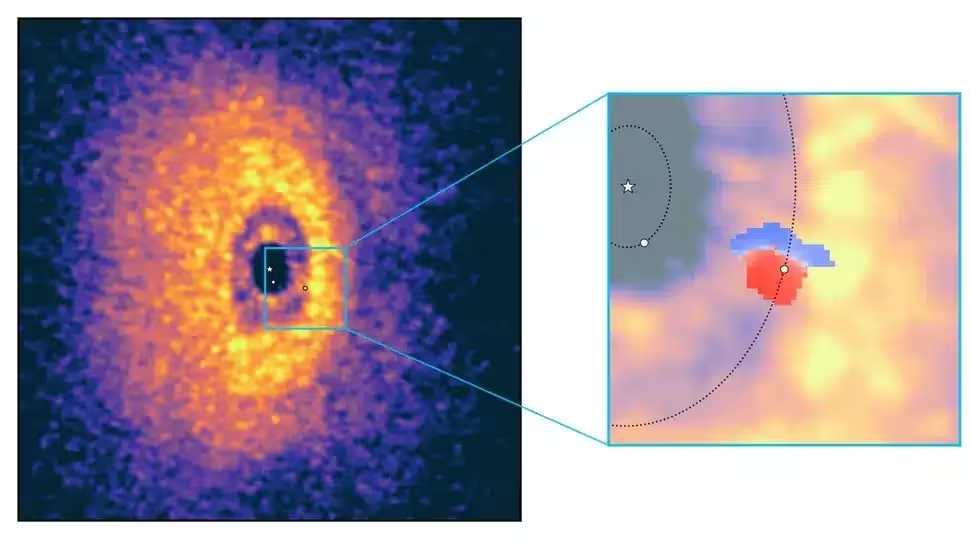
The ALMA data reveal that these two planets are impacting their surroundings in fundamentally different ways. WISPIT 2b, which researchers estimate has already grown to roughly five times the mass of Jupiter, is actively clearing a distinct gap in the disk as it continues to gobble up material. In contrast, the less mature WISPIT 2c has produced a broader cavity within the structure.
“We clearly see both planets shaping their environment. WISPIT 2c has carved a cavity, and WISPIT 2b a gap,” said Myriam Benisty of the Max Planck Institute, in a statement. “Around WISPIT 2b, we find swirls of gas that had been predicted by simulations of disk-planet interactions, but never actually seen before. Now there is an image of them!”
A Comprehensive Laboratory for Planetary Evolution
The WISPIT 2 system is particularly significant because it captures several critical stages of planetary development within a single frame. According to the report, this system represents the only known instance where scientists can simultaneously observe the protoplanetary disk, the planet itself, clear evidence of active material accretion, and the complex interaction of gas dynamics.
While features like these have been documented in other systems, such as the well-studied PDS 70, WISPIT 2 provides a more complete, unified picture. This allows researchers to refine their models regarding how planetary formation influences the evolution of the host disk.
“Hopefully, observations like this will teach astronomers to distinguish between disk features that indicate the presence of a protoplanet and features that don’t,” said Stefano Facchini of the University of Milan.
Orbits That Defy Conventional Expectations
WISPIT 2b stands out for its extreme orbital distance, residing roughly 57 times further from its star than Earth is from the Sun. This distance is nearly double that between the Sun and Neptune, placing the forming planet in a region much further out than the majority of known exoplanets.
To map these features, the team utilized the combined power of 66 radio antennas within the ALMA array. By analyzing the carbon monoxide emissions and hydrogen gas signatures, the researchers were able to create detailed, false-color maps that highlight the specific structural patterns caused by the presence of these two massive, growing worlds.
The findings, detailed in two papers published on arXiv, underscore the potential for future breakthroughs in the field. As researchers integrate data from ALMA upgrades and the upcoming Extremely Large Telescope currently under construction in Chile, the ability to resolve the minute details of distant, young solar systems is expected to increase dramatically.
This article has been fact checked for accuracy, with information verified against reputable sources. Learn more about us and our editorial process.
Last reviewed on .
Article history
- Latest version
Reference(s)
- “Myriam Benisty.” <https://www.mpia.de/6385635/dr-myriam-benisty>.
- “Astronomers produce the first complete picture of (gas) planet formation in action.” <https://www.mpg.de/26990768/astronomers-produce-the-first-complete-picture-of-gas-planet-formation-in-action>.
- Bürgy, Cade. “A closer look at the WISPIT 2 host star. Evidence for a spectroscopic binary.” arXiv.org <https://arxiv.org/abs/2607.22405>.
- projects, Contributors. “T Tauri-type star.”, June 30, 2018 Wikimedia Foundation, Inc. <https://en.wikipedia.org/wiki/PDS_70>.
Cite this page:
- Posted by Karan Das