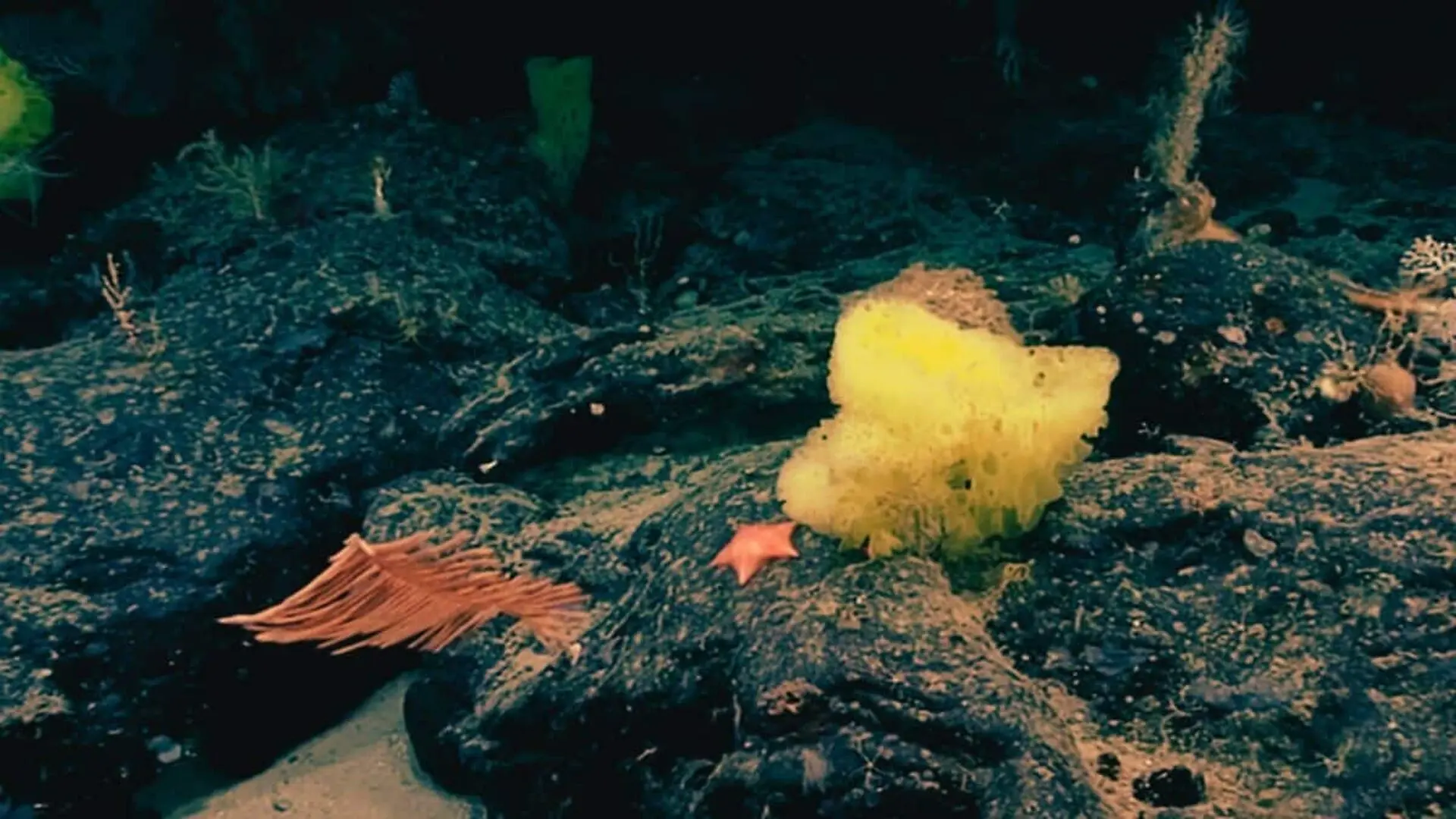
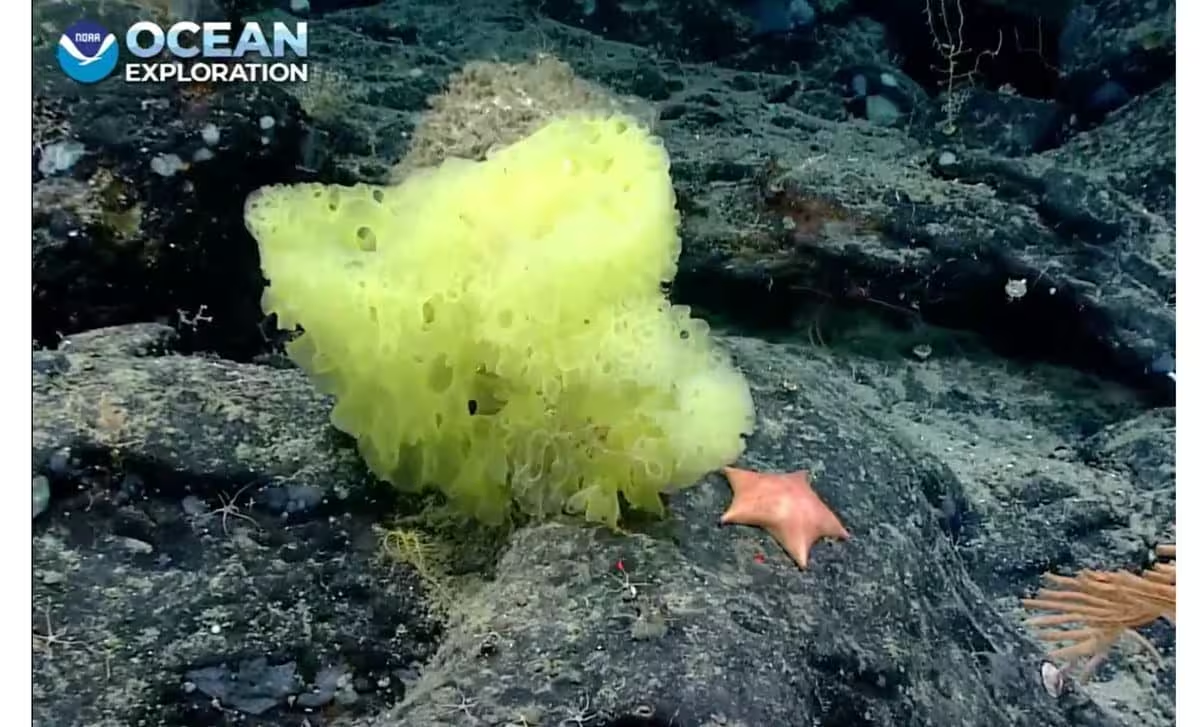
Researchers conducting a deep-sea exploration in the Atlantic Ocean have captured a striking image that seems to have leaped straight from the pages of a cartoon. During a mission led by the National Oceanic and Atmospheric Administration (NOAA), remotely operated vehicles (ROVs) documented a bright yellow sponge resting alongside a vibrant pink sea star, bearing a distinct resemblance to the iconic duo SpongeBob SquarePants and Patrick Star.
The pair was discovered resting on the slopes of the Retriever Seamount, an underwater mountain located approximately 200 miles east of New York City. The scene was captured at a staggering depth of nearly 6,200 feet, providing researchers with a rare, clear look at life within the deep-sea abyss.
An Unexpected Animated Lookalike in the Abyss
Marine biologist Christopher Mah, who closely examined the footage, noted the remarkable visual irony of the encounter. Sharing the observation, Mah remarked that while he usually steers clear of pop-culture comparisons, this instance was too distinct to ignore, describing it as a real-life version of the famous animated pair. The findings were documented through the NOAA expedition, which utilizes advanced ROV technology to navigate and observe ecosystems that remain largely inaccessible to human divers.
The bright coloration of the specimens is particularly unusual for such extreme depths. The yellow sponge, identified as a member of the genus Hertwigia, and the pink sea star, from the genus Chondraster, stand out against the backdrop of an environment typically dominated by muted oranges and pale tones due to the near-total absence of light.
While the visual parallel to the animated characters is lighthearted, the biological reality of the encounter is far less friendly. Scientists clarify that the proximity of these two organisms is likely driven by a predatory instinct rather than companionship. Sea stars belonging to the Chondraster genus are known carnivores, and in the deep-sea food web, sponges often serve as their prey.
In these hostile, high-pressure environments, sea stars frequently secure their food by latching onto an organism and extending their stomach externally to digest the tissue. Consequently, the moment captured by the ROV was likely a snapshot of a hunter and its target, far removed from the playful dynamic depicted in fiction.
Scientists may have found the real life SpongeBob and Patrick nearly 6,200 feet below the Atlantic.
A NOAA expedition captured a yellow sponge and pink sea star sitting side by side, and marine biologist Christopher Mah pointed out the obvious comparison.
This discovery underscores the vast, untapped potential for research within the ocean’s depths. NOAA’s ongoing efforts to map and study habitats as deep as 15,000 feet continue to reveal unique biological diversity and behaviors that were previously unknown to science, serving as a reminder that the deep sea remains one of the final frontiers for discovery.
Raza, Hassan. “Scientists Discover Real Life SpongeBob and Patrick Living in the Deep Atlantic Ocean.” BioScience. BioScience ISSN 2521-5760, 15 September 2026. <https://www.bioscience.com.pk/en/subject/biology/spongebob-and-patrick-appear-in-the-oceans-abyss-as-scientists-uncover-a-bizarre-deep-sea-scene>.
Raza, H. (2026, September 15). “Scientists Discover Real Life SpongeBob and Patrick Living in the Deep Atlantic Ocean.” BioScience. ISSN 2521-5760. Retrieved September 15, 2026 from https://www.bioscience.com.pk/en/subject/biology/spongebob-and-patrick-appear-in-the-oceans-abyss-as-scientists-uncover-a-bizarre-deep-sea-scene
Raza, Hassan. “Scientists Discover Real Life SpongeBob and Patrick Living in the Deep Atlantic Ocean.” BioScience. ISSN 2521-5760. https://www.bioscience.com.pk/en/subject/biology/spongebob-and-patrick-appear-in-the-oceans-abyss-as-scientists-uncover-a-bizarre-deep-sea-scene (accessed September 15, 2026).