Astronomers Discover Bizarre Mega-Earth That Defies Current Planet Formation Rules
Astronomers have discovered a rare, ultra-dense mega-Earth 23 times the mass of our planet, offering new clues into the nature of exotic celestial bodies.

Astronomers have identified a rare, high-density exoplanet that defies standard planetary classification, prompting researchers to formalize the definition of a new category of worlds dubbed “mega-Earths.” Located within a relatively young system, the planet, GJ 523b, packs a staggering 23.5 times the mass of Earth into a radius just 2.55 times larger than our home planet. This compact, heavy composition suggests a distinct evolutionary history that sets it apart from the more common, gas-shrouded sub-Neptunes found at similar sizes.
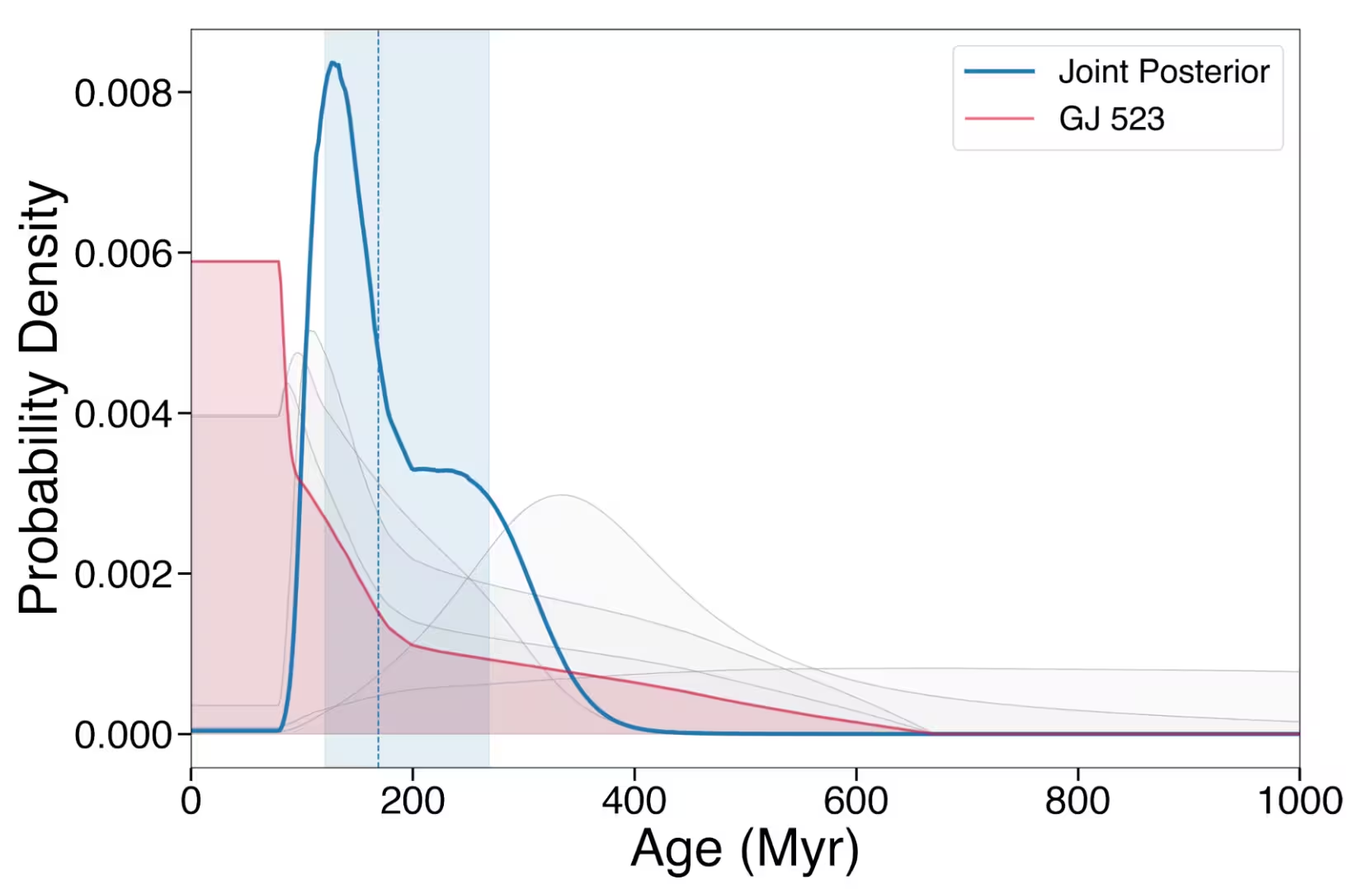
The discovery, led by Max Kroft of the University of Wisconsin–Madison’s Wisconsin Center for Origins Research, is currently under peer review and available on the arXiv preprint server. According to the research team, GJ 523b circles its host star every 17.7 days and is estimated to be roughly 169 million years old, a mere blink of an eye in cosmic timescales.
Defining the “Mega-Earth”
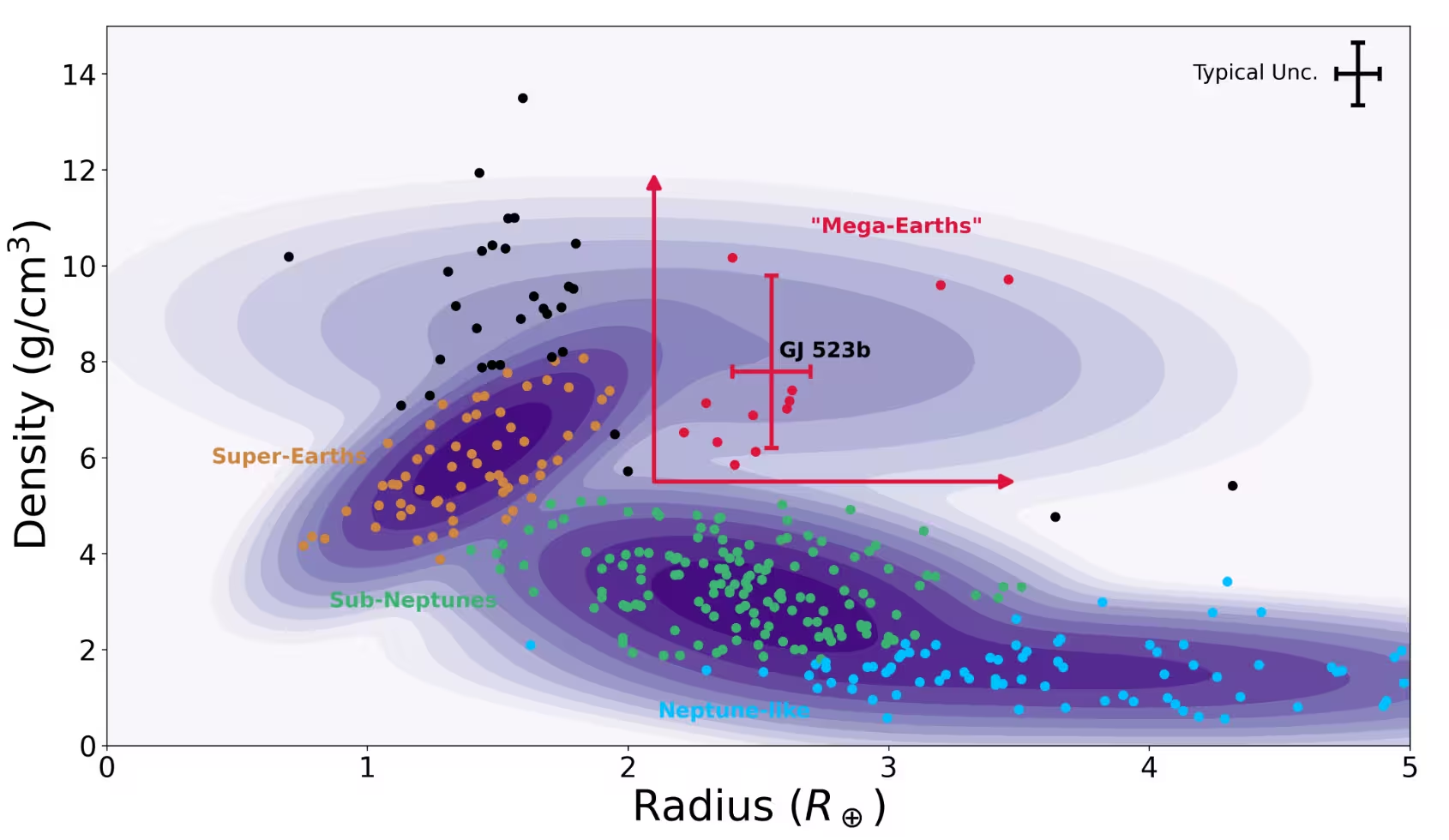
While the term “mega-Earth” has circulated in astronomical circles for over a decade, it lacked a rigorous scientific framework. The Wisconsin-led team proposes that the label be applied to planets with radii between 2.1 and 5 Earth radii that maintain a density of at least 5.5 grams per cubic centimeter. GJ 523b, with a density of 7.8 grams per cubic centimeter, serves as a prime example of this class.
Typically, planets of this size fall into the category of “sub-Neptunes,” which are expected to possess thick, puffy envelopes of hydrogen and helium. GJ 523b, however, shows no sign of such a gaseous shroud, appearing to be composed primarily of rock and water. "Dense planets like this aren’t uncommon, but they’re usually small rocky planets similar to Earth or Mercury,“ Kroft explained. ”This planet is two and a half times the size of Earth, which is not what we expected at all."
Detecting an Anomaly
The candidate was first spotted by NASA’s Transiting Exoplanet Survey Satellite (TESS), which monitors stars for the subtle brightness dips caused by passing planets. To confirm the planet’s extreme mass, the team employed the NEID high-resolution spectrograph on the WIYN 3.5-meter Telescope, performing 30 radial-velocity measurements to gauge the planet’s gravitational influence on its host star. Using specialized analysis software, the researchers accounted for stellar activity—which can often mimic the signals of orbiting planets—to isolate the planetary signature.
Further complicating the mystery is the planet’s orbital architecture. Calculations indicate a stellar inclination of about 17.6 degrees, suggesting the planet’s orbit is tilted at a significant angle relative to the star’s rotation, with a three-dimensional obliquity exceeding 71 degrees. This high degree of misalignment, combined with a modest orbital eccentricity, points toward a chaotic past that may involve dramatic planetary migration or violent collisions during the system’s early formation.
Future Research Pathways
While the exact origins of GJ 523b remain elusive, the team suggests that giant impacts or a unique combination of pebble and planetesimal accretion could explain how a planet might lose its primordial gas while growing a massive, dense core. Identifying similar worlds will be crucial to validating these formation theories.
“It’s hard to infer things about planet formation in general from a sample size of one,” Kroft noted. The researchers hope that future observations—possibly utilizing the James Webb Space Telescope for atmospheric analysis or data from the Gaia mission to search for distant companion objects—will help expand the census of these overdense worlds.
This article has been fact checked for accuracy, with information verified against reputable sources. Learn more about us and our editorial process.
Last reviewed on .
Article history
- Latest version
Reference(s)
- “GJ 523b is a Massive, 170 Myr-old Mega-Earth, Likely on a Polar Orbit.” <https://arxiv.org/html/2603.24682v1>.
Cite this page:
- Posted by Aisha Ahmed