NASA Reveals Returning Spokes on Saturn’s B Ring, a Mystery Scientists Still Chase
Unusual structures crossing Saturn’s B ring reveal new clues about the forces shaping its iconic rings.
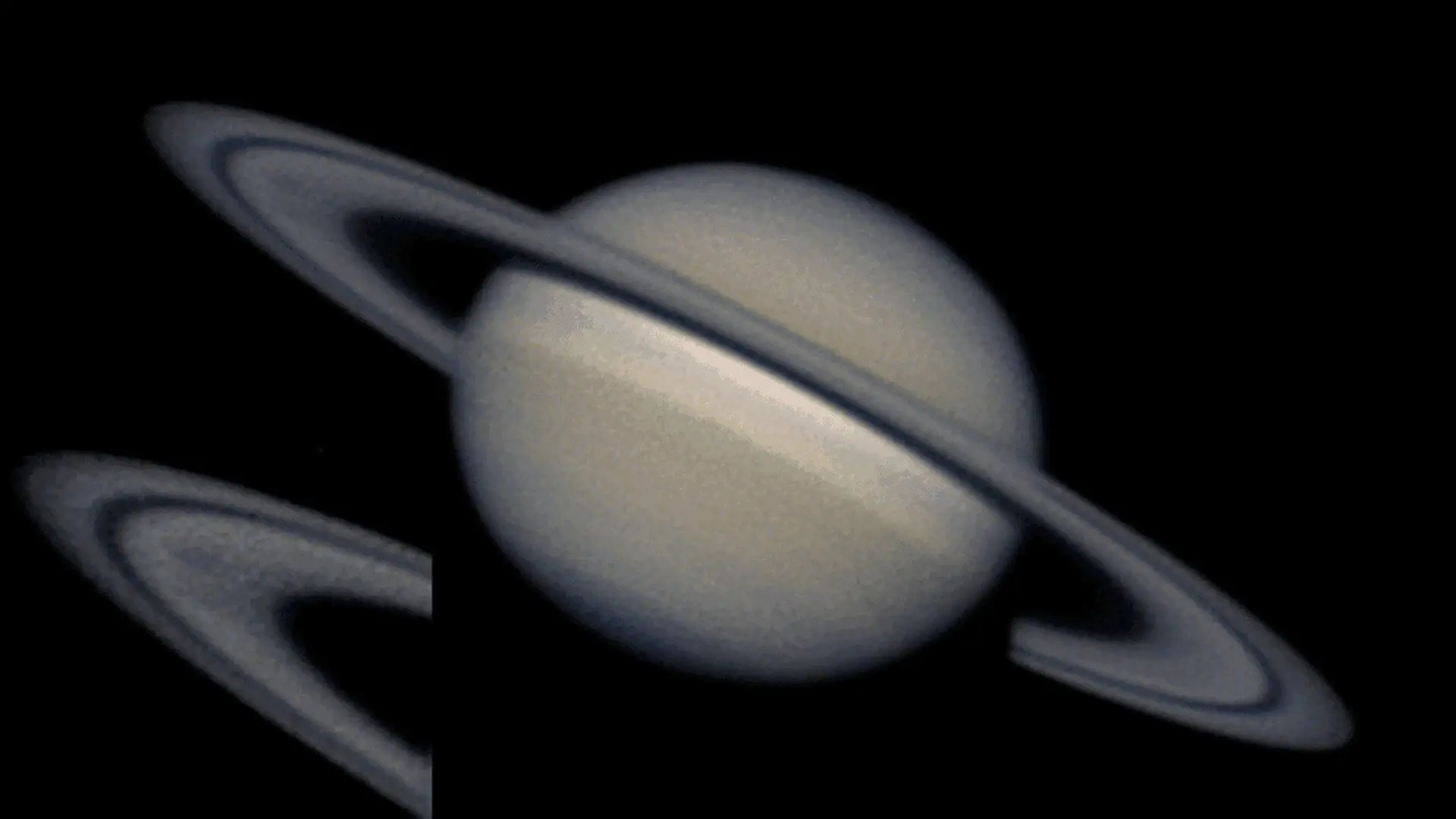
A recent image of Saturn’s B ring reveals the resurgence of one of the planet’s most enigmatic structures: faint, radial features commonly called ring spokes. Released by NASA, the photograph underscores a phenomenon that continues to puzzle researchers studying the intricate dynamics of Saturn’s icy ring system.
Transient Radial Features Sweep Across the Ring Plane
Since their first detection by spacecraft and ground‑based telescopes, these fleeting radial markings have captured the imagination of astronomers. Unlike the permanent ice and rock particles that compose the rings, the spokes appear as shifting bands that traverse the ring plane.
The new capture concentrates on the B ring, a bright and massive segment of Saturn’s rings. The spokes manifest as slender filaments that radiate outward from the planet, giving the impression of structures that are not tied to the regular motion of the countless particles within the rings.
Current theories link the appearance of these features to a complex interplay among Saturn’s magnetic field, solar illumination, and minuscule charged dust grains embedded in the rings. Their visibility fluctuates over time, demanding repeated observations to decode their behavior.
Rather than representing permanent gaps, the spokes are temporary disturbances that travel with the surrounding material while retaining their distinct radial orientation.
Seasonal variations in Saturn’s orbit and the changing angle of sunlight striking the rings influence when the spokes become observable, making certain periods more conducive to their emergence.
NASA Highlights the Reappearance of a Classic Ring Phenomenon
The picture was shared by NASA as part of its public‑outreach program, drawing renewed attention to a long‑standing mystery of the outer Solar System. Earlier missions, notably Cassini, have supplied valuable data on how these patterns develop.
During its eight‑year tour of Saturn, the Cassini spacecraft delivered some of the most detailed measurements of the ring system to date, enabling scientists to associate the spokes with electric and magnetic phenomena surrounding the planet.
The latest visual adds to a decades‑long effort to unravel the connections between Saturn’s atmosphere, magnetic environment, and ring dynamics. Although progress has been made, the precise mechanisms that give rise to the spokes remain an active area of investigation.
The continued fascination with these structures underscores why Saturn remains a focal point for planetary research. Its rings serve as a natural laboratory for probing interactions among particles, radiation, and magnetic forces.
The B Ring: A Dense Laboratory Still Full of Secrets
The B ring stands out as the most massive portion of Saturn’s ring complex, populated by a vast spectrum of particles ranging from microscopic grains to sizable icy fragments. Its brilliance and density make it one of the most striking features observable from Earth.
Beyond a simple collection of orbiting debris, the ring system is sculpted by gravity, collisional processes, magnetic interactions, and the influence of Saturn’s moons. Small fluctuations in these forces can generate extensive patterns that stretch across the rings.
Spokes offer a rare window into physical processes that are difficult to observe elsewhere in the Solar System. By tracking their occurrence and distribution, researchers can refine models of Saturn’s magnetic field and its coupling with ring material.
These transient features illustrate the dynamic nature of planetary systems. While Saturn’s rings may appear static to casual observers, high‑resolution studies reveal a constantly evolving architecture shaped by invisible forces.
Ongoing and future observations aim to clarify the lifecycle of the spokes, determine why they intensify during specific phases of Saturn’s year, and ultimately deepen our understanding of ring‑planet interactions.
This article has been fact checked for accuracy, with information verified against reputable sources. Learn more about us and our editorial process.
Last reviewed on .
Article history
- Latest version
Reference(s)
- Bonnell, Jerry. “APOD: 2026 August 5 - Spokes on Saturn's B Ring - NASA Science.”, August 5, 2026 NASA <https://science.nasa.gov/image-article/apod-2026-august-5-spokes-on-saturns-b-ring/>.
Cite this page:
- Posted by Karan Das