New Horizons Could Hit the Termination Shock by 2029 - And May Cross It More Than Once
New Horizons may soon cross the heliopause, entering interstellar space as the Sun’s influence wanes, according to fresh research.
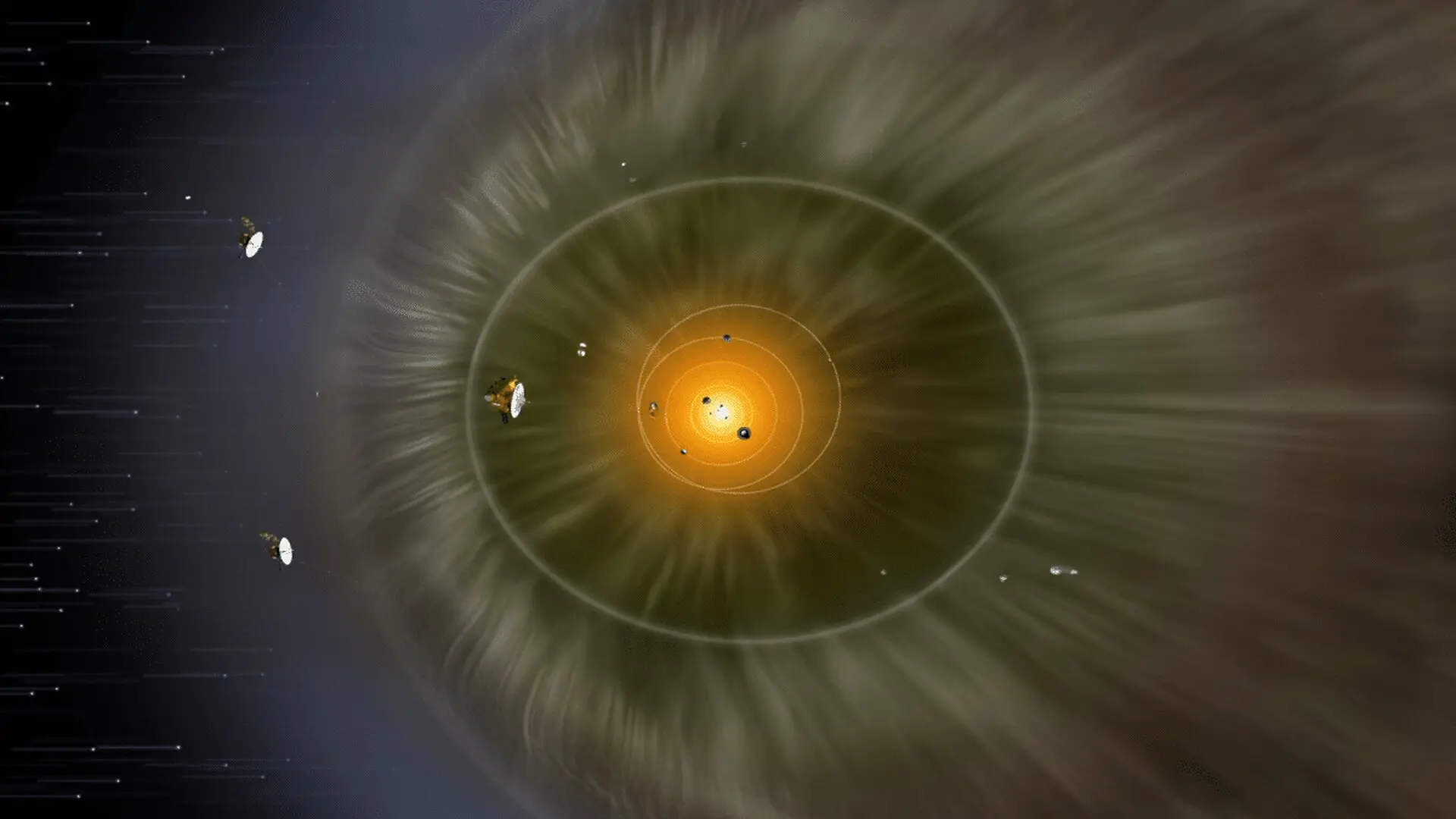
Recent modeling efforts are allowing researchers to locate the Sun’s far‑reaching boundary with unprecedented precision. Integrating solar‑wind forecasts and state‑of‑the‑art heliospheric simulations, scientists have refined the timeline for when NASA’s New Horizons probe may reach the termination shock – the transitional zone that separates the solar system from interstellar space. The results, appearing in Advances in Space Research and The Astrophysical Journal, offer new guidance for the next phase of deep‑space exploration.
Mapping the Sun’s Outer Boundary with New Solar‑Wind Models
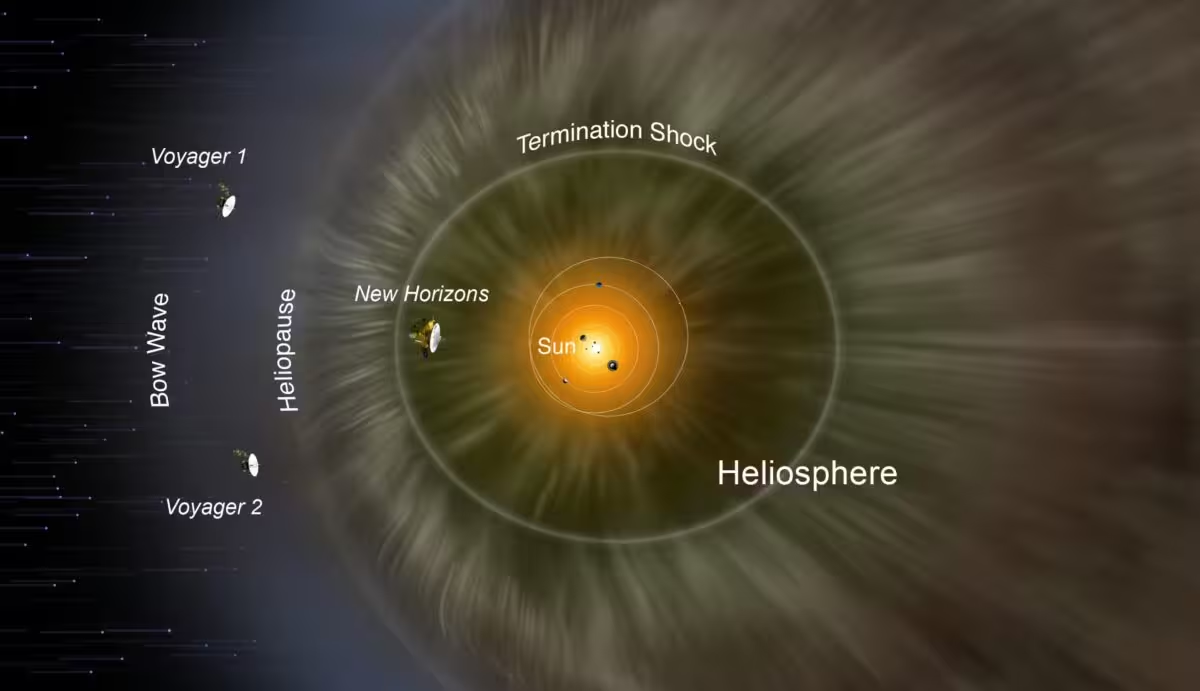
Beyond Pluto’s orbit, the environment encountered by New Horizons becomes increasingly alien. The spacecraft travels through a region where the solar wind—a steady stream of charged particles emitted by the Sun—gradually loses its dominance. Farther out lies the termination shock, a surface where the once‑supersonic wind decelerates sharply after colliding with interstellar material.
A team at Southwest Research Institute is blending solar‑wind prediction techniques with sophisticated heliospheric simulations to pinpoint the current position of this boundary. Because the heliosphere expands and contracts in response to the Sun’s activity cycle, its size is not fixed. Periods of heightened solar activity generate stronger winds that push the bubble outward, while quieter intervals allow it to contract toward the Sun.
This variability makes forecasting a complex task. Unlike planetary orbits that remain constant, the termination shock drifts in response to solar conditions. By feeding real‑time solar‑wind measurements into numerical models, the researchers are producing increasingly reliable estimates of where the invisible frontier will sit when New Horizons arrives.
New Horizons Joins Voyager Fleet on the Path to Interstellar Space
New Horizons already holds a celebrated place in space‑exploration history. After providing the first close‑up images of Pluto in 2015 and later flying by the Kuiper Belt object Arrokoth, the probe kept moving outward. Its present trajectory points toward the leading edge of the heliosphere, making it an ideal platform for probing the Sun’s outermost domain.
Only Voyager 1 and Voyager 2 have previously crossed major heliospheric boundaries and entered interstellar space. If New Horizons reaches the termination shock, it would become the third spacecraft to make that transition, delivering fresh measurements from modern instruments operating in a different sector of the heliosphere.
Data collected along this journey could illuminate how the solar wind behaves at extreme distances, how the heliosphere interacts with the surrounding interstellar medium, and how energetic particles travel through these remote regions. Each new observation refines our picture of the giant plasma bubble that shields the solar system from a substantial portion of galactic radiation.
Updated Projections Indicate Termination Shock May Be Reached by Late 2020s
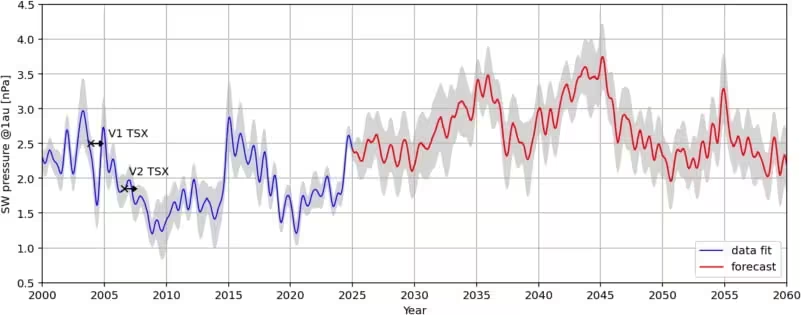
The two recent papers, published in Advances in Space Research and The Astrophysical Journal, present a broad but scientifically valuable window for the upcoming encounter. According to the authors, New Horizons could arrive at the termination shock sometime between 2029 and 2040, depending on the evolution of solar activity and the heliosphere’s response over the next decade.
“We want to understand when the spacecraft will reach the termination shock to prepare to take measurements and download data about this region,” said Dr. Jonathan Gasser, lead author of the two papers.
The forecast underscores the heliosphere’s intricate dynamics. Rather than a rigid shell, the boundary behaves like a breathing structure that reacts to shifting solar conditions. Consequently, the exact location of the termination shock years ahead cannot be fixed with absolute certainty. Researchers therefore employ simulations that span a wide range of plausible solar‑wind scenarios to gauge where the frontier is likely to be.
Potential Multiple Crossings of the Termination Shock
One surprising outcome of the study is that the encounter might not be a single, definitive event. Because the heliosphere continually expands and contracts, the termination shock can migrate inward and outward over time. This raises the possibility that a spacecraft positioned near the boundary could traverse it more than once.
“Based on our research, we predict that New Horizons will encounter the termination shock as early as 2029 or as late as 2040. And it is possible that it could cross the boundary more than once as the heliosphere continues to expand and contract.”
Repeated crossings would grant scientists an unprecedented chance to observe how the boundary evolves under varying solar conditions. Instead of a solitary data set, researchers could compare measurements from multiple transitions between regions dominated by different plasma environments, thereby testing and refining heliospheric models.
These scenarios highlight how dynamic the solar system’s outer frontier truly is. What appears on diagrams as a clean dividing line is, in reality, a constantly shifting region shaped by the ongoing interaction between the Sun and the galaxy beyond.
Implications for Deep‑Space Missions and Heliophysics
Grasping the structure and behavior of the heliosphere extends far beyond the fate of a single probe. The heliospheric bubble influences the flow of cosmic radiation into the solar system, affecting the environment encountered by spacecraft venturing to great distances.
More accurate forecasts of heliospheric boundaries could improve planning for future deep‑space missions and clarify how our solar system engages with the interstellar medium. Scientists continue to debate the overall shape of the heliosphere, with some models favoring a comet‑like tail and others suggesting a croissant‑shaped form. Measurements from New Horizons may help resolve these competing hypotheses.
As the probe journeys farther into the darkness beyond the planets, it carries not only scientific instruments but also the promise of revealing where the Sun’s influence finally wanes and the broader galaxy begins. The coming decade may determine whether New Horizons becomes the next explorer to cross one of the most significant boundaries in space.
This article has been fact checked for accuracy, with information verified against reputable sources. Learn more about us and our editorial process.
Last reviewed on .
Article history
- Latest version
Reference(s)
- “Redirecting.” <http://linkinghub.elsevier.com/retrieve/pii/S0273117726005612>.
- Gasser, Jonathan., et al. “Solar Wind Forecasting for Long-term Variations of the Global Heliosphere.” The Astrophysical Journal, vol. 999, no. 1, February 20, 2026, pp. 11 American Astronomical Society, doi: 10.3847/1538-4357/ae3152. <https://iopscience.iop.org/article/10.3847/1538-4357/ae3152>.
Cite this page:
- Posted by Karan Das