China’s Tianwen-2 Targets Earth’s Quasi-Moon Kamo’oalewa for Historic First Landing
China’s Tianwen‑2 spacecraft nears the mysterious quasi‑moon Kamo’oalewa, paving the way for a historic sample‑return mission.
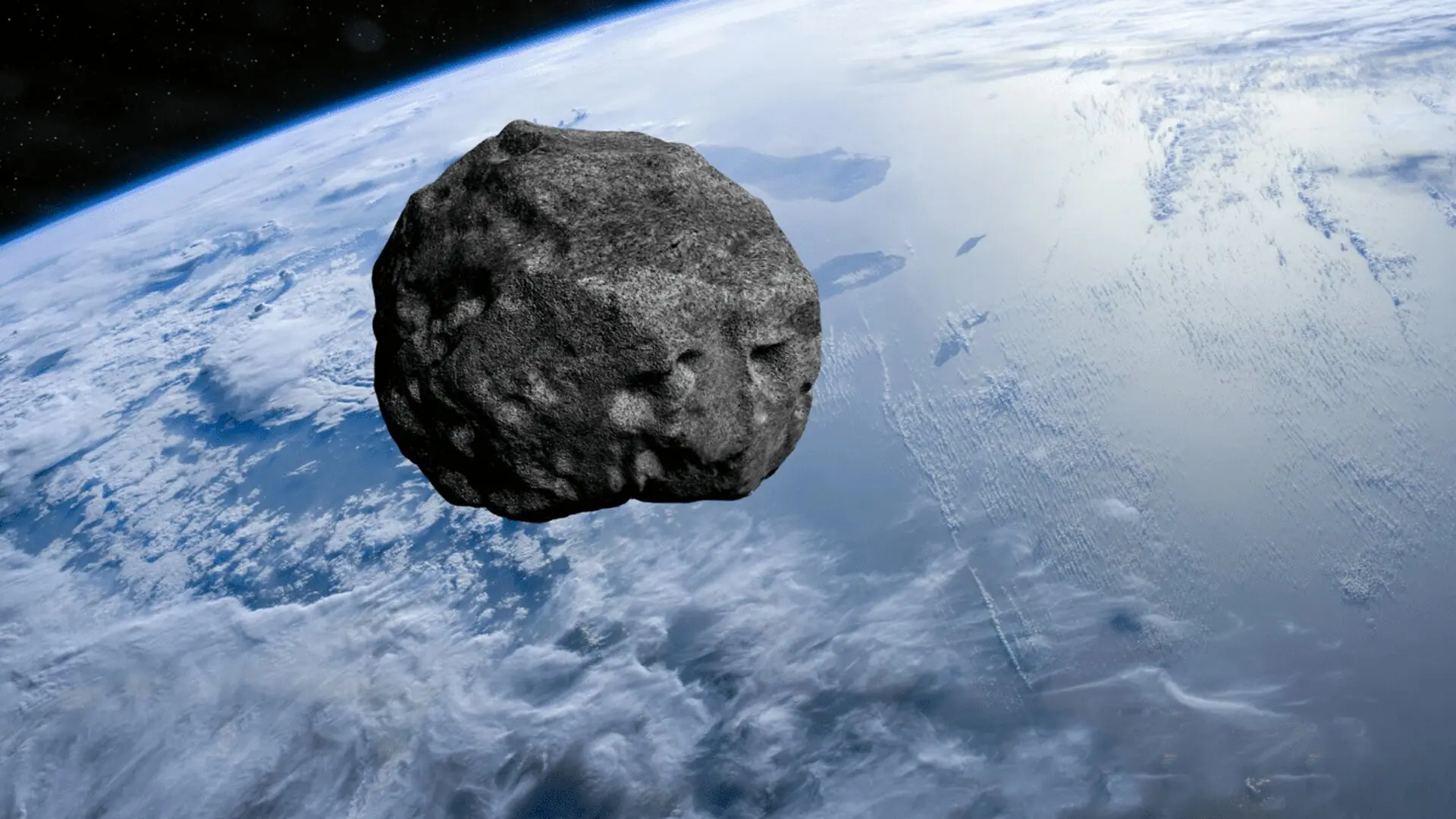
China’s deep‑space probe Tianwen-2 has entered the vicinity of the puzzling near‑Earth asteroid Kamo’oalewa, positioning itself for what could become the inaugural landing on one of Earth’s quasi‑moons. The mission, initially reported by LiveScience, intends to retrieve material from the small body and bring it back to terrestrial laboratories, giving researchers a rare chance to examine a relic that has long eluded a clear origin story.
What Makes Kamo’oalewa a Scientific Enigma
Unlike the Moon, which is permanently bound to Earth, Kamo’oalewa is classified as a quasi‑moon: an asteroid that orbits the Sun while staying in a resonant pattern with Earth’s own orbit. Though it shadows our planet for decades, it is not captured by Earth’s gravity in the same way as the traditional satellite. With a diameter of only a few dozen metres, the rock has sparked debate about its provenance—some hypotheses point to a fragment ejected from the Moon during an ancient impact, while others argue for an origin among the broader near‑Earth asteroid population.
The uncertainty surrounding its composition is precisely why Tianwen‑2 is so valuable. By touching down, gathering samples, and returning them, the probe could provide definitive chemical, mineralogical, and isotopic data that settle the lunar‑fragment versus independent‑asteroid question.
“What makes [this mission] extraordinary is that we don’t yet know [the object’s] composition or origin. We’ll only obtain definitive answers after completing our exploration,” says Li Chunlai, a researcher at the Chinese Academy of Sciences’ National Astronomical Observatories and chief commander of the mission’s ground‑segment team, in a state‑released video with English subtitles.
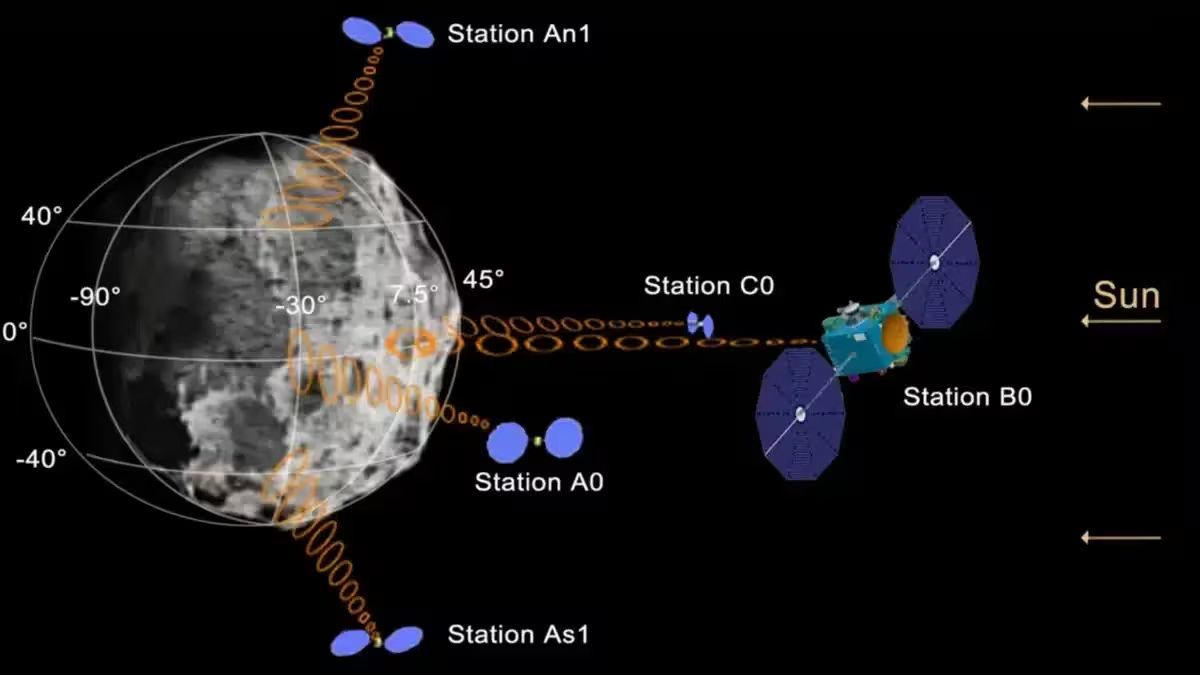
A First‑of‑Its‑Kind Touchdown Could Redefine Planetary Science
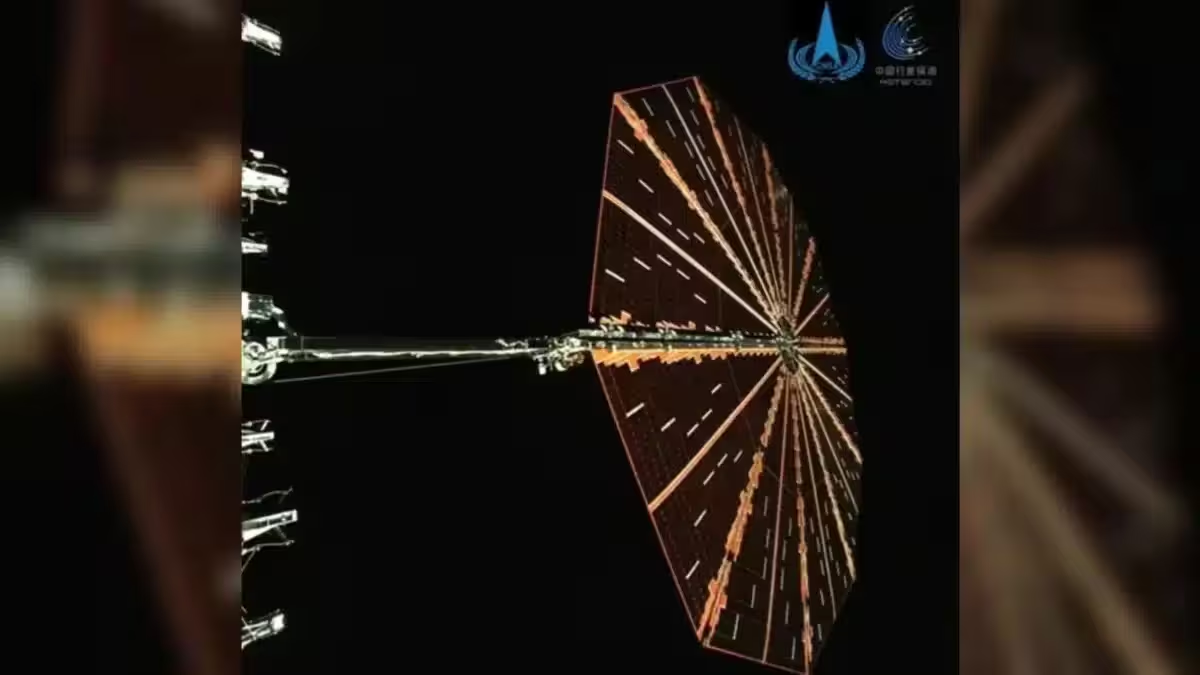
Landing on a body with vanishingly low gravity demands a novel approach. Conventional descent techniques cannot be applied; each maneuver must be calibrated to prevent the probe from bouncing off or disturbing the surface material before a sample can be collected. Engineers have been refining these tactics since Tianwen‑2 lifted off from the Xichang Satellite Launch Center in May 2025. Along the way, the spacecraft transmitted striking images of itself and even captured a selfie with Earth during its cruise, offering a glimpse of a mission that has otherwise been shrouded in secrecy.
LiveScience notes that the endeavor is more than a technical showcase. A successful return of pristine material would finally resolve a debate that has lingered since Kamo’oalewa was first catalogued, shedding light on the Moon’s collisional history and the mechanisms that disperse debris throughout the inner Solar System.
European Space Agency specialist Marco Fenucci, who has authored several papers on the object, told Live Science:
“I am curious to find out the answer about its origin, since the debate on its [potential] lunar origin is still very open. This mission should definitely give us an answer to this matter.”
Clarifying the Nature of Earth’s Quasi‑Moon
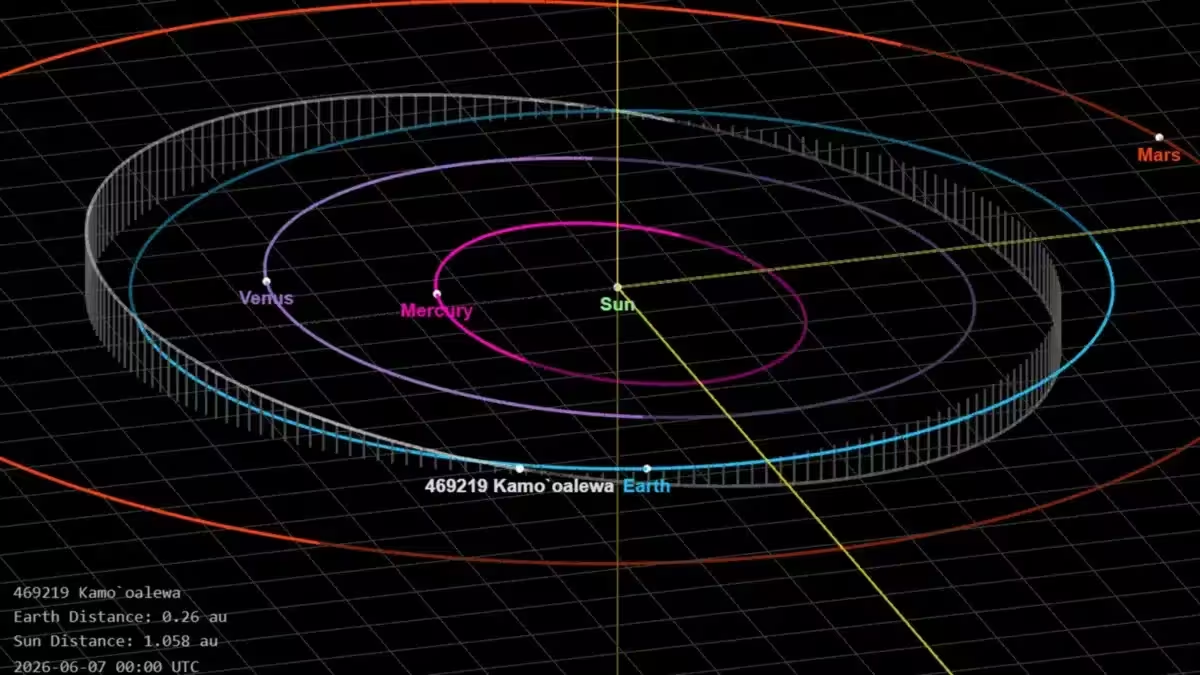
The orbital dance that keeps Kamo’oalewa near Earth often leads to misconceptions about what a quasi‑moon actually is. The asteroid orbits the Sun, but its period closely matches Earth’s, creating the illusion of a companion that travels alongside our planet for generations. This rare dynamical relationship makes it one of only a few known quasi‑moons and, despite its modest size, one of the most observable from the ground.
Richard Binzel, a planetary scientist at MIT renowned for his work on asteroid taxonomy, offered a vivid analogy to Live Science:
“The way Kamo’oalewa moves with Earth is kind of like a dog that might tag along with you for a while on a long walk through the woods, but it’s not your dog.”
Such an image underscores why the rock is an attractive target: it remains close enough for detailed study while preserving ancient Solar System clues that larger bodies have long erased. Data gathered by Tianwen‑2 could refine orbital models, improve theories of asteroid evolution, and illuminate the pathways that fragments take through near‑Earth space.
Implications for Planetary‑Defense Strategies
Beyond the scientific payoff, Tianwen‑2 contributes to global efforts to safeguard Earth from asteroid impacts. Detailed knowledge of an object’s makeup, density, internal structure, and surface behavior informs models that predict how a potential threat would respond to deflection techniques. Even modest near‑Earth bodies can generate regional devastation if they survive atmospheric entry.
Richard Binzel, creator of the Torino Scale for impact risk assessment, highlighted this broader relevance:
“Over the time scale of centuries, these kinds of objects have a chance of striking the Earth,” he said. “Therefore, a better understanding of space rocks like Kamo’oalewa can prepare us in how to deal with a threatening object if one were ever discovered.”
As agencies worldwide expand their asteroid‑exploration programs, missions such as Tianwen‑2 become essential not only for resolving lingering scientific questions but also for enhancing humanity’s capacity to anticipate and mitigate cosmic hazards. A successful touchdown and sample return from Kamo’oalewa would mark a milestone in planetary exploration and provide valuable data for researchers across the globe.
This article has been fact checked for accuracy, with information verified against reputable sources. Learn more about us and our editorial process.
Last reviewed on .
Article history
- Latest version
Cite this page:
- Posted by Karan Das