NASA Cuts $5.9 B From Artemis After Years of Delays, Reveals Costly Audit
NASA’s Artemis revamp shelves billions in lunar hardware, revealing years of delays, cost overruns and shifting priorities.

A fresh audit from NASA’s Office of Inspector General shows that hardware originally intended for the Artemis program accrued nearly $6 billion in expenses before the agency halted the work. The review highlights how evolving mission goals, technical hurdles and prolonged schedule slips reshaped the scope of the United States’ lunar ambitions.
Revised Artemis Roadmap Shelves Costly Hardware
According to NASA, the agency’s updated Artemis architecture changes the sequence of crewed lunar landings, moving the first landing from Artemis III to Artemis IV. The plan also drops the more advanced versions of the Space Launch System (SLS) rocket and cancels the Gateway space station that was slated for lunar orbit, shifting focus toward a sustained surface presence.
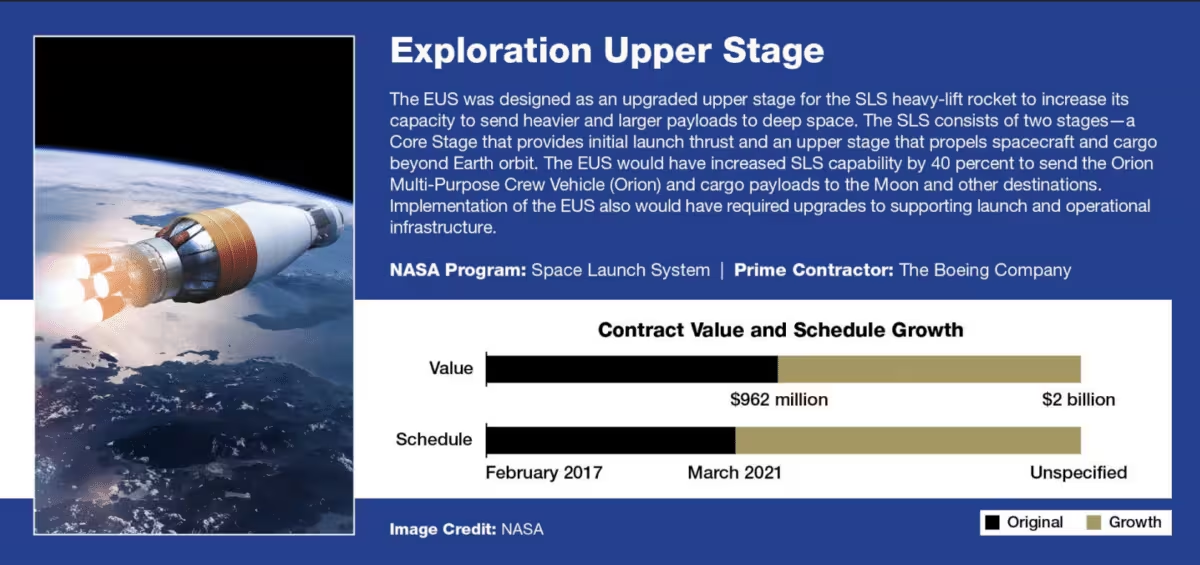
These shifts left several major projects without a clear mission despite years of development and billions already spent. The OIG audit estimates that hardware initially contracted for roughly $2.9 billion ultimately consumed $5.9 billion before work was stopped. Affected items include the Exploration Upper Stage (EUS), the Universal Stage Adapter (USA), Mobile Launcher 2 (ML‑2) and the HALO habitation module for Gateway. NASA contends that persisting with the earlier architecture would have generated even larger overruns and pushed human lunar exploration further into the next decade.
We are doing things differently now. NASA cannot take years longer than expected and spend billions more than planned when the world is waiting for the headlines only NASA can deliver. The programs covered in the report will free up more than $3 billion in the years ahead for… https://t.co/lx5fm1ZlEy
— NASA Administrator Jared Isaacman (@NASAAdmin) June 24, 2026
Audit Reveals Years of Slippage and Rising Expenses
The report details how flagship Artemis components fell far behind their original timelines and budgets. Boeing’s Exploration Upper Stage, intended to boost the payload capacity of future SLS rockets, was added to the contractor’s 2017 agreement at a value of $962 million with a planned delivery in March 2021. By the time NASA issued a stop‑work order in 2026, spending had risen to almost $2 billion, and Boeing projected final costs near $3.7 billion. The delivery date slipped by roughly seven and a half years. The audit attributes the overruns to shifting agency priorities, supply‑chain disruptions, evolving mission requirements and contractor performance issues.
“NASA noted significant weaknesses related to EUS production efficiency, including unrealistic production schedules and the lack of a clear plan for improvement,” the memo states.
The findings suggest that management and planning shortfalls played a role comparable to technical complexity in extending development timelines.
Smaller Artemis Projects Turn Into Big Cost Drains
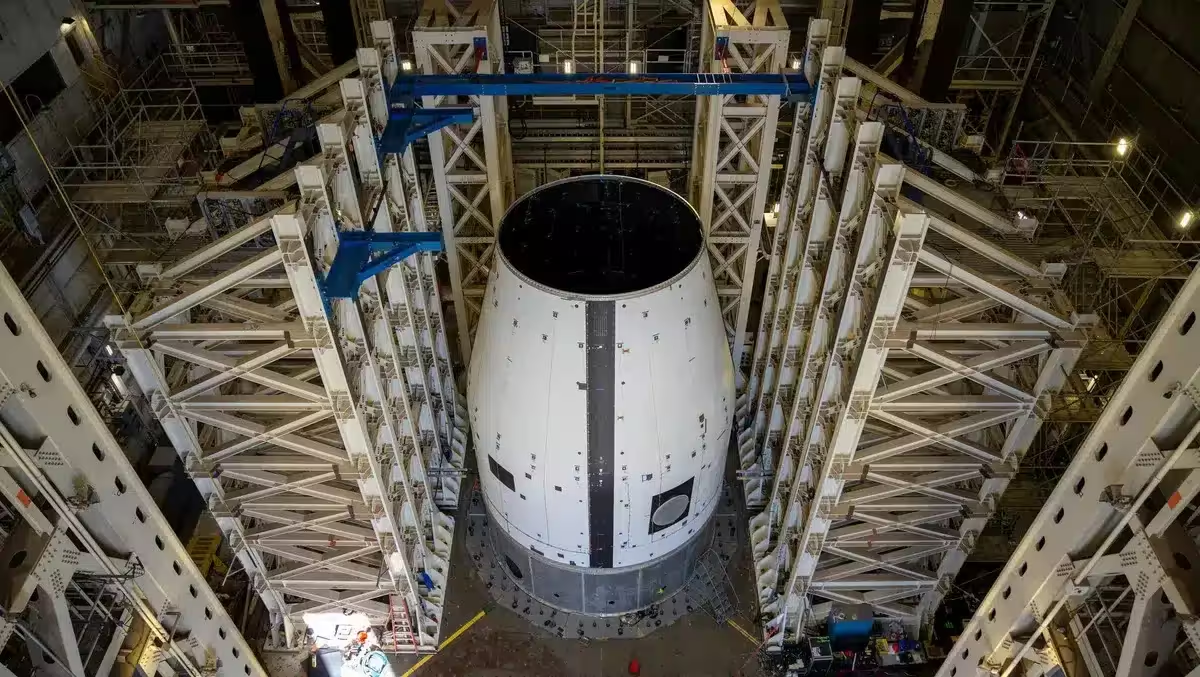
The audit also shows how seemingly modest hardware grew into costly development efforts. The Universal Stage Adapter, a conical structure linking the Exploration Upper Stage to the Orion spacecraft while accommodating secondary payloads, was awarded to Dynetics in 2017 for $131 million. Repeated design changes and delays pushed NASA’s expenditure to $353 million by early 2026, with projected final costs approaching $497 million if the program had continued.
The OIG summarized the situation, noting that “the USA contract’s cost and schedule estimates grew beyond original estimates due to both NASA‑directed modifications and Dynetics’ performance issues.” A comparable pattern emerged with Mobile Launcher 2, the launch tower required for future SLS variants. Bechtel received a $383 million contract for the tower in 2019, but redesigns, schedule shifts and technical challenges lifted projected costs toward $2 billion. The report concluded that “Bechtel’s reluctance to utilize NASA expertise, failure to track risks, challenges with managing the launcher’s weight, and lack of a certified earned value management system impacted the contractor’s cost, schedule, and performance.”
HALO Habitat for Gateway Dropped Amid Redesign
The decision to cancel the Gateway lunar outpost also halted work on the HALO (Habitation and Logistics Outpost) module. Northrop Grumman, with major input from Thales Alenia Space, began the project under a $187 million contract in 2019. Subsequent modifications pushed total spending to roughly $1.9 billion before NASA suspended the effort. Engineers also uncovered extensive corrosion after the module arrived in the United States, adding further complications. The OIG notes that pressure to meet aggressive Artemis milestones contributed to the program’s challenges.
“Driven by the necessity to meet Artemis launch schedules, the Gateway Program worked toward unrealistic schedules throughout the life cycle of HALO,” OIG’s memo states, and cites an independent Standing Review Board comment that “lack of schedule realism may be driving suboptimal engineering decisions during development.”
New Artemis Plan Emphasizes Cost Control and Speed
While the audit records billions spent on hardware that will never fly in its intended form, NASA argues that its revised Artemis strategy is designed to avoid similar outcomes. Agency officials say that persisting with the previous architecture would have led to higher expenses and delayed human lunar exploration well beyond the next decade. In its formal response to the audit, NASA emphasized that the cost projections rely on assumptions tied to an outdated program structure. The agency stated, “These projections rely on past performance under outdated architectural assumptions that do not reflect the Ignition Day principles of discipline, affordability, simplification, and speed.”
The updated approach seeks to streamline mission design, cut reliance on costly hardware and accelerate the timeline for returning astronauts to the Moon. The ultimate test of this new direction will come as Artemis IV, now slated for 2028, moves toward launch and validates NASA’s vision for a sustainable lunar presence.
This article has been fact checked for accuracy, with information verified against reputable sources. Learn more about us and our editorial process.
Last reviewed on .
Article history
- Latest version
Reference(s)
- “Interim Memo Ml 26 002 Nasas Management Of Programs And Projects After Mission Termination Artemis Campaign Systems.” <https://oig.nasa.gov/wp-content/uploads/2026/06/interim-memo-ml-26-002-nasas-management-of-programs-and-projects-after-mission-termination-artemis-campaign-systems.pdf>.
- “https://twitter.com/NASAOIG/status/2069833061483565102.” <https://t.co/lx5fm1ZlEy>.
Cite this page:
- Posted by Karan Das