800 Million Years Ago an Asteroid Breakup Sent a Cosmic Bombardment to Earth, Moon and Mars
New study suggests a massive asteroid shattered 800 million years ago, unleashing a debris wave that swept through the inner Solar System.
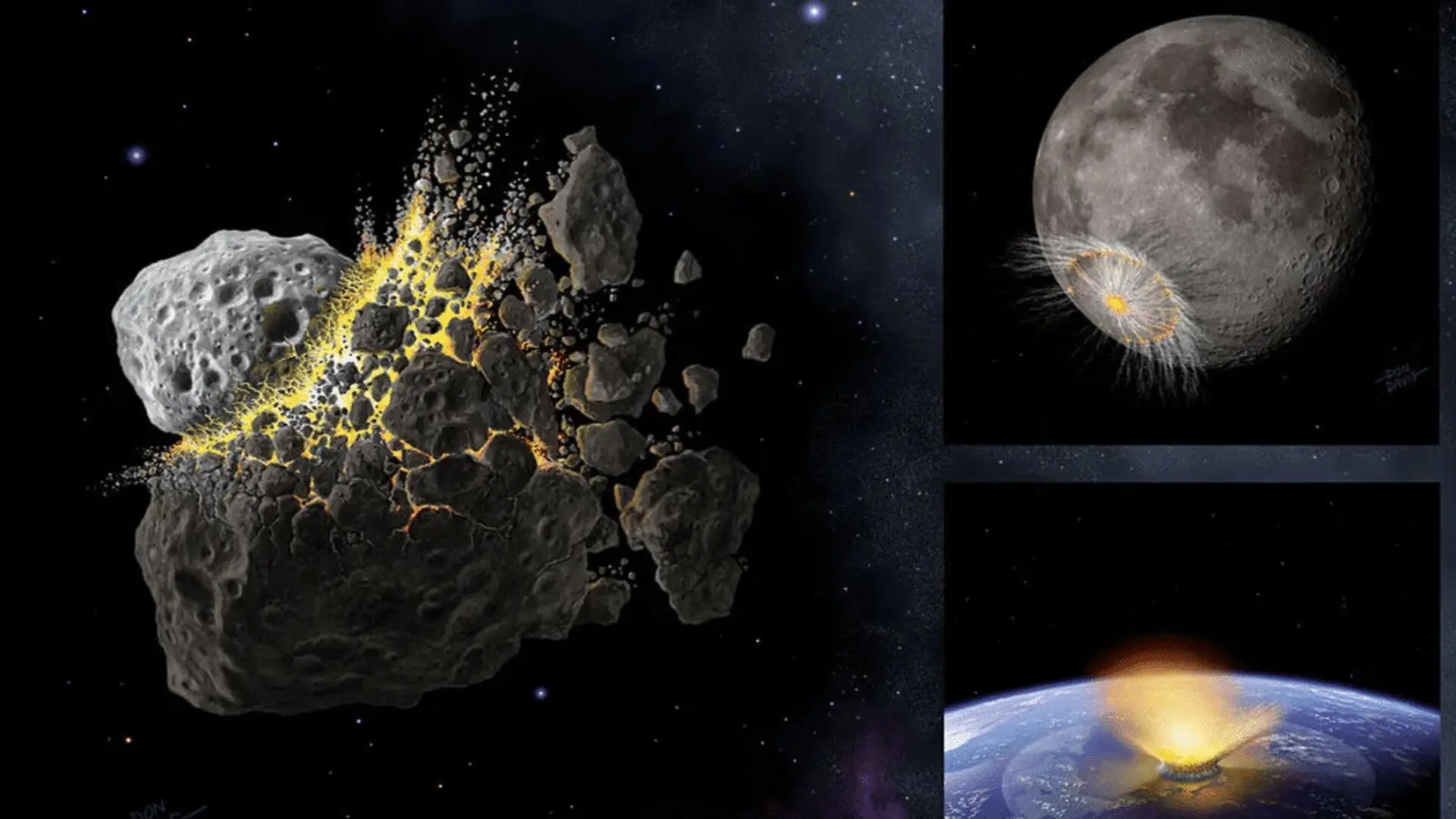
New calculations suggest that a catastrophic breakup of a parent body in the main asteroid belt around 800 million years ago may have seeded a prolonged shower of impacts across Earth, the Moon and Mars, according to a paper in The Planetary Science Journal. The debris generated by the creation of the Eulalia asteroid family is proposed as the source of a spike in ancient lunar cratering and could have left imprints on the evolutionary paths of the inner planets.
Lunar Surface Holds Clues to an Overlooked Bombardment
Researchers zeroed in on a span when the inner planets appear to have suffered an unusual rise in large collisions. The scenario begins with the shattering of a primitive asteroid inside the main belt, spawning a swarm of fragments that eventually migrated toward the terrestrial zone.
The Moon serves as a natural archive because its barren landscape retains impact scars far longer than Earth’s ever‑changing crust. Lacking oceans, active plate tectonics and a thick atmosphere, lunar craters can survive for billions of years, offering a window into events that have been erased from Earth’s geological record.
Earlier work identified a surge of impacts roughly 800 million years ago by examining crater counts and impact‑glass beads recovered during the Apollo missions. Those beads were produced when meteoritic blows melted lunar rock, which then cooled rapidly and locked in a timestamp of the collision.
The current investigation ties those lunar signatures to a concrete asteroid family. By simulating collision outcomes and tracking orbital paths, the team demonstrated how fragments from the Eulalia family could have been steered into Earth‑crossing trajectories.
“How impacts have molded the origin and development of life in our solar system remains poorly quantified,” said Dr. William Bottke, executive director of SwRI’s Solar System Science and Exploration Division in Boulder, Colorado. “The Moon’s heavily cratered façade reminds us that Earth endured massive impacts, yet only the Chicxulub event 66 million years ago is directly linked to a major biological turnover.”
Jupiter’s Resonance Acted as a Cosmic Conveyor Belt
The location of the original collision proved pivotal. The parent body lay adjacent to the powerful 3:1 mean‑motion resonance with Jupiter, a zone where the giant planet’s gravity can destabilize asteroid orbits.
When the asteroid fragmented, many pieces were swiftly injected into this resonant pathway, funneling material inward toward Mercury, Venus, Earth, the Moon and Mars.
“Our forensic analysis combined collisional and dynamical modeling to connect these objects to the birth of the Eulalia family, which resulted from a carbonaceous‑chondrite‑like asteroid striking another body,” Bottke explained. “The proximity of the parent to the 3:1 resonance with Jupiter was the critical factor.”
The influx unfolded over millions of years rather than as a single cataclysmic burst. Simulations indicate that roughly half of the fragments entered the resonance shortly after breakup, while the remainder drifted gradually into the same corridor via the Yarkovsky effect.
This subtle force arises because rotating asteroids absorb sunlight and re‑emit heat asymmetrically, producing a tiny thrust that can modify their orbits over extensive timescales, eventually guiding them onto planet‑crossing routes.
“Rare, well‑positioned collisions in the main belt can rain debris on all inner‑solar‑system worlds,” Bottke noted. “Thus, the Moon’s static record allows us to infer the ancient impact history of Earth and Mars.”
Earth Likely Felt a Much Heavier Storm
Even though the Moon offers the clearest imprint, Earth’s larger size and stronger gravity would have attracted a substantially higher number of projectiles. Researchers estimate that for each sizable impact recorded on the Moon, about twenty comparable or larger bodies may have struck Earth.
Much of this bombardment is invisible today because tectonic recycling, volcanic resurfacing and erosion continuously remodel the planet’s crust, erasing ancient scars.
The timing of the asteroid influx coincides with a interval of global cooling and notable shifts in Earth’s biosphere. While the authors caution that the study does not establish a direct causal link, they highlight the temporal overlap as a promising avenue for future research.
By merging lunar data with asteroid‑dynamics models, scientists gain a new framework for probing how distant events may have steered planetary development.
Mars May Have Shared the Fallout
Mars, with its relatively static surface, could also retain evidence of the bombardment. The team proposes that the influx of fragments might have triggered widespread seismic shaking and perhaps intensified volcanic activity on the Red Planet.
“The peak of this impact episode aligns with a period of extensive cooling and major biospheric transitions, making it tempting to link the two,” Bottke said. “On Mars, such collisions would have generated significant seismic events and could be tied to a surge in volcanism, illustrating how main‑belt disruptions can echo across terrestrial worlds.”
The study, published in The Planetary Science Journal, underscores that asteroid breakups are not isolated phenomena. A single fragmentation event can disperse material throughout the inner solar system, leaving a durable record on the Moon while erasing traces on Earth.
Continued investigations that blend lunar sample analysis, asteroid observations and sophisticated planetary modeling will help determine whether this ancient bombardment was a singular episode or part of a broader pattern that shaped the evolution of our neighboring worlds.
This article has been fact checked for accuracy, with information verified against reputable sources. Learn more about us and our editorial process.
Last reviewed on .
Article history
- Latest version
Reference(s)
- Bottke, William F.., et al. “An 800 Myr-old Impact Shower on the Terrestrial Planets from the Breakup of the Eulalia Parent Body.” The Planetary Science Journal, vol. 7, no. 7, July 15, 2026, pp. 171 American Astronomical Society, doi: 10.3847/PSJ/ae74cc. <https://iopscience.iop.org/article/10.3847/PSJ/ae74cc>.
Cite this page:
- Posted by Karan Das