Massive Celtic Site Found Under Czech Highway: Gold Coins, Amber and 22k Artifact Bags
Construction of a new highway uncovers a hidden Celtic site packed with gold coins, amber and evidence of a lost trading hub.
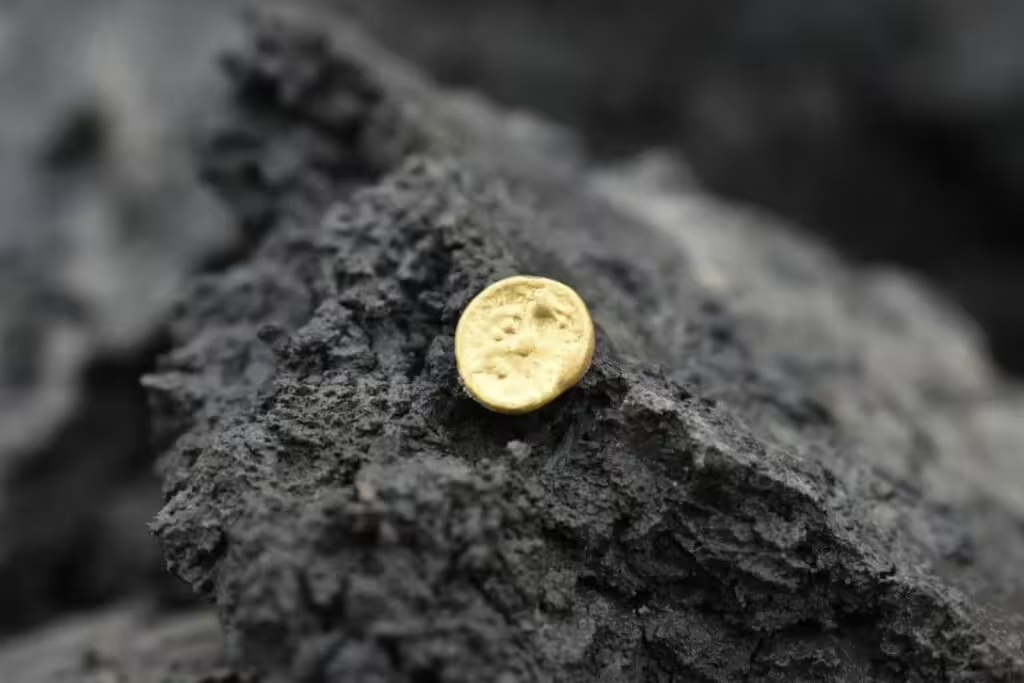
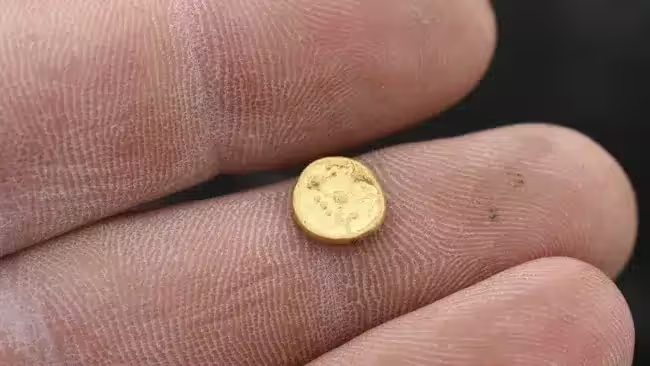
Archaeologists working on the future D35 highway near Hradec Králové have unearthed a wealth of Celtic material, including gold and silver coins, Baltic amber, glass fragments, mirrors and metal vessels, all belonging to a surprisingly extensive La Tène settlement.
The find was announced by the Museum of East Bohemia in Hradec Králové, in collaboration with the University of Hradec Králové and Archaia Praha. Researchers highlight the site’s size, state of preservation and diversity of artefacts as unparalleled for Bohemia, dating to the Iron Age La Tène culture often linked with Celtic peoples.
Initial surveys in 2023 identified the area as part of the highway corridor, prompting a two‑year excavation. Lead archaeologist Matouš Holas told Czech Television that the first objects immediately indicated a settlement of considerable magnitude, one that might have remained concealed without the road‑building project.
A Settlement Spanning 25 Hectares
Covering roughly 25 hectares (about 62 acres), the site dwarfs typical Iron Age locales in the region, which usually occupy just 1–2 hectares. Its scale and dense artifact concentration have led experts to label it among the largest Celtic sites recorded in Central Europe.
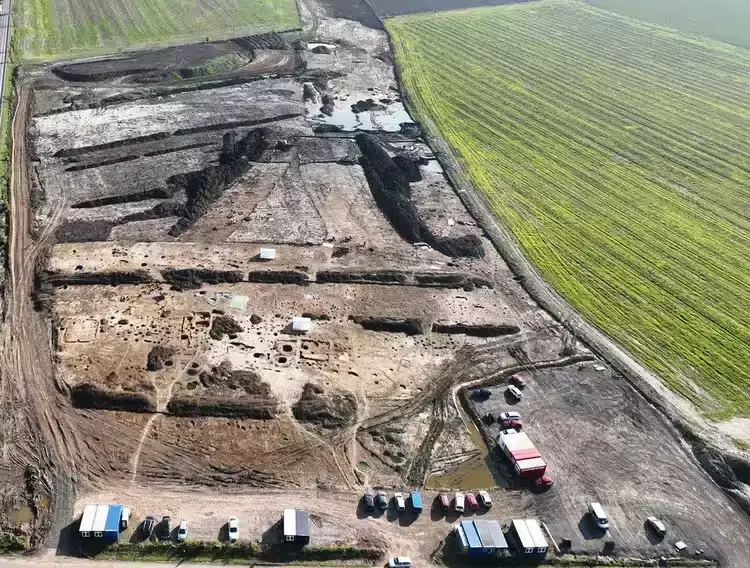
The museum places the settlement’s zenith in the 2nd century B.C., predating the emergence of oppida—large fortified centres common later in the Iron Age. Unlike those later towns, this community appears to have flourished without defensive walls, suggesting a focus on production, exchange and possibly ritual activities rather than military fortification.
Excavations revealed residential structures, workshops and likely one or two sanctuaries, yet no surrounding rampart. The absence of fortifications leaves open questions about the settlement’s security situation, but the material evidence underscores a society organized around craft and trade.
Trade Networks Revealed by Coins and Amber
Among the recovered items are gold and silver coins, coin dies, pottery sherds, metal tools and a range of luxury goods. The museum describes the site as a supra‑regional hub of production and exchange, its links evident in the presence of Baltic amber and high‑quality ceramics.
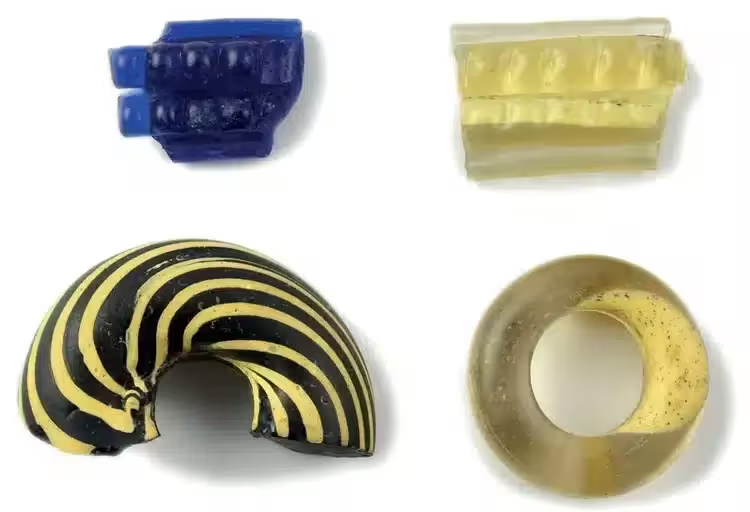
The Czech Center Museum Houston notes that the small coins mimic Roman models of the same period, while glass, jewelry, mirrors and metal vessels point to a community engaged in diverse crafts. Workshop remains indicate that artisans from several trades operated on‑site.
The volume of material is extraordinary. Initial counts reported 13 000 bags of artefacts, while later tallies from the Museum of East Bohemia reach 22 000 bags, encompassing everyday objects and opulent jewelry. The discrepancy likely reflects different stages of excavation and cataloguing, but both figures illustrate the site’s prolific output.
The presence of Baltic amber ties the settlement to the historic Amber Trail, a trade route linking the Baltic coast with the Mediterranean. Researchers also connect the find to broader luxury‑goods networks studied by archaeologists such as Maciej Karwowski of the University of Vienna.
Exceptional Preservation Offers a Complete Snapshot
Beyond the sheer number of objects, the site is remarkable for how much of the original occupation layers survived. Minimal disturbance from intensive agriculture or illicit metal‑detecting meant that archaeologists could examine largely intact La Tène strata.
The topsoil retained a dense concentration of artefacts, preserving not only individual items but also the broader pattern of how inhabitants used the space. The museum explains that the upper soil layers contain more information than deeper fills, providing a detailed record of daily life.
Together, the coins, tools, pottery, dwelling traces and possible sanctuaries paint a picture of a vibrant community that produced goods, managed valuable materials and likely gathered for ceremonial purposes.
Who Built the Settlement?
Scholars associate the site with the Celtic Boii, a tribe traditionally linked to the name Bohemia. Czech historian František Palacký described the Boii as the region’s earliest inhabitants, a view echoed by the Czech Center Museum Houston.
The attribution remains tentative. Tomáš Mangel, an assistant professor at the University of Hradec Králové whose research focuses on Iron Age settlements, stresses that while the Boii are the traditional candidates, definitive proof of their involvement is still lacking.
Evidence suggests the community vanished around the 1st century B.C.E. without signs of violent conquest, implying that economic or environmental factors may have driven its decline. Excavation has paused for now, while analysts continue to study the extensive collection of artefacts.
This article has been fact checked for accuracy, with information verified against reputable sources. Learn more about us and our editorial process.
Last reviewed on .
Article history
- Latest version
Reference(s)
- “Unikátní nález laténského sídliště - Muzeum východních Čech v Hradci Králové.” <https://www.muzeumhk.cz/novinky-archeologie/1840-unikatni-nalez-latenskeho-sidliste.html>.
- “Maciej Karwowski.” University of Vienna <https://ucrisportal.univie.ac.at/en/persons/maciej-karwowski/>.
- <https://www.researchgate.net/profile/Tomas-Mangel>.
Cite this page:
- Posted by Zara Tariq