Physicists Discover How A Rare Spacetime Crystal Could Collapse Into A Microscopic Black Hole
Physicists have discovered a bizarre spacetime crystal that challenges our current understanding of gravity, revealing unexpected new cosmic phenomena.
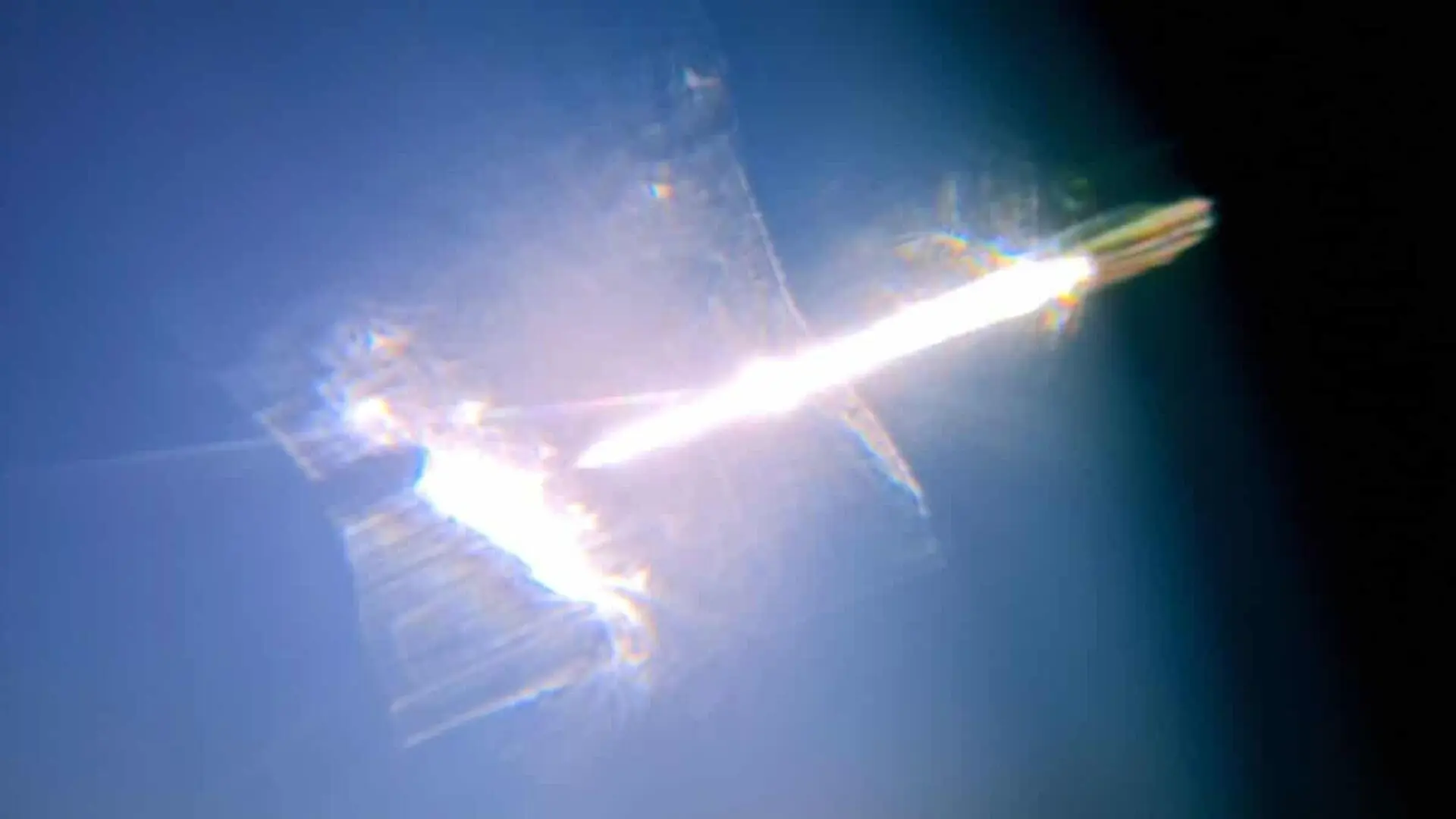
Physicists from Goethe University Frankfurt and TU Wien have uncovered a theoretical mechanism in which a unique arrangement of spacetime, dubbed a spacetime crystal, can spontaneously collapse into a microscopic black hole. This transition hinges on a phenomenon known as critical collapse, a delicate tipping point where a system exists at the razor-thin margin between stability and total gravitational breakdown.
While the massive black holes associated with galactic centers or stellar deaths are well-documented, these proposed microscopic structures remain a subject of intense scientific fascination. Their existence could offer vital clues about the high-energy conditions that dominated the universe in the immediate aftermath of the Big Bang.
Mapping the Geometry of Spacetime Crystals
The concept of a spacetime crystal relies on the fundamental principles defined by Einstein’s theory of relativity, which dictates that matter and energy do not simply occupy space but actively warp its geometry. According to Christian Ecker of the Institute for Theoretical Physics at Goethe University Frankfurt, while massive celestial bodies exert a profound influence on their surroundings, smaller concentrations of mass create subtle curvatures that follow the same laws of physics.
“We say that spacetime is curved by mass,” Ecker noted. “Large objects such as stars curve spacetime strongly—for example, we can observe this when light rays are deflected by massive stars. But smaller masses also produce spacetime curvature, just to a lesser extent.”
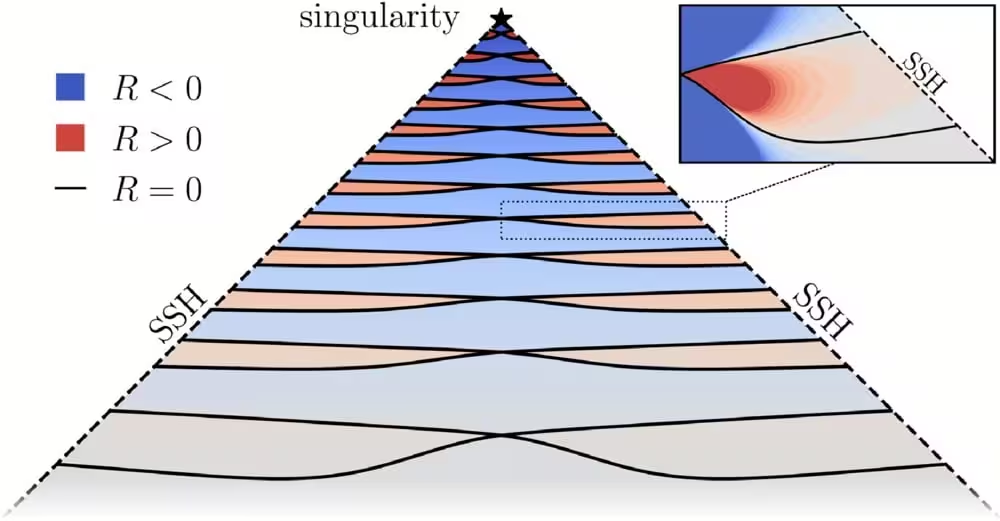
Under specific conditions, this curvature can manifest in an ordered, repeating pattern, effectively behaving like a crystal structure. However, this state is remarkably fragile. Professor Daniel Grumiller of TU Wien explains that the system mimics a phase transition, similar to how water molecules lock into an ice lattice at the freezing point. Even a minute injection of energy can force the system across this threshold, triggering the formation of a microscopic black hole, or alternatively, causing the structure to dissipate entirely.
Advancing Theoretical Physics Through Dimensional Shifts
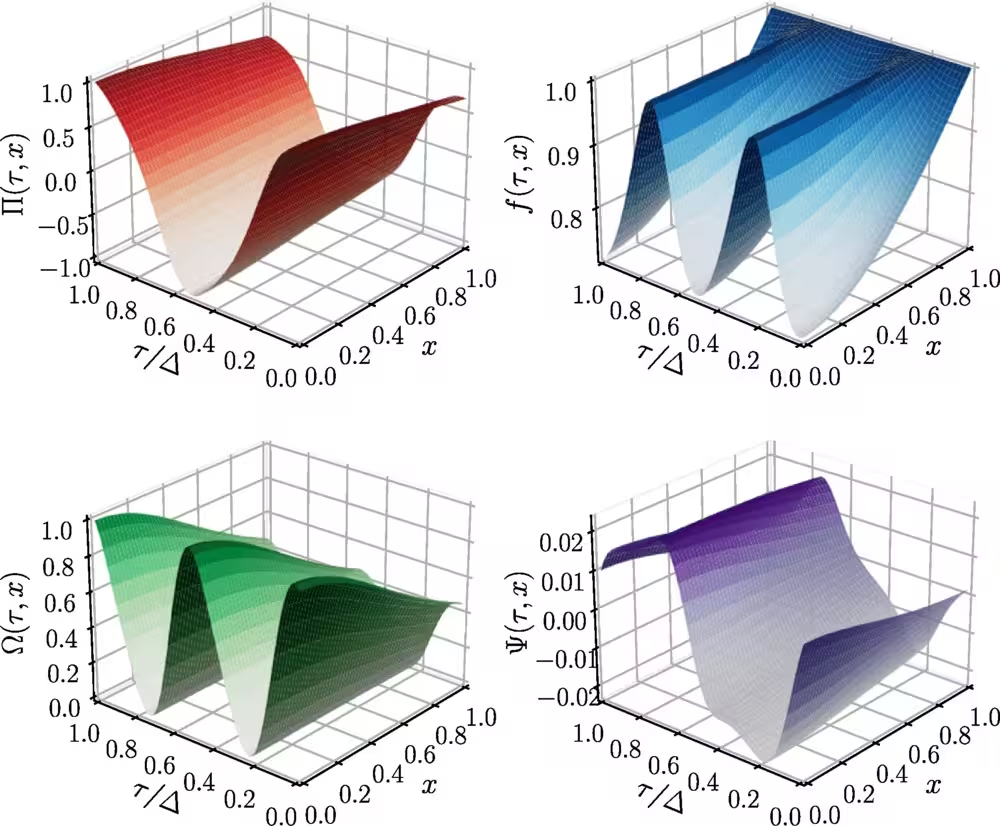
The pursuit of an analytical solution for this behavior has challenged researchers since the phenomenon of critical collapse was first observed in computer simulations in 1993. To move beyond numerical modeling, the team utilized a mathematical strategy that involved expanding their calculations into higher dimensions.
By exploring the problem within a framework of theoretically infinite dimensions, the researchers were able to simplify the complex equations governing the system. As Ecker highlighted, physicists often leverage higher-dimensional spaces—whether five, forty-two, or even an infinite number—to gain mathematical clarity, later projecting those insights back into the four-dimensional reality of our own universe. The results, published in Physical Review Letters, provide a new analytical path for examining these gravitational anomalies.
New Frontiers in Gravitational Research
This methodology offers a robust new framework for exploring extreme gravitational phenomena that were previously inaccessible to analytical study. According to Florian Ecker of TU Wien, the technique is highly stable and allows for refined approximations that can deepen our understanding of spacetime dynamics.
“This gives us a new method for studying black-hole-related phenomena that could previously not be analyzed analytically,” Ecker said.
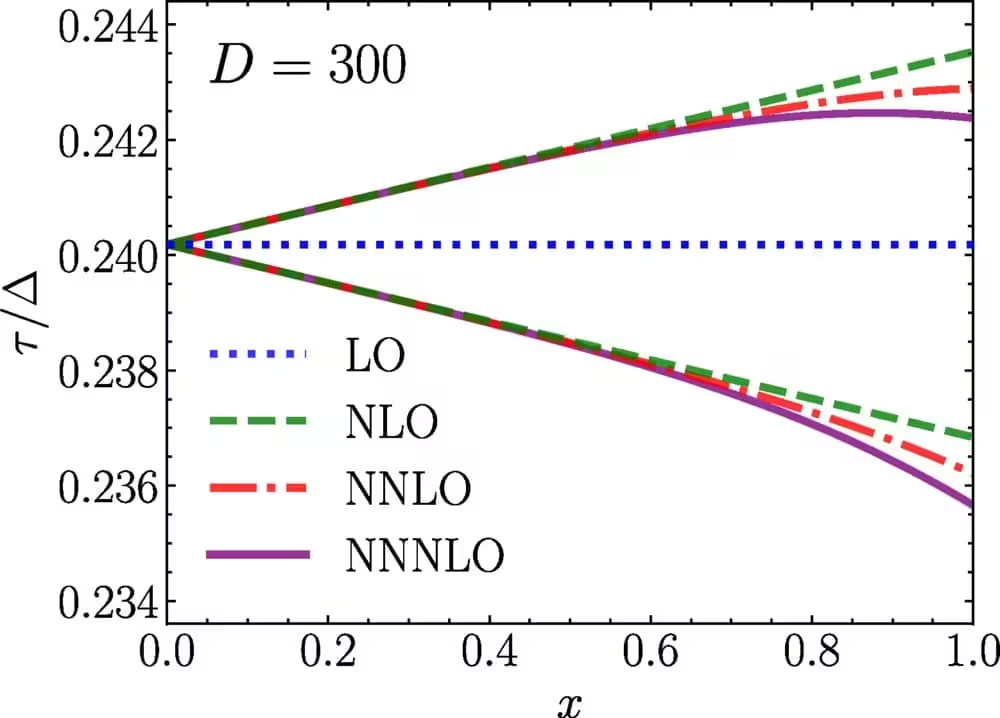
While this research does not imply that microscopic black holes are currently forming in our local neighborhood of space, it provides a crucial lens through which to view the volatility of the fabric of the universe. By characterizing these unstable states, physicists have gained a clearer picture of the precise conditions required to bridge the gap between structured spacetime and the singular density of a black hole.
This article has been fact checked for accuracy, with information verified against reputable sources. Learn more about us and our editorial process.
Last reviewed on .
Article history
- Latest version
Reference(s)
- “Dr. Christian Ecker – Relativistic Astrophysics.” <https://relastro.uni-frankfurt.de/dr-christian-ecker/>.
- “Research Portal | TU Wien.”, January 1, 2014 <https://tiss.tuwien.ac.at/fpl/person/index.xhtml?tid=44240>.
- Ecker, Christian., et al. “Analytic Discrete Self-Similar Solutions of Einstein-Klein-Gordon at Large
- <https://www.researchgate.net/profile/Florian_Ecker>.
Cite this page:
- Posted by Farah Siddiqui