Earth Is Changing Shape As Its Poles Rise and Its Equator Sinks
Earth’s poles are rising faster than previously expected as the planet’s solid surface and gravitational field evolve in separate, complex directions.

The physical structure of our planet is in a state of measurable flux. New research highlights that Earth’s surface is undergoing a global deformation characterized by rising polar regions and sinking equatorial zones. A study published in the Journal of Geophysical Research: Solid Earth demonstrates that this reshaping accelerated between 1997 and 2015, driven by the complex interplay of ice mass loss, ocean dynamics, and the planet’s gravitational response.
Shifting Geometry at the Poles and Equator
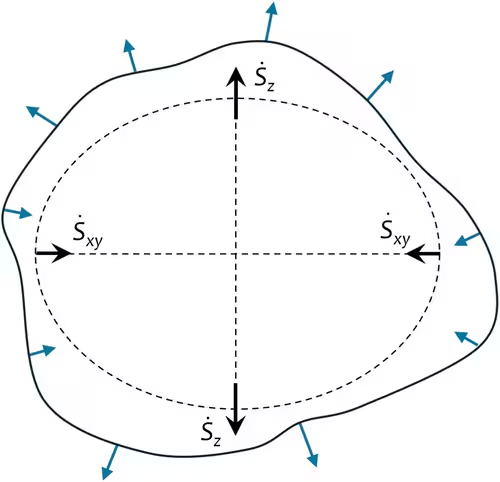
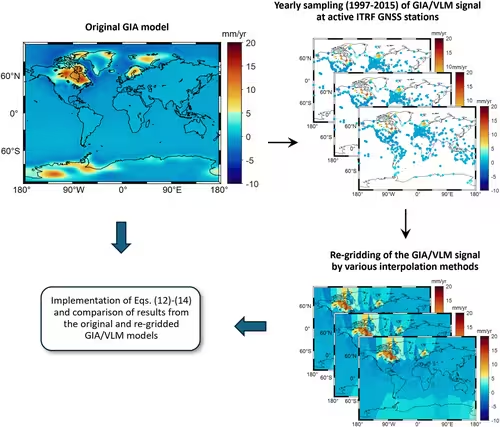
While Earth is often visualized as a sphere, its rotation creates a natural equatorial bulge and polar flattening. By utilizing data from a global network of Global Navigation Satellite System (GNSS) stations, geologist Christopher Kotsakis of the Aristotle University of Thessaloniki mapped the subtle vertical shifts in the planet’s crust over nearly two decades. The data reveals a consistent, global pattern: as polar regions undergo uplift, equatorial areas experience subsidence.
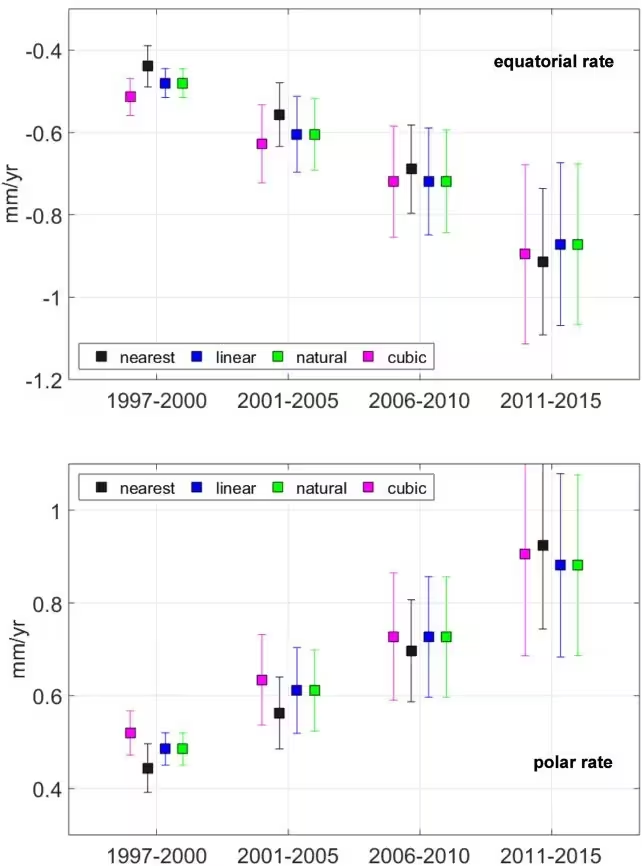
The rate of this deformation increased significantly during the study period. Between 1997 and 2000, the poles were rising at approximately 0.5 millimeters per year; by 2015, that velocity had doubled to roughly 1 millimeter per year. Simultaneously, the sinking motion observed in lower latitudes also gained speed, suggesting that the planet’s overall shape is becoming slightly less oblate.
“Our results indicate an acceleration of polar uplift accompanied by a comparably increasing rate of equatorial subsidence,” Kotsakis notes. This ongoing adjustment points to a distinct, gradual alteration in the rocky figure of the Earth.
The Mechanics of Surface Deformation
The crust is highly sensitive to shifting loads, a phenomenon seen in glacial isostatic adjustment, where the Earth continues to respond to the removal of ice sheets from the last ice age. Modern ice loss in regions like Greenland and Antarctica compounds this effect. As the weight of these massive glaciers diminishes, the underlying lithosphere experiences elastic rebound, causing the land to rise.
However, the mass does not vanish; it enters the global ocean system, which places new, redistributed pressure on the seafloor. This dual process means that vertical sea-level change is not merely a matter of rising water against static land. Instead, the seafloor and the coastlines are actively moving in response to the redistribution of weight, creating a complex, linked system of planetary deformation.
Reconciling Physical Surface and Gravitational Pull
One of the most intriguing findings involves the divergence between the physical shape of the planet and its gravitational footprint, known as the geoid. While the physical surface is becoming less flattened, the redistribution of mass—specifically the concentration of water at lower latitudes—tends to increase the flattening of the gravitational field.
According to Kotsakis, these two trends are not contradictory but rather represent different physical measurements. The GNSS data tracks the mechanical movement of the Earth’s crust, while geoid measurements reflect the shifting distribution of mass. Earth can thus appear to become more spherical in terms of its physical topography while simultaneously appearing more flattened through the lens of gravimetry. These minute changes, though invisible from space, provide geoscientists with a high-resolution record of how the planet dynamically adjusts to changing environmental loads.
This article has been fact checked for accuracy, with information verified against reputable sources. Learn more about us and our editorial process.
Last reviewed on .
Article history
- Latest version
Reference(s)
- Kotsakis, C.. “Mapping Global GNSS Vertical Velocities to Solid Earth Figure Change.” Journal of Geophysical Research: Solid Earth, vol. 131, no. 9, September 9, 2026 American Geophysical Union (AGU), doi: 10.1029/2026JB034224. <https://agupubs.onlinelibrary.wiley.com/doi/10.1029/2026JB034224>.
Cite this page:
- Posted by Farah Siddiqui