Greenland Sharks Can See Far Better Than Scientists Once Thought
Despite living for centuries in near darkness, the Greenland shark retains a fully functional visual system, revealing how evolution preserves vision even in the cold, dim depths of the Arctic deep sea.
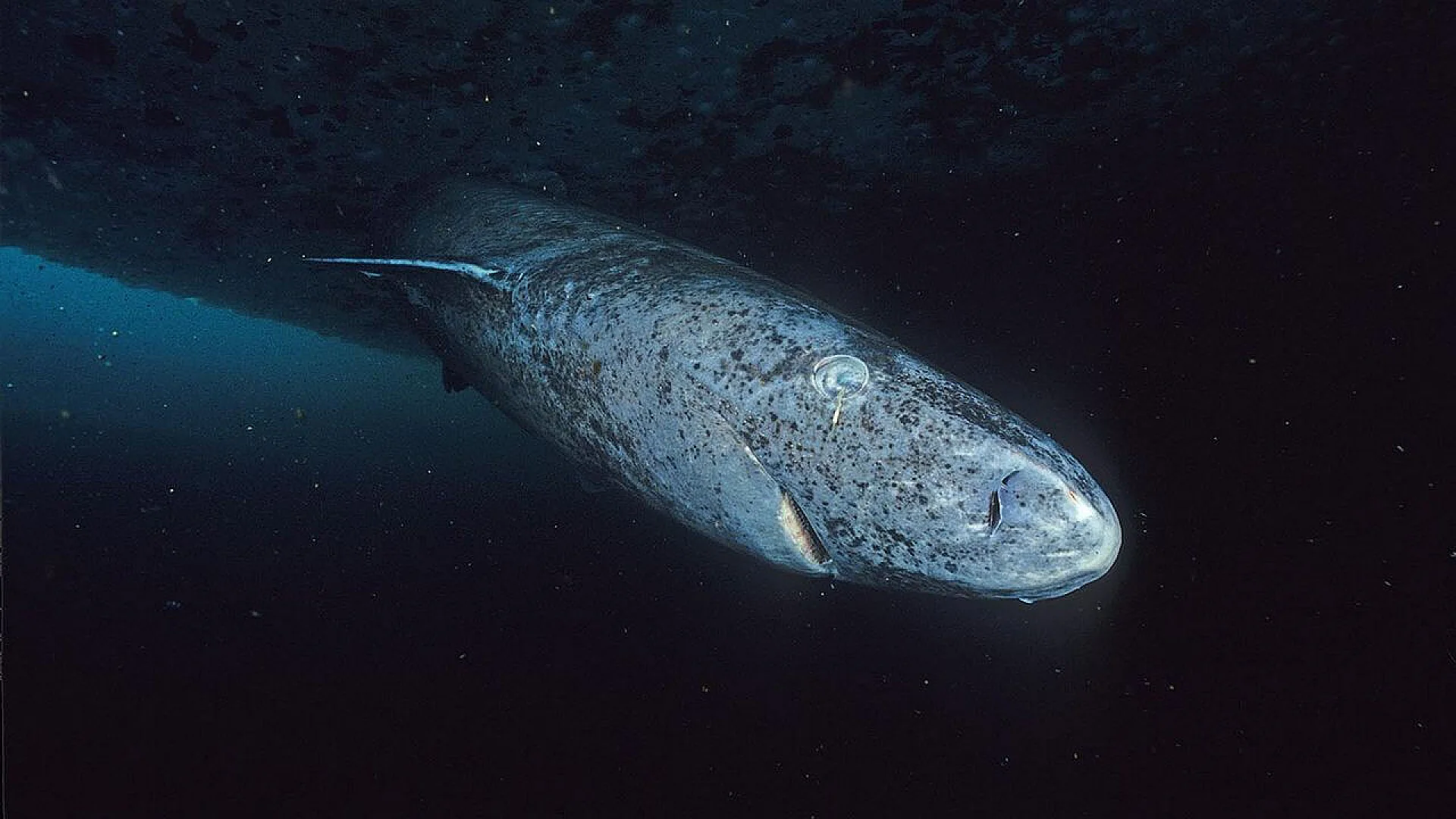
In the cold, silent depths of the Arctic Ocean, light fades rapidly with depth, leaving little more than a blue-green haze even during the brightest months. For decades, biologists assumed that animals living under such conditions had little use for vision. Among them was the Greenland shark, a slow-moving giant capable of living for centuries, often bearing eye parasites that seemed to confirm the idea of poor or even degenerated eyesight.
That assumption has now been overturned.
A new multidisciplinary study shows that the Greenland shark retains a fully functional visual system that is not only intact, but finely tuned for life in extreme low-light conditions. Rather than representing a vestigial sense, vision in this species appears to remain an important tool for navigating its environment, detecting movement, and possibly interacting with prey and conspecifics.
The findings challenge a common narrative in evolutionary biology, that long-lived animals in dark habitats inevitably lose complex sensory systems over time. Instead, they suggest that even minimal light can exert enough selective pressure to preserve vision across centuries of life.
A Shark That Redefined Longevity
The Greenland shark, Somniosus microcephalus, occupies a unique place in the animal kingdom. Radiocarbon dating of eye tissue has revealed lifespans exceeding 250 years, making it the longest-living known vertebrate. It inhabits deep and frigid waters of the North Atlantic and Arctic Oceans, often descending to depths where sunlight barely penetrates.
These sharks are infamous for carrying copepod parasites attached to their corneas, which frequently cause visible clouding of the eyes. Observations of sluggish movement and scavenging behavior further fueled the belief that sight played little to no role in their lives.
Yet absence of obvious visual behavior does not necessarily mean absence of vision. The new research set out to test that assumption directly, using modern genetic, cellular, and physiological tools to determine whether the Greenland shark’s visual system had truly deteriorated or whether it had simply adapted in subtle ways.
Looking Inside the Greenland Shark Eye
Rather than relying on external appearance alone, the researchers examined the Greenland shark’s visual system from multiple biological levels. They analyzed the shark’s genome to identify genes related to vision, studied retinal tissue to observe cellular structure, and assessed the functional properties of its visual pigments.
At the genetic level, the results were striking. The Greenland shark retains a full complement of genes required for vertebrate vision. These include genes responsible for phototransduction, the biochemical cascade that converts light into neural signals, as well as genes essential for retinal maintenance and signaling.
Importantly, there was no evidence of widespread gene loss or degradation in visual pathways. This finding alone contradicted the idea that vision had become biologically irrelevant in this species.
A Retina Built for Dim Light
Microscopic examination of the retina revealed a structure dominated by rod photoreceptors, the cells responsible for detecting light under low-illumination conditions. Rods are far more sensitive than cones, making them essential for vision in darkness.
In the Greenland shark, rods were densely packed and elongated, a configuration known to enhance photon capture. This architecture is typical of deep-sea and nocturnal species that rely on even the faintest available light.
Cones, which support color vision and function best in bright conditions, were scarce. This is not a sign of degeneration, but of specialization. In an environment where color discrimination offers little advantage, maintaining a rod-heavy retina is an efficient evolutionary strategy.
The retina also contained Müller glial cells and other essential support cells, confirming that the tissue is not only present but structurally healthy and functional.
Tuned to the Colors of the Deep
Light that penetrates deep ocean water is not evenly distributed across wavelengths. Longer wavelengths such as red and yellow are absorbed quickly, leaving mostly blue-green light. Visual systems of deep-sea animals often evolve to match this spectral environment.
The Greenland shark’s visual pigments show exactly this kind of tuning. The study found that its rod opsin, the light-sensitive protein at the heart of rod photoreceptors, is maximally sensitive to short wavelengths typical of deep-sea light.
Compared to shallow-water sharks, the Greenland shark’s visual pigments are shifted toward the blue end of the spectrum. This adaptation enhances sensitivity to the limited light available at depth, allowing the shark to detect contrasts and movement rather than detailed images.
Such spectral tuning reinforces the conclusion that the Greenland shark’s visual system is not merely intact, but optimized for its ecological niche.
Why Vision Still Matters in the Deep Sea
If Greenland sharks can see, the next question is why vision remains important in an environment so close to darkness.
Even at great depths, bioluminescence is widespread. Many deep-sea organisms produce light, whether to attract prey, deter predators, or communicate. A functional visual system would allow Greenland sharks to detect these signals, providing a significant ecological advantage.
Vision may also assist in orientation, predator avoidance, and locating carrion or slow-moving prey. While smell and mechanosensory systems are undoubtedly important, vision adds another layer of environmental awareness that can improve survival over centuries of life.
Rather than being replaced, sensory systems in the Greenland shark appear to work together, each contributing to a broader picture of its surroundings.
Rethinking Sensory Evolution in Extreme Environments
The study has implications that extend beyond a single species. It challenges the idea that long-term exposure to extreme environments necessarily leads to sensory loss. Instead, it supports a more nuanced view, where senses are reshaped rather than discarded.
Vision is metabolically expensive. Maintaining retinal cells and neural processing requires energy, especially over a lifespan measured in centuries. The persistence of a functional visual system suggests that the benefits of vision, even limited vision, outweigh its costs for the Greenland shark.
This insight may apply to other deep-sea and polar species, many of which have been assumed to rely little on vision. It also raises questions about how sensory systems evolve under weak but persistent environmental pressures.
What Remains Unknown
While the study provides compelling evidence of a functional visual system, it does not answer every question. How Greenland sharks use vision behaviorally remains largely unexplored. Observing visual responses in such large, elusive animals is a significant challenge.
It is also unclear how vision interacts with other senses during feeding, navigation, and social behavior. Future research combining physiological data with behavioral observations may help fill these gaps.
Nonetheless, the findings establish a critical foundation, showing that vision should not be dismissed when studying Greenland shark ecology.
A Quiet Sense That Endures
The Greenland shark moves slowly through waters that seem almost devoid of light, carrying centuries of biological history within its tissues. Hidden behind clouded corneas and parasitic hitchhikers is a visual system that has endured, adapted, and persisted against expectations.
Rather than fading away, sight in the Greenland shark has been reshaped to meet the demands of its world. In doing so, it offers a powerful reminder that evolution often favors refinement over loss, even in the darkest corners of the planet.
The research was published in Nature Communications on January 05, 2026.
This article has been fact checked for accuracy, with information verified against reputable sources. Learn more about us and our editorial process.
Last reviewed on .
Article history
- Latest version
- Last updated by Dayyal Dungrela, MLT, BSc, BS
Reference(s)
- Fogg, Lily G.., et al. “The visual system of the longest-living vertebrate, the Greenland shark.” Nature Communications, vol. 17, no. 1, 05 January 2026, doi: 10.1038/s41467-025-67429-6. <https://www.nature.com/articles/s41467-025-67429-6>.
Cite this page:
- Posted by Zara Tariq