NASA Orbiter Captures Uncanny Image of a Bear Face on the Surface of Mars
NASA’s HiRISE camera has captured a striking geological formation on Mars that bears a haunting, lifelike resemblance from 251 kilometers above the surface.
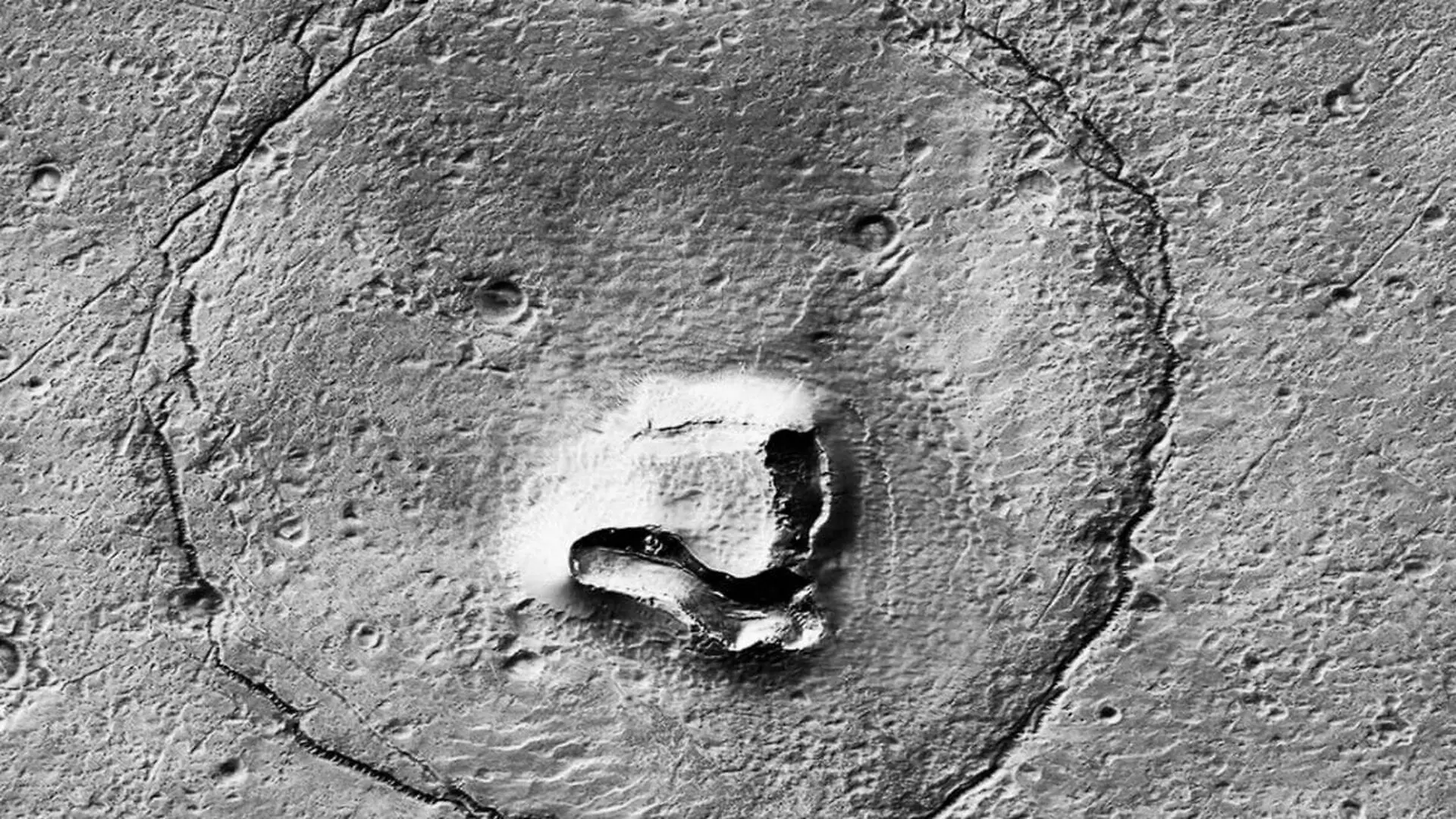
On December 12, 2022, NASA’s Mars Reconnaissance Orbiter captured an unusual snapshot while passing 251 kilometers above the planet’s southern highlands. The image, retrieved by the HiRISE camera—a high-resolution instrument operated by the University of Arizona—revealed a formation that appears remarkably similar to the face of a bear.
The feature is composed of a circular fracture pattern forming the head, two distinct craters representing the eyes, and a V-shaped collapse structure that serves as a snout. At a resolution where objects as small as 78 centimeters can be identified, the arrangement is striking, though planetary scientists emphasize that it is entirely coincidental.
The Geology of Martian Pareidolia
According to Alfred McEwen, the planetary scientist heading the HiRISE team, the “bear” is a mosaic of unrelated geological events. The circular fracture is likely the remnant of a buried impact crater where sediment has settled over time, while the V-shaped nose is interpreted as a volcanic or mud vent. The surrounding terrain suggests a collapse structure, potentially caused by the historical outflow of lava or mud.
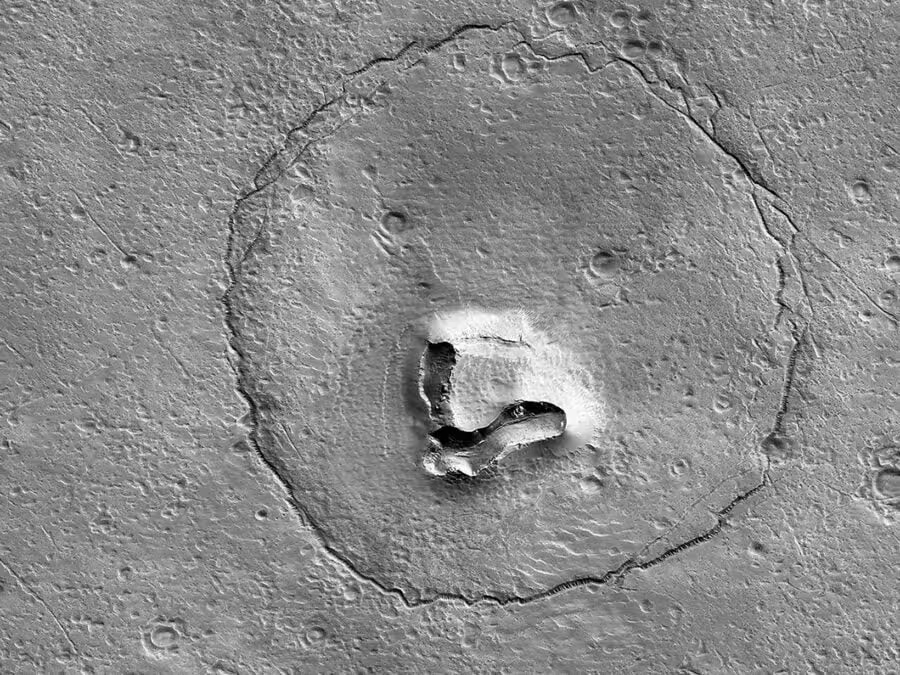
The image is a classic example of pareidolia, a psychological phenomenon where the human brain identifies familiar patterns—particularly faces—in random or ambiguous stimuli. This cognitive reflex is centered in the fusiform face area of the temporal lobe, an evolutionary development that allowed our ancestors to rapidly distinguish threats in low-light conditions. While this trait was vital for survival on Earth, it often leads us to perceive non-existent structures on the Martian surface.
Historical Misinterpretations and Scientific Data
Mars has a long history of triggering these perceptions. In 1976, the Viking 1 orbiter captured an image of a mesa in the Cydonia region that resembled a human face. While this led to widespread speculation about extraterrestrial architecture, subsequent high-resolution imaging proved it to be nothing more than a natural geological formation caught under specific lighting conditions.
Other instances of Martian patterns have held more scientific significance. In August 2024, the ExoMars Trace Gas Orbiter, using its CaSSIS imaging system, documented nearly 1,000 chloride salt deposits in the Terra Sirenum region. Among these, researchers identified a formation resembling a smiley face. Unlike the bear, these deposits are of high scientific interest; they represent the mineral remnants of water evaporation from two to three billion years ago.
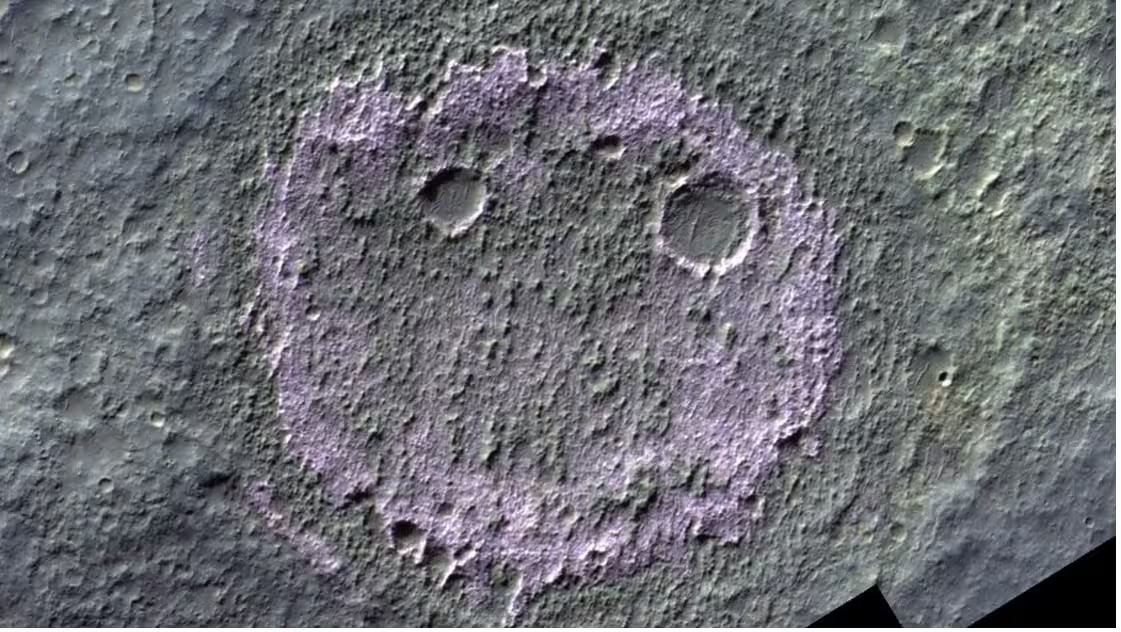
These chloride markers are crucial to understanding Martian habitability. Because highly saline water can remain liquid at temperatures as low as -40°C, these sites represent the most likely environments where microbial life could have persisted as the planet lost its atmosphere and surface water. The data, published in Nature Scientific Data, informs the upcoming mission of the ExoMars Rosalind Franklin rover, which is scheduled to land in 2028 to investigate these potential volcanic and sedimentary zones for evidence of past life.
The Probability of Accidental Icons
From alleged religious icons appearing in stains to wind-sculpted rocks mistaken for fossils, the HiRISE camera’s high-resolution capabilities make the occasional face appear almost inevitable. Having operated continuously since 2006, the system has mapped a massive portion of the 144 million square kilometers of the Martian surface. Given the sheer scale of the landscape and the diversity of geological processes—from wind erosion to impact cratering—it is statistically certain that some features will mimic terrestrial shapes.
The “bear” of the southern highlands remains a product of geometry, shadow, and human perception. It stands as a reminder of both the complexity of Mars’ geological history and the persistent, pattern-seeking nature of the human mind.
This article has been fact checked for accuracy, with information verified against reputable sources. Learn more about us and our editorial process.
Last reviewed on .
Article history
- Latest version
Reference(s)
- Cermak, Alicia. “A Bear Lookalike on Mars - NASA Science.”, February 1, 2023 NASA <https://science.nasa.gov/?p=323161>.
Cite this page:
- Posted by Vikram Desai