3rd Century Silver Amulet Unearthed in Frankfurt Redraws Timeline of Early Christianity
An 1,800‑year‑old silver amulet unearthed near Frankfurt bears an 18‑line Latin inscription, the earliest proof of Christian faith north of the Alps.

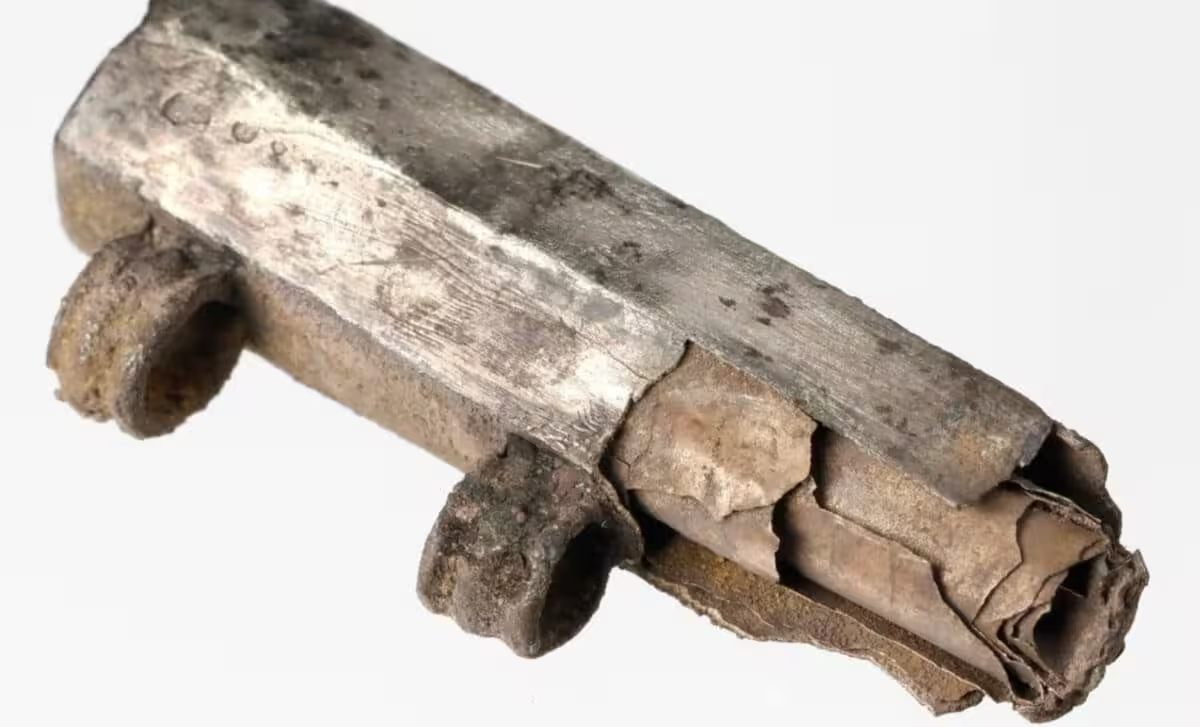
Archaeologists uncovered a silver amulet in 2018 while excavating a burial ground at the ancient Roman town of Nida, near present‑day Frankfurt. The tiny pendant was positioned beneath the chin of a male internee, suggesting it was worn around his neck in life and then interred with him.
Radiocarbon and typological analysis date the object to between 230 and 270 A.D., pushing back the earliest reliable trace of Christian activity in the northern Alpine provinces by at least five decades. According to the Archaeological Museum Frankfurt, the inscription on the amulet could only be deciphered after extensive imaging and years of specialist study.
Ancient Inscription Unearthed from a Roman Tomb
The amulet was recovered from what researchers have labeled grave 134 at the Nida site. Inside the silver casing lay an extremely delicate foil scroll that fragmented upon exposure, preventing direct visual inspection.
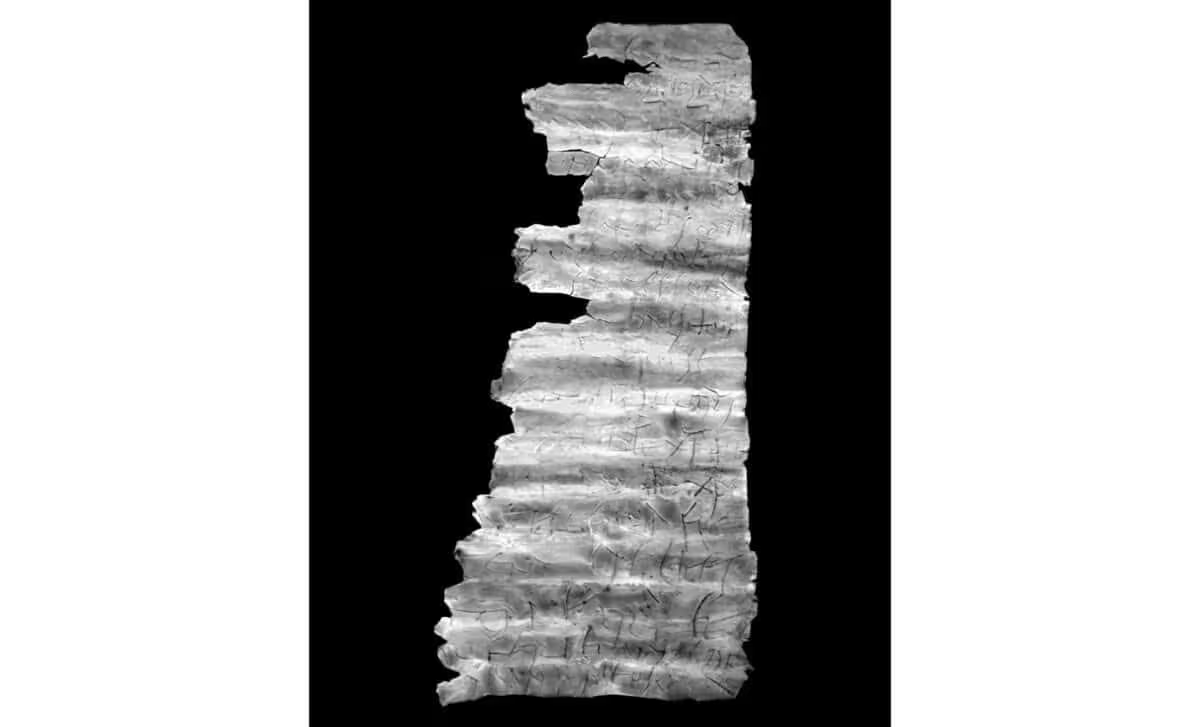
Initial X‑ray examinations in 2019 confirmed the presence of writing, but it was not until May 2024 that a team at the Leibniz Center for Archaeology in Mainz applied high‑resolution computed tomography to virtually unroll the damaged foil. The scan produced a detailed three‑dimensional model that allowed scholars to study the script segment by segment without physically opening the artifact.
Ivan Calandra, who oversaw the imaging project, explained that “the silver sheet had been rolled, then crumpled and compressed over nearly two millennia,” making the virtual reconstruction essential. The resulting model—available through the scan—enabled a meticulous analysis of each line of text.
Digital Reconstruction Reveals an 18‑Line Latin Text
Using the CT data, Markus Scholz of Frankfurt’s Goethe University collaborated with theologians and epigraphic specialists to piece together the recovered characters. The reconstruction demanded careful cross‑checking and, in some cases, months of deliberation to resolve ambiguous fragments.
The text is composed entirely in Latin, a notable departure from many contemporary amulets that favor Greek or Hebrew scripts. Portions of the scroll remain eroded, leaving several words open to scholarly debate.
Preliminary translation begins with a possible invocation of Saint Titus and includes the emphatic phrases “Holy, holy, holy!” and “In the name of Jesus Christ, Son of God!” The inscription further alludes to the biblical passage in Paul’s letter to the Philippians that describes “all knees bow[ing]” before Christ.
A Personal Testament of Faith from the Third Century
Unlike many Roman amulets that blend pagan symbols with protective formulas, this artifact contains exclusively Christian language, indicating a deliberate personal commitment to the new faith.
During the third century, openly professing Christianity could expose an individual to severe penalties, as Roman authorities periodically targeted believers—a climate that began under emperors such as Nero and persisted in later persecutions.
The individual interred with the amulet appears to have carried his religious conviction to the grave. Local scholars suggest that the find may shift the accepted chronology of Christianity’s spread in the Frankfurt region by several decades.
Frankfurt’s head of culture and science, Ina Hartwig, emphasized the interdisciplinary impact of the discovery, noting its relevance for archaeology, religious studies, philology, and anthropology. Mayor Mike Josef described the Frankfurt Inscription as “a scientific sensation,” underscoring its potential to rewrite early Christian history in the area.
This article has been fact checked for accuracy, with information verified against reputable sources. Learn more about us and our editorial process.
Last reviewed on .
Article history
- Latest version
Cite this page:
- Posted by Vikram Desai