Seismic Pattern Reveals Fault Stress Is Moving Closer to Istanbul
Seismic activity under the Sea of Marmara is moving toward Istanbul. Experts warn a stressed fault segment could trigger a magnitude 7 earthquake.
Seismic Patterns Suggest Mounting Pressure Near Istanbul
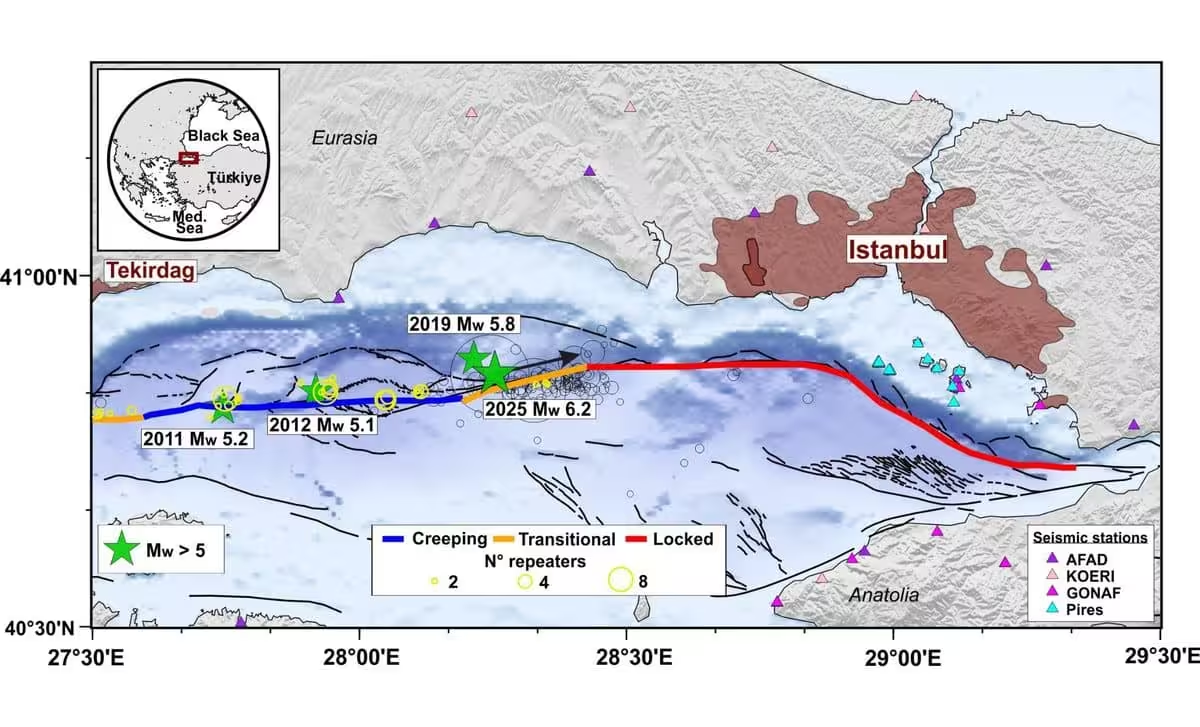
A multi-year investigation into the underwater landscape of the Sea of Marmara has uncovered a concerning trend: a series of moderate earthquakes is gradually migrating eastward toward the densely populated metropolis of Istanbul. By analyzing two decades of geological data, researchers have identified a systematic progression of seismic ruptures along the Main Marmara Fault that brings tectonic strain closer to the city’s doorstep.
The study, led by Patricia Martínez-Garzón of the GFZ Helmholtz Centre for Geosciences, indicates that the fault is not behaving as a static structure but as a dynamic system where stress is being redistributed through a sequence of tremors. The most recent major event in this pattern, a magnitude 6.2 earthquake on April 23, 2025, represents the largest seismic disturbance in the region in over 60 years. According to findings published in Science, this event effectively pushed the active rupture zone further toward the locked segments of the fault that sit immediately south of Istanbul, home to approximately 18 million people.
The Physics of a Deep-Seated Threat
The North Anatolian Fault Zone, which includes the Main Marmara Fault, acts as a primary boundary between the Anatolian and Eurasian tectonic plates. While sections of the fault further west exhibit “fault creep”—a gradual, silent sliding that releases tectonic stress—the portion adjacent to Istanbul is largely locked. This segment, particularly the area near the Princes’ Islands, has not seen a major earthquake exceeding magnitude 7 since 1766.
Historical data suggests that major seismic events in this region recur roughly every 250 years. However, geologists caution that these timelines are not precise calendars. The current concern centers on how stress is being funneled into the “silent” gaps along the fault. Researchers highlighted a 15 to 20-kilometer stretch near Avcılar that has remained relatively quiet, accumulating strain while neighboring segments have ruptured.
The team also pointed to the dangers of “rupture directivity.” During the 2025 event, seismic energy was disproportionately focused toward the east, increasing the intensity of ground motion in that direction. Should a future rupture propagate directly toward the city, this phenomenon could significantly amplify the severity of the shaking felt by residents.
Preparedness in an Uncertain Future
While the study provides a clearer map of where stress is accumulating, co-author Marco Bohnhoff notes that these observations do not constitute a forecast. It remains impossible to determine exactly when the next major rupture will occur. The next significant event could manifest as a moderate magnitude 6 earthquake, or it could trigger a more widespread failure across the locked segments.
To mitigate these risks, the research team advocates for a major expansion of the region’s monitoring infrastructure. By integrating deep-borehole sensors, ocean-bottom seismometers, and fiber-optic cables along the seafloor, scientists hope to gain higher-resolution data that could enable faster detection of initial rupture phases.
For now, the findings confirm that the Sea of Marmara remains a region of high tectonic potential. As the fault system continues to evolve, the primary objective for geoscientists and city planners is to leverage this improved understanding of fault interaction to refine emergency preparedness strategies for the urban population living above this complex, shifting boundary.
This article has been fact checked for accuracy, with information verified against reputable sources. Learn more about us and our editorial process.
Last reviewed on .
Article history
- Latest version
Reference(s)
- Martínez-Garzón, Patricia., et al. “Progressive eastward rupture of the Main Marmara fault toward Istanbul.” Science, vol. 391, no. 6783, January 22, 2026, pp. 379-383. American Association for the Advancement of Science (AAAS), doi: 10.1126/science.adz0072. <https://www.science.org/doi/10.1126/science.adz0072>.
Cite this page:
- Posted by Vikram Desai