6 Year Old Finds Rare Ancient Fossil Not Seen in Nebraska for 55 Years
Please provide the text you would like me to rewrite.
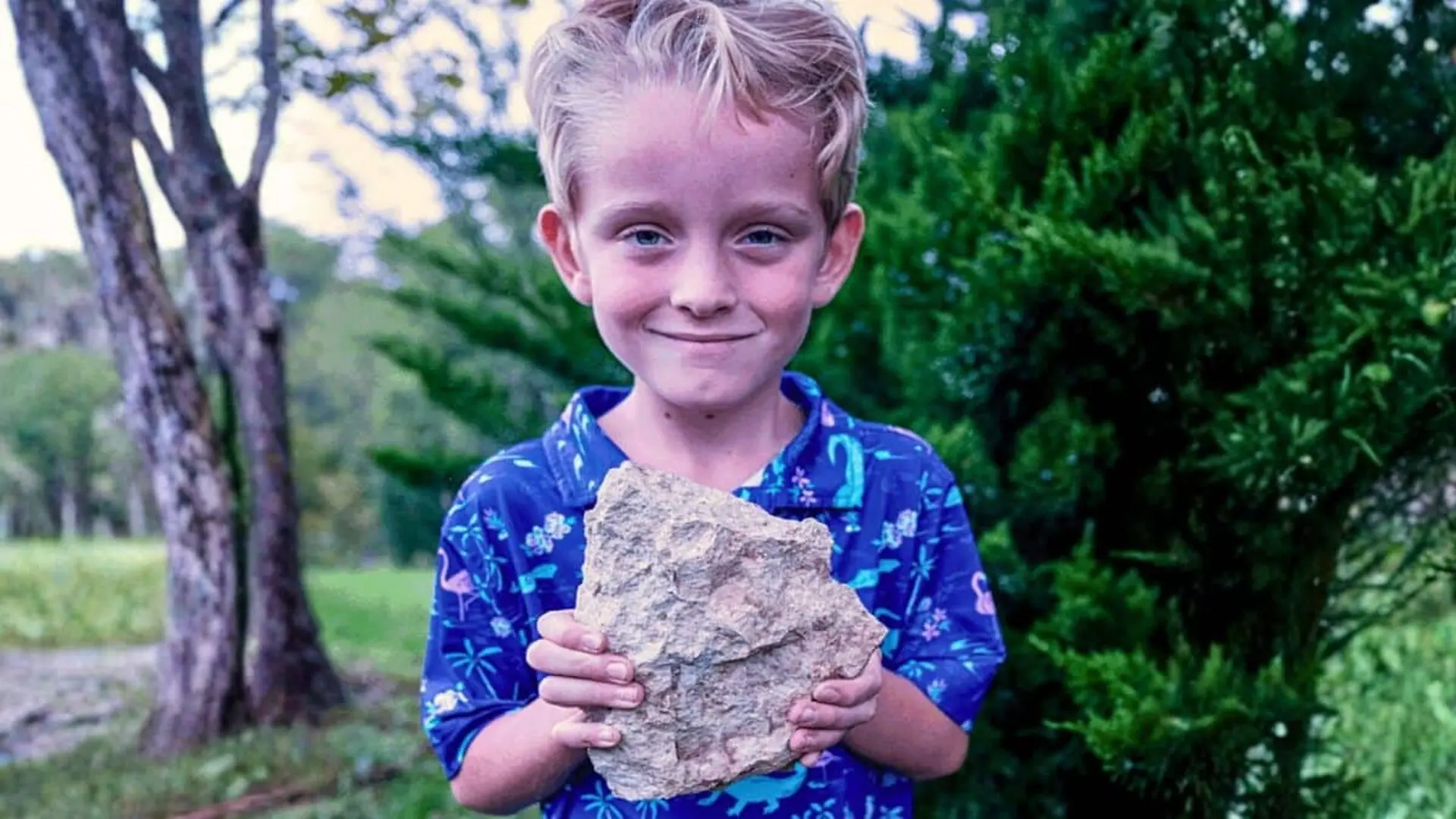
A six-year-old amateur paleontologist has made a discovery at Nebraska’s Schramm Park State Recreation Area that has left experts stunned. While scouring the park’s limestone deposits for common crinoids—fossilized sea lilies—young Leo Youngdahl uncovered a specimen that had not been documented in the state for over half a century.
The fossil, which Youngdahl initially mistook for the textured belly of a garter snake, was eventually identified as a conulariid. These ancient marine invertebrates, characterized by their distinct, pyramid-shaped geometry, have rarely been found in the region. According to state officials, such a find has not occurred in Nebraska in more than 55 years.
An Unidentified Anomaly
The discovery quickly baffled staff at the recreation area. Kelly Ekue, an outdoor education specialist who has spent seven years leading fossil-hunting programs at the site, noted that the specimen stood out immediately from the typical invertebrate fossils found in the local rock strata. Its size and unique, almost fish-like appearance challenged expectations for the geological era represented at the park.
“This fossil didn’t look anything like any of the species we see,” Ekue told KLKN-TV. Following a review of images by geologists and experts at the University of Nebraska State Museum, the creature’s identity was confirmed. The signature herringbone pattern impressed into the stone provided definitive evidence of a conulariid, a rarity that curators described as being more difficult to locate than a mammoth bone.

Decoding the Ancient Marine Pyramid
Conulariids represent an enigmatic chapter in evolutionary history. Anatomically, these creatures inhabited a four-sided, conical structure that tapered to a point, featuring a longitudinal groove along each corner. Their outer shells were composed of calcium phosphate—the same material that constitutes vertebrate teeth and bones—arranged in microscopic, segmented rods. This structural composition accounts for the fossilized herringbone texture.
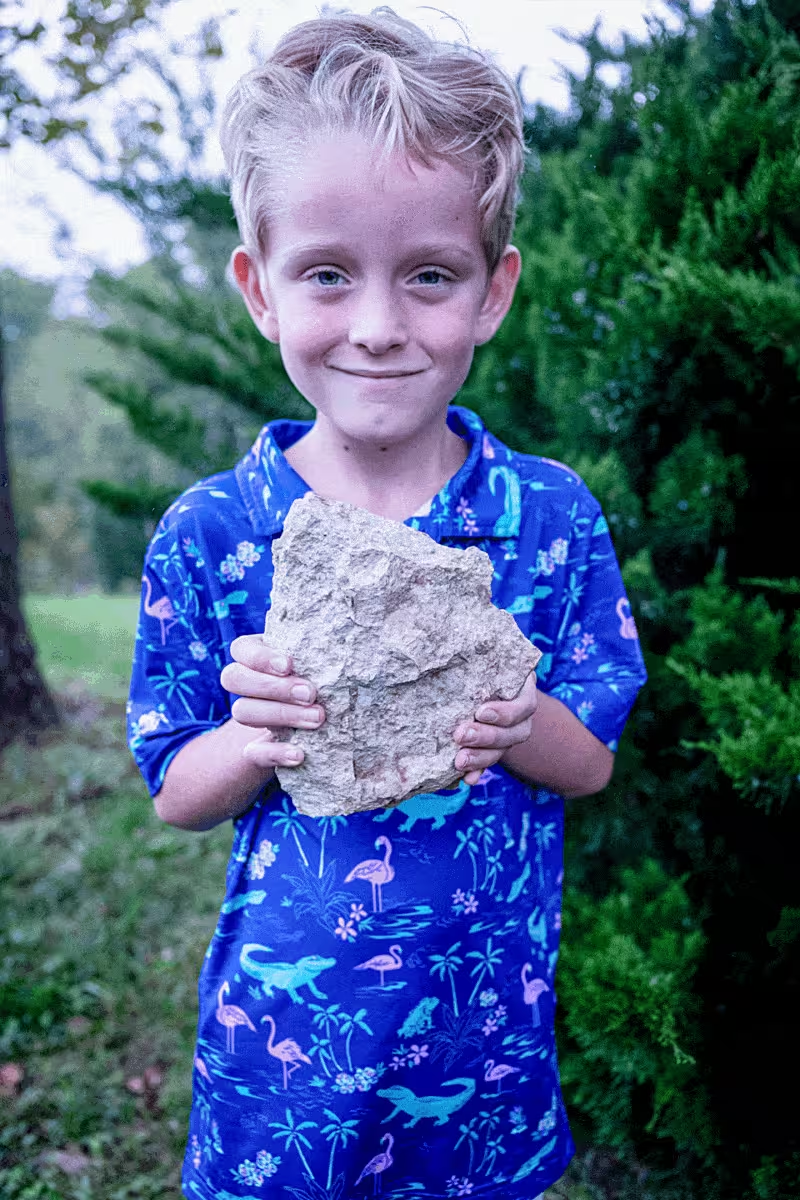
Most researchers classify these organisms within the cnidarian family, placing them in the same biological group as modern jellyfish and corals. First emerging approximately 540 million years ago, the group persisted until the end of the Triassic period roughly 200 million years ago. Because their physical structures were fragile and prone to rapid decomposition, intact imprints measuring 2.75 inches—like the one discovered by Youngdahl—are exceptionally uncommon in the geological record.
A Glimpse Into the Pennsylvanian Seafloor
The limestone beds at Schramm Park trace their origins to the Late Pennsylvanian period, some 300 million years ago, when the region was submerged beneath a warm, shallow tropical sea. The site remains a focal point for understanding this period, as the local strata are entirely devoid of vertebrate life, consisting exclusively of invertebrate marine life from that vanished environment.
The fossil will now be held at the park’s education center, serving as a teaching tool for visiting students and researchers. This placement continues the educational legacy established by E.F. Schramm, a University of Nebraska–Lincoln geology professor who donated the land. The site’s geological significance is so profound that a specific layer of rock, the Gretna Shale, was named in honor of the area.
This article has been fact checked for accuracy, with information verified against reputable sources. Learn more about us and our editorial process.
Last reviewed on .
Article history
- Latest version
Reference(s)
- <https://outdoornebraska.gov/about/press-events/news/6-year-old-finds-rare-fossil-at-schramm/>.
- Adams, Noelle. “6-year-old finds ancient fossil at park near Gretna.”, October 13, 2026 Channel 8 KLKN-TV <https://www.klkntv.com/6-year-old-finds-ancient-fossil-at-park-near-gretna/>.
- “Geolex — Gretna.” <https://ngmdb.usgs.gov/Geolex/Units/Gretna_8491.html>.
Cite this page:
- Posted by Vikram Desai