Stunning 1,600 Year Old Roman Shipwreck Discovery Reveals Perfectly Preserved Bronze Statues
Archaeologists have recovered a 1,600-year-old Roman trading ship and its cargo of coins from an ancient port, uncovering a long-lost piece of history.
A remarkable cache of ancient Roman treasures has been recovered from the seabed near the port of Caesarea, where a merchant vessel met its end some 1,600 years ago. The discovery, unearthed by a collaborative team of professional archaeologists from the Israel Antiquities Authority (IAA) and local diving enthusiasts, offers an unparalleled glimpse into the maritime trade of the late Roman Empire.
While the waters off the coast of Caesarea have long been a site of significant archaeological interest, the nature of this particular haul stands out. Excavation leads Dr. Jacob Sharvit and Dr. Dror Planer highlighted the discovery for its extraordinary preservation and the unique artistic value of the artifacts found resting within the sand.
Remarkable Preservation in the Deep
Among the most striking recovered items are a series of bronze statues and lamps that appear to have defied the passage of time. The collection includes depictions of the sun god Sol and the moon goddess Luna, as well as a lamp cast in the likeness of an African figure. The team also retrieved remnants of three life-sized statues, various zoomorphic bronze figures—including a whale and a boar-headed faucet—and other decorative elements.
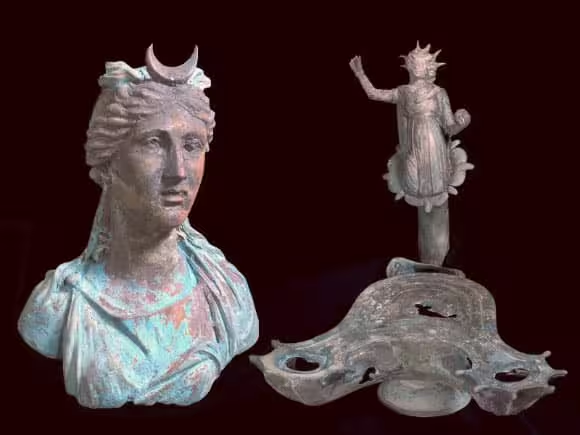
Experts credit the protective layer of seafloor sand for the pristine condition of these metals. As noted by The Sydney Morning Herald, the environment was so gentle on the artifacts that they appear to have been cast quite recently, despite their antiquity.
A Financial Snapshot of a Fallen Empire
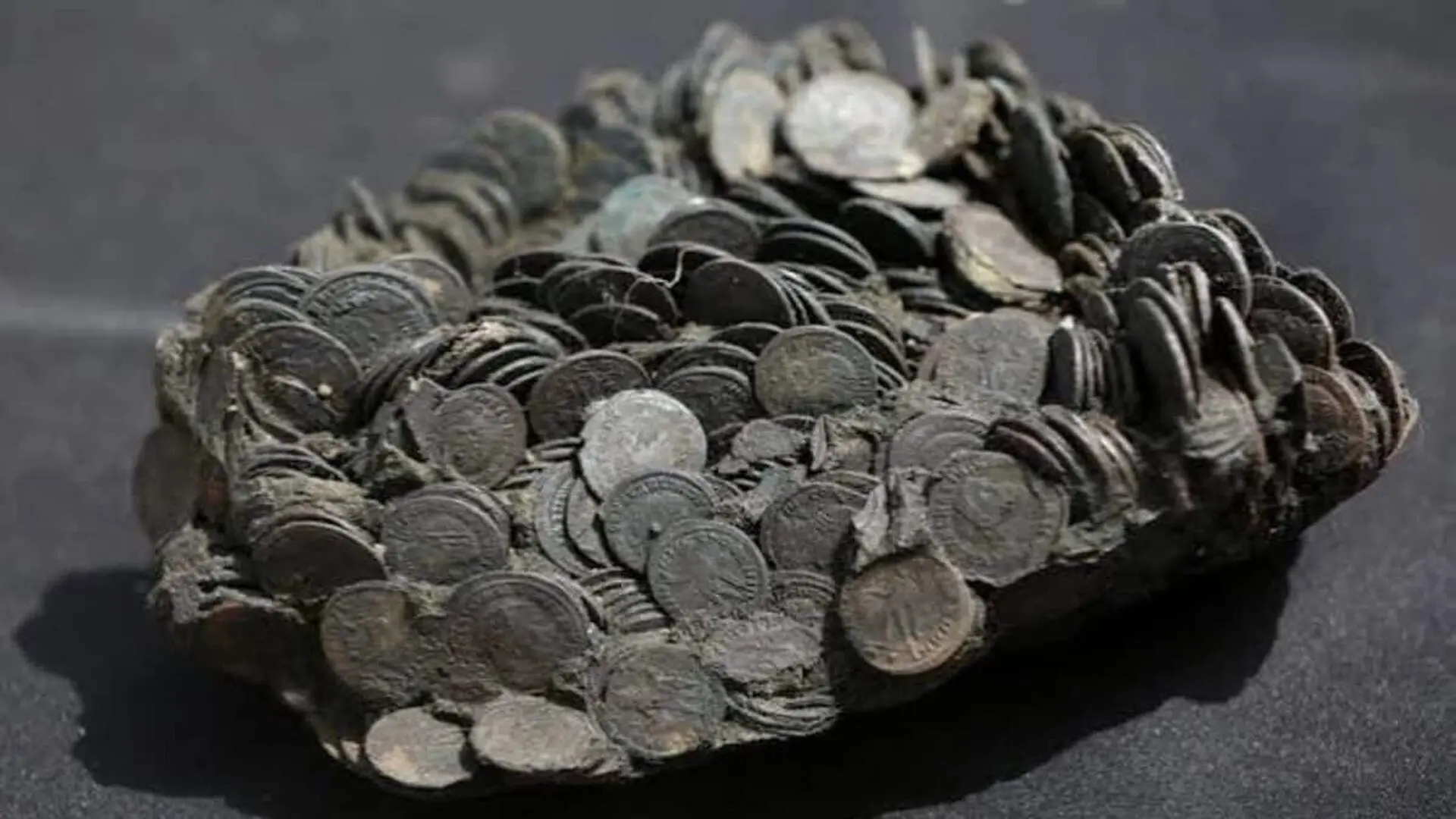
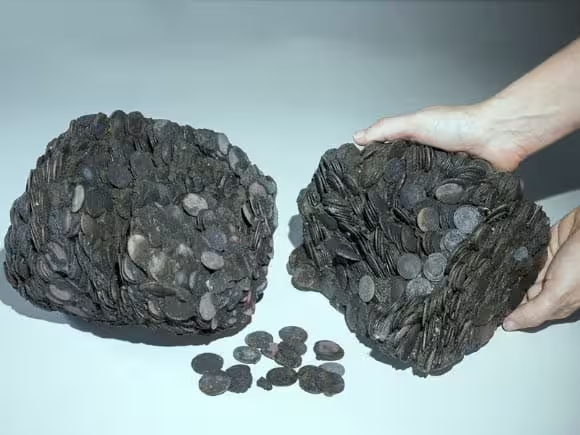
Beyond the artistic treasures, the divers identified two massive metallic lumps, totaling roughly 20 kilograms in weight. These clusters are comprised of thousands of Roman coins that had fused together, mirroring the shape of the ceramic vessels that originally held them. The numismatic evidence provides a firm timeline for the wreck, featuring the imagery of Constantine the Great—who governed the Western Empire from 312 to 324 CE before presiding over the unified Roman Empire until 337 CE—and his rival, Licinius.
The Final Voyage of a Recycling Vessel
Archaeologists believe the ship was likely a merchant vessel tasked with transporting metal for recycling, a common practice in the late Roman era. Based on the distribution of debris on the ocean floor, the researchers hypothesize that the ship likely encountered a violent storm while attempting to enter the harbor, eventually drifting and colliding with the harbor’s seawall and rocky outcrops.
For researchers, the wreck serves as a potent reminder of the prosperity of Caesarea during this era. The wealth of items, including fragments of domestic pottery used for water storage, points to a period of significant economic stability. As Dr. Sharvit and Dr. Planer concluded, the sheer volume and diversity of these finds offer an evocative portrait of the commercial activity that defined Caesarea as a vital hub during the height of Roman administrative and economic power.
This article has been fact checked for accuracy, with information verified against reputable sources. Learn more about us and our editorial process.
Last reviewed on .
Article history
- Latest version
Reference(s)
- <https://antiquities.academia.edu/KobySharvit>.
- Power, Julie. “Roman trash is today's treasure: Israeli divers find 1600-year-old ancient cargo saved by shipwreck.”, May 16, 2016 The Sydney Morning Herald <https://www.smh.com.au/world/roman-trash-is-todays-treasure-israeli-divers-find-1600yearold-ancient-cargo-saved-by-shipwreck-20160517-gowmjc.html>.
Cite this page:
- Posted by Vikram Desai