New Research Suggests The Great Pyramid May Be A Giant Stone Archive Of Astronomical Data
Could the mysterious void inside the Great Pyramid of Giza be an intentional design feature? Explore the latest theories behind this ancient architectural enigma.
For millennia, the granite sarcophagus resting within the Great Pyramid’s King’s Chamber has presented a persistent archaeological enigma. Its dimensions, too expansive to have been maneuvered through the structure’s narrow, completed corridors, confirm the box was placed during the initial phase of construction. Yet, despite the immense effort invested in its placement, the chamber has yielded no evidence of a royal interment, leaving scholars to rely on the standard conclusion: it was a burial site later emptied by ancient tomb robbers.
A new, unreviewed study posted to the SSRN preprint archive by independent researcher Sefy Levy offers a radical departure from this view. Rather than functioning as a funerary vessel, Levy proposes that Khufu’s pyramid was designed as a monumental repository of astronomical knowledge, where the edifice itself—not its contents—served as the primary record of complex celestial cycles.
Decoding the Geometry of the Heavens
Levy’s approach discards modern units of measurement in favor of the design specifications attributed to the Old Kingdom builders: a base of 440 royal cubits and a seked (slope) of 5½. By applying mathematical operations derived from the Rhind Mathematical Papyrus, he calculates six exterior dimensions and compares them against fourteen documented astronomical and calendrical values from ancient Egyptian history.
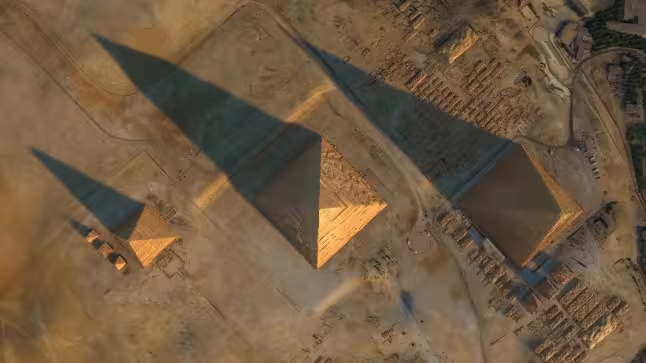
According to his findings, ten of these fourteen values align with the pyramid’s geometry within a 0.2 percent margin of error. Notable correlations include the 27.5-day interval of lunar perigee and the 70-day period associated with the heliacal rising of Sirius. While the relationship between the pyramid’s perimeter and its height yields an approximation of 2π—a connection long noted by researchers—Levy integrates this into a broader framework alongside orbital cycles for Venus and Jupiter.
Statistical Probability and Ancient Intent
To determine if these correlations might be the result of coincidental design, Levy conducted a computer simulation modeling 100,000 pyramids built to Old Kingdom specifications. He found that approximately 2.4 percent of these models achieved an equal or higher number of astronomical hits. While he argues this low probability suggests intentionality, the findings remain subject to professional scrutiny and independent replication.

The Burden of Evidence
Mainstream Egyptology remains skeptical, primarily due to the absence of contemporary texts that explicitly describe the Great Pyramid as a data archive. The consensus continues to view the structure as the focal point of a royal mortuary complex, intended to facilitate the passage of the pharaoh’s ka or spirit. While the pyramid shape is recognized in Egyptian mythology as a representation of the primeval mound from which the world emerged, the idea that its dimensions function as a sophisticated mathematical manual remains outside the established historical record.
Levy’s broader claims extend into the hypothetical, suggesting that these alignments might memorialize the transition of ancestral populations during the collapse of the Green Sahara. Because these assertions rely on unverified migration theories and mathematical interpretations that critics argue are susceptible to confirmation bias, the academic community will likely demand rigorous testing before accepting the hypothesis. For now, the Great Pyramid keeps its secrets, functioning as a silent monolith that refuses to confirm whether it was built for the dead, the stars, or both.
This article has been fact checked for accuracy, with information verified against reputable sources. Learn more about us and our editorial process.
Last reviewed on .
Article history
- Latest version
Reference(s)
- <https://papers.ssrn.com/sol3/papers.cfm?abstract_id=7340278>.
- <https://independent.academia.edu/SefyLevy>.
- projects, Contributors. “example of ancient Egyptian mathematics.”, February 18, 2003 Wikimedia Foundation, Inc. <https://en.wikipedia.org/wiki/Rhind_Mathematical_Papyrus>.
Cite this page:
- Posted by Vikram Desai