Colorado Homes Harbor Silent Radon Threat Behind 500 Lung Cancer Deaths Each Year
Colorado homes may conceal radon, an invisible killer linked to 21,000 U.S. deaths annually, yet most families remain unaware.
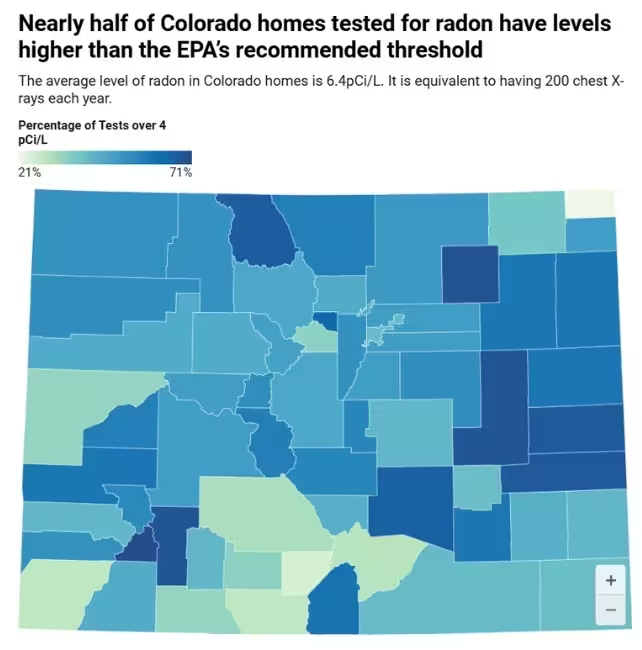
A sealed Colorado home on a chilly evening can feel perfectly fresh, yet hidden dangers may linger in the air. State health officials report that the average indoor radon concentration in Colorado residences is 6.4 picocuries per liter (pCi/L), a level comparable to undergoing roughly 200 chest X‑rays each year, according to the Colorado Department of Public Health and Environment (CDPHE). Because radon is invisible, odorless, and tasteless, most occupants remain unaware of its presence.
Across the United States, the Environmental Protection Agency (EPA) attributes about 21,000 lung cancer deaths annually to prolonged radon exposure, as detailed in its health risk overview. Radon stands as the leading cause of lung cancer among never‑smokers and the second leading cause overall, trailing only tobacco.
In Colorado alone, CDPHE estimates radon contributes to roughly 500 lung cancer deaths each year. Yet only half of the state’s homes have ever been tested, and among those, about half exceed the EPA’s recommended action level.
Colorado’s Elevated Indoor Radon: A Geological Hazard
Radon originates from the natural decay of uranium embedded in soil and rock. As uranium atoms disintegrate, the resulting gas migrates upward, entering buildings through foundation cracks, sump‑pump openings, and unsealed crawl spaces. While the gas disperses rapidly outdoors, it can accumulate indoors without adequate ventilation, especially in the lowest parts of a structure.
The state’s geology amplifies this risk. Extensive areas rest on granite‑rich bedrock that harbors more uranium than many other regions. According to World Population Review, Colorado ranks among the top ten states for indoor radon, with an average reading of 6.8 pCi/L, well above the EPA’s action threshold of 4 pCi/L. Readings vary widely across the state’s 64 counties, creating significant differences between neighboring properties.
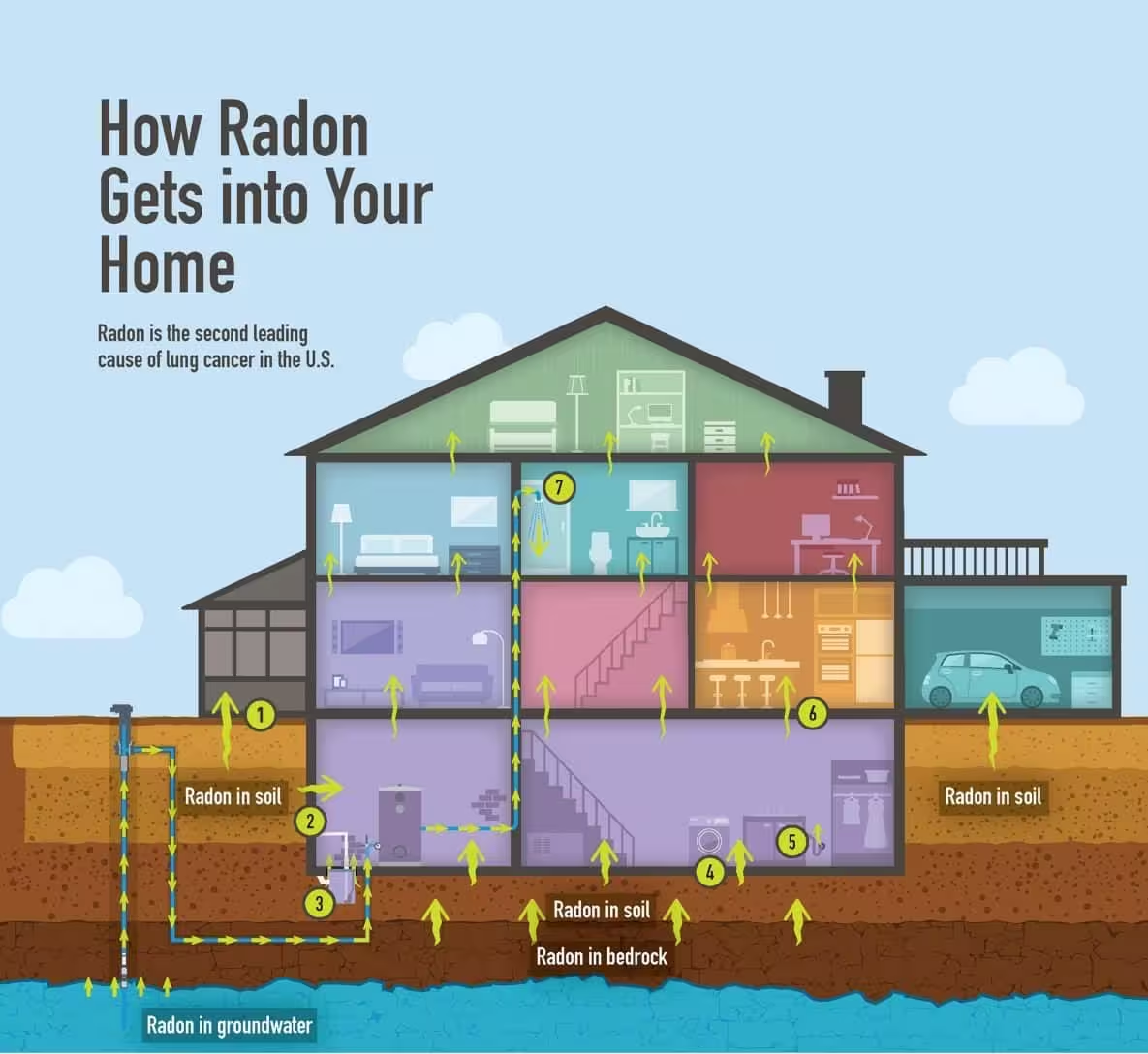
Winter building practices intensify the problem. During cold months, warm indoor air rises and exits through upper levels, creating a slight vacuum at ground level that draws soil gases into basements and lower floors. Energy‑efficient, tightly sealed homes retain any radon that seeps in. In residences that rely on private wells, the CDPHE notes that radon can dissolve into groundwater and re‑enter indoor air via showers and faucets, sometimes necessitating both air and water testing.
How Inhaled Radon Leads to Lung Cancer
When radon decays inside a home, it produces short‑lived radioactive particles that can be inhaled deep into the lungs. These particles emit bursts of energy capable of breaking chemical bonds in the DNA of lung cells. Damage that the body cannot fully repair accumulates over years, mirroring the cumulative harm caused by long‑term tobacco smoke.
A comprehensive review in CA: A Cancer Journal for Clinicians found that tobacco accounts for about 86 percent of lung cancer cases, while radon and other ionizing radiation sources contribute a smaller yet measurable share. The EPA estimates that among lifelong nonsmokers exposed to 4 pCi/L over many years, roughly 7 in 1,000 may develop lung cancer. For smokers, the risk compounds because tobacco and radon decay products damage the same lung tissue, increasing the overall burden.
Children are particularly vulnerable. The CDPHE points out that kids breathe more rapidly and spend more time near floor level, where radon decay products tend to settle. Because radon exposure produces no immediate symptoms such as coughing or irritation, prolonged undetected exposure poses a hidden danger.
Tracking Radon Exposure: A Colorado Cancer Specialist
A significant portion of public awareness in the state stems from the efforts of Jan Lowery, a cancer epidemiologist at the University of Colorado Anschutz Medical Campus. Lowery’s outreach program spans all 55 of Colorado’s counties, aiming to educate residents about household radon levels and mitigation options.
Through the University of Colorado Anschutz Cancer Center, her team has distributed more than 1,600 free test kits statewide. By February 2026, nearly 40 percent of the returned kits revealed radon concentrations at or above the EPA’s action level, underscoring the widespread nature of elevated radon across Colorado homes.
Steps to Test and Reduce Radon in Homes
The only reliable method to determine radon levels in a specific residence is testing. The EPA advises testing all dwellings on or below the third floor, beginning with the lowest regularly occupied space. Short‑term kits operate for 2 to 90 days, while long‑term kits run for 90 days or more, offering a more accurate annual average.
Test kits typically cost less than $50 and are available for free through state programs and the Anschutz Cancer Center. The EPA recommends conducting tests during colder months, when windows remain closed and indoor radon concentrations tend to peak.
If results show concentrations of 4 pCi/L or higher, both state and federal guidelines suggest installing a radon mitigation system: a vent pipe and continuously operating fan that draw soil gases from beneath the foundation and release them above the roofline.
According to the EPA, such systems can reduce indoor radon levels by up to 99 percent. Installation costs usually range from $1,000 to $3,000. For households that cannot afford these expenses, Colorado’s Low Income Radon Mitigation Assistance program may cover most or all of the cost for qualifying residents.
This article has been fact checked for accuracy, with information verified against reputable sources. Learn more about us and our editorial process.
Last reviewed on .
Article history
- Latest version
Reference(s)
- “Radon causes lung cancer: test your home | Colorado Department of Public Health and Environment.”, January 7, 2025 <https://cdphe.colorado.gov/press-release/radon-causes-lung-cancer-test-your-home-0>.
- “Health Risk Radon.” <http://epa.gov/radon/health-risk-radon>.
- Review, World. “Radon Levels by State.”, July 24, 2026 World Population Review <https://worldpopulationreview.com/state-rankings/radon-levels-by-state>.
- Islami, Farhad., et al. “Proportion and number of cancer cases and deaths attributable to potentially modifiable risk factors in the United States, 2019.” CA: A Cancer Journal for Clinicians, vol. 74, no. 5, July 11, 2024, pp. 405-432. Wiley, doi: 10.3322/caac.21858. <https://doi.org/10.3322/caac.21858>.
- “Jan Lowery.”, January 15, 2026 The Conversation <https://theconversation.com/profiles/jan-lowery-2568052>.
Cite this page:
- Posted by Vikram Desai