Decades-Old Nuclear Tests Reveal A Massive Shifting Structure Deep Inside Earth
Signals from historical nuclear tests have uncovered new evidence of fluid movement occurring deep within Earth’s outer core.

Data derived from historic underground nuclear detonations has provided researchers with a rare, high-resolution look into the dynamic nature of Earth’s outer core. A study published in the Journal of Geophysical Research: Solid Earth challenges the long-held view of this region as a uniform, static body of molten metal, revealing instead a complex environment capable of large-scale evolution over a span of just decades.
A research team led by Virginia Tech geophysicist Ying Zhou examined seismic data collected from nuclear tests conducted at Moruroa Atoll in French Polynesia between 1977 and 1995. By analyzing the precise, repetitive signals generated by these subterranean explosions, the team was able to track subtle but significant fluctuations in how seismic waves propagated through the planet’s deepest layers.
Deep-Earth Dynamics Revealed Through Nuclear Testing
For over a century, seismologists have relied on the waves generated by earthquakes to map the interior of our planet, establishing the fundamental model of a solid inner core, a liquid outer core, and the surrounding mantle. However, seismic signals from natural events often lack the repeatability needed for precise long-term monitoring.
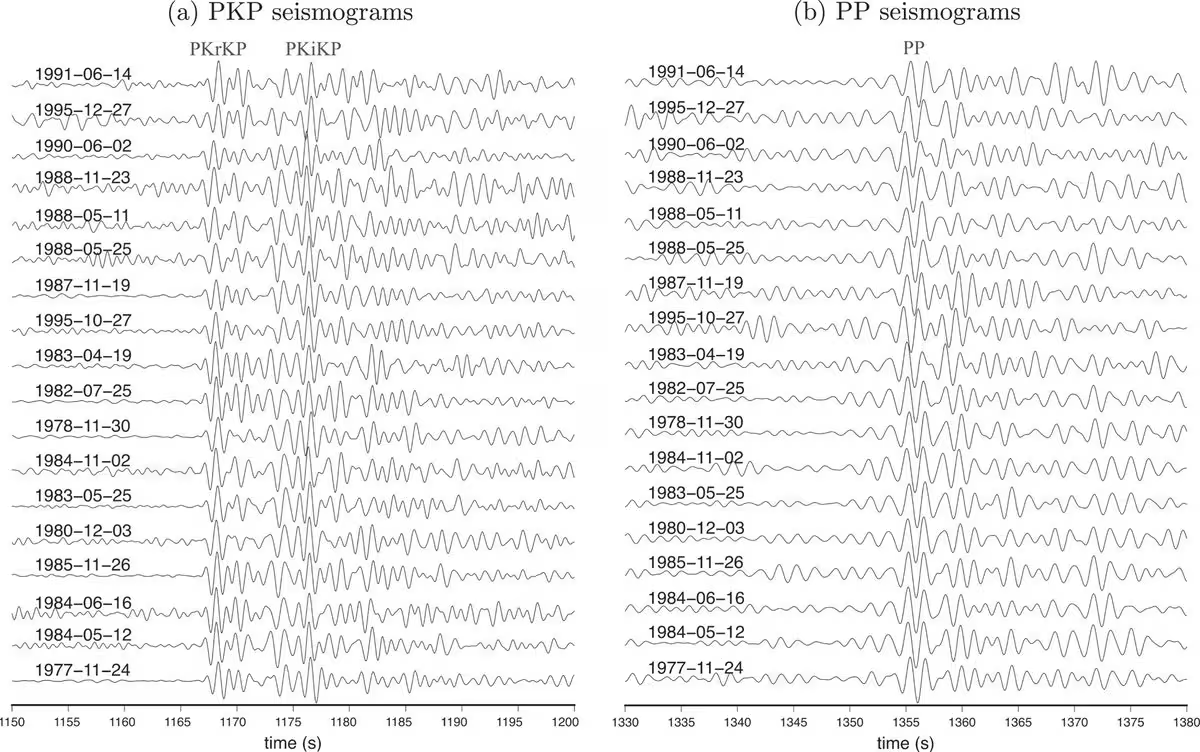
The new research leverages a unique advantage offered by underground nuclear blasts: consistency. Because these tests were conducted at nearly identical sites, the seismic waves traveled along highly similar paths through the planet, allowing for rigorous comparative analysis. The study scrutinized 112 pairs of explosions—each spaced less than 0.05 degrees apart—to detect temporal shifts in wave travel times.
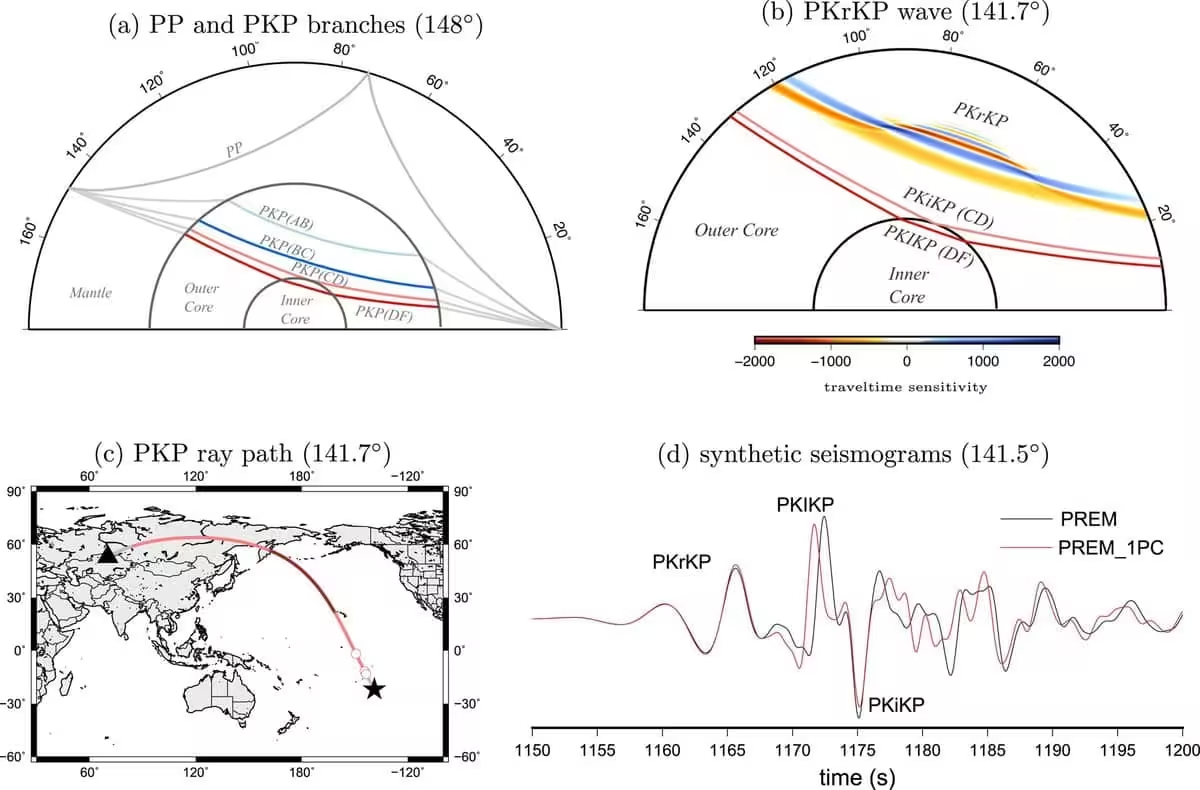
By identifying a specific seismic wave known as PKrKP, which reflects within the outer core, the researchers successfully isolated variations occurring deep within the metallic liquid, providing a clearer picture of the region’s internal structure.
Evidence of Shifting Structures Beneath the Pacific
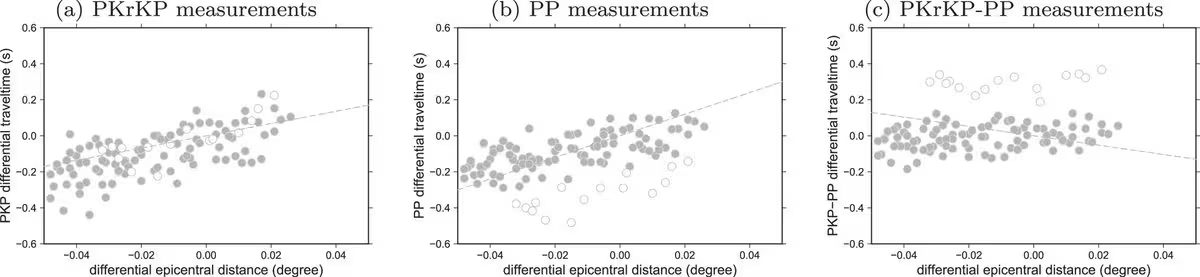
The temporal analysis revealed significant fluctuations in seismic wave velocity over the 18-year study period. Compared to the 1977 baseline, waves accelerated by approximately 0.1 seconds by 1982-1983 and further by 0.15 seconds between 1988 and 1990. By 1995, however, the waves had slowed by roughly 0.15 to 0.2 seconds.
While these time shifts appear minimal, they represent profound changes in the physical properties of the core. The team suggests that a massive anomaly located beneath the southern Pacific—estimated to be 700 kilometers wide and 100 kilometers thick—is the likely culprit for the observed data. This feature may consist of solid material suspended within the molten outer core, shifting dynamically as the fluid circulates. Such activity is crucial, as the outer core’s motion drives the geodynamo, the process responsible for sustaining Earth’s protective magnetic field.
Repurposing Legacy Data for Modern Science
The study highlights how historical nuclear testing records can serve as an unexpected geological resource. By acting as a time capsule for seismic data, these legacy recordings allow geophysicists to bypass the limitations of natural earthquake activity. The findings reinforce the theory that the deep interior is not a static environment, but rather one characterized by ongoing interactions between the inner and outer core, providing researchers with a sophisticated new avenue for mapping the mysteries beneath the surface.
This article has been fact checked for accuracy, with information verified against reputable sources. Learn more about us and our editorial process.
Last reviewed on .
Article history
- Latest version
Reference(s)
- Zhou, Ying. “Temporal Changes in the Earth's Outer Core From Nuclear‐Test PKP Waves.” Journal of Geophysical Research: Solid Earth, vol. 131, no. 8, August 18, 2026 American Geophysical Union (AGU), doi: 10.1029/2026JB033798. <https://agupubs.onlinelibrary.wiley.com/doi/10.1029/2026JB033798>.
Cite this page:
- Posted by Vikram Desai