Researchers Turn Plastic Waste Into Hydrogen Using Old Car Battery Acid and Sunlight in a Single Process
Scientists transform plastic waste and old batteries into clean hydrogen fuel

A Cambridge research team has demonstrated a method that simultaneously dismantles polyethylene terephthalate (PET) waste and produces clean hydrogen, using sulfuric acid reclaimed from spent lead‑acid batteries and solar energy. The integrated approach transforms hard‑to‑recycle plastics into valuable feedstocks while delivering a green fuel in a single reactor.
Plastic pollution, especially from PET bottles and food containers, remains a mounting environmental problem. At the same time, the recycling of lead‑acid batteries typically recovers only the metal, leaving the corrosive sulfuric acid largely unused.
By coupling these two waste streams, the University of Cambridge scientists have created a closed‑loop system that extracts useful chemicals from plastic and harnesses sunlight to split water‑derived protons into hydrogen.
Recovering Industrial Precursors from PET
The procedure starts with shredded PET, which is combined with concentrated sulfuric acid recovered from old car batteries and heated to 140 °C (284 °F). Under these conditions the polymer depolymerises, yielding ethylene glycol and terephthalic acid – both core ingredients for the chemical industry. Terephthalic acid precipitates out of the mixture, allowing straightforward separation.
“Sulfuric acid is a component of car batteries, but when they are recycled, they only recover the lead component,” said Kay Kwarteng, lead author of the study. “We could extract the battery acid and use that instead. It makes a strong argument for sustainability.”
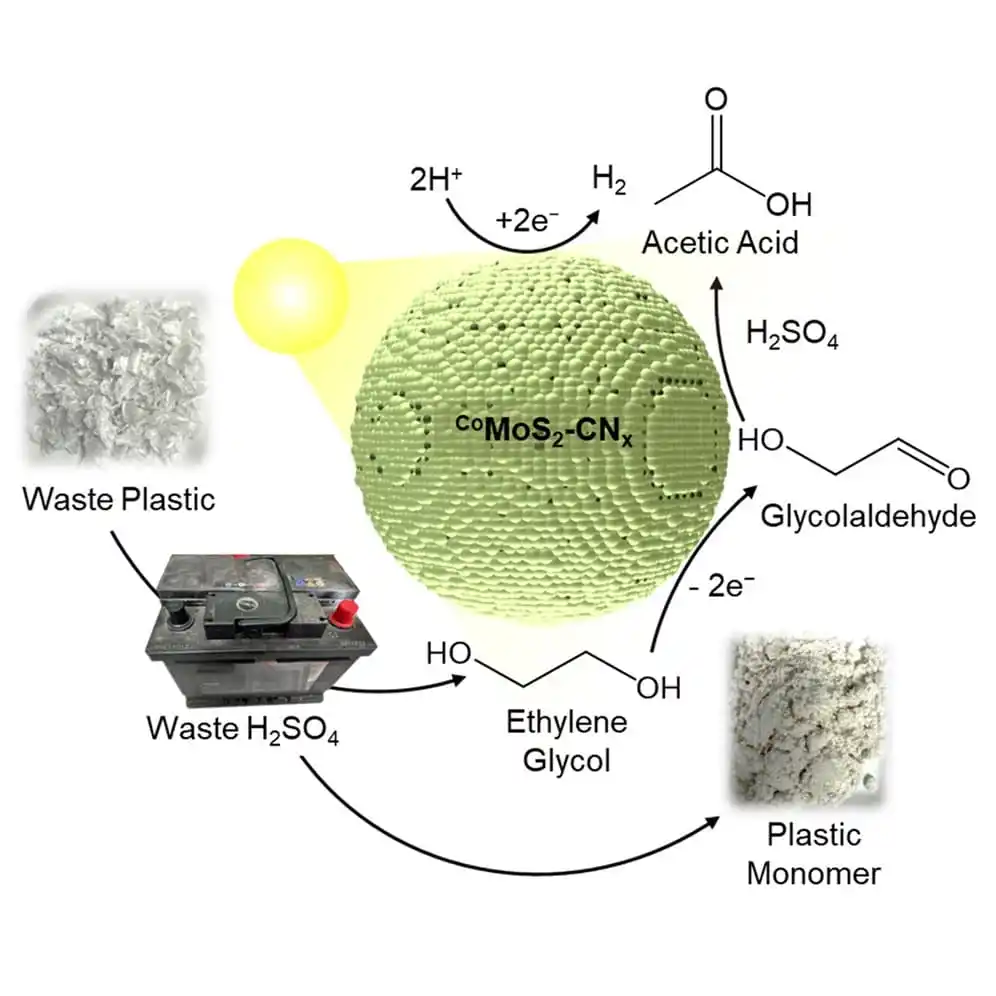
The acidic solution that remains after terephthalic acid removal is rich in ethylene glycol, which serves as the feedstock for the subsequent hydrogen‑generation step.
Solar‑Powered Hydrogen Production
Turning ethylene glycol into hydrogen typically requires alkaline conditions, yet the recycling stream is strongly acidic. To overcome this mismatch, the researchers designed a molybdenum‑based catalyst that remains active in acid and is triggered by visible light.
The catalyst’s performance was reported in Joule, where the authors showed that illumination drives oxidation of ethylene glycol, releasing electrons that reduce protons in the acid to molecular hydrogen while converting the glycol to acetic acid.
“Once we expose the catalyst to light, it oxidizes the ethylene glycol which generates electrons,” Kwarteng explained. “These electrons can convert protons — present in the acid mixture — to hydrogen, and they oxidize the ethylene glycol to acetic acid.”
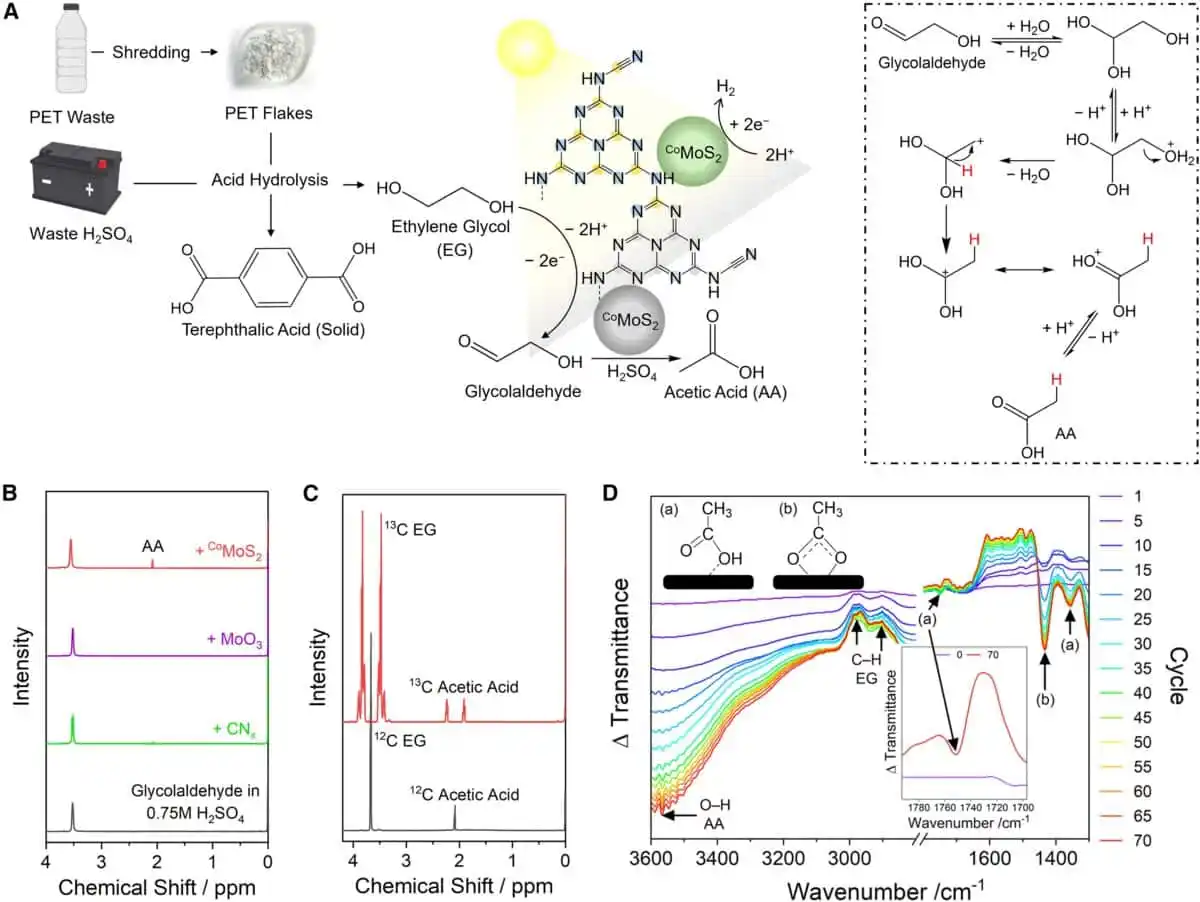
A notable feature of the work is that both depolymerisation and hydrogen evolution occur in the same vessel, something that had not been demonstrated before despite individual successes in each step.
Implications for Sustainable Chemical Synthesis
Beyond fuel generation, the team envisions applying the same chemistry to hydrogenation reactions that dominate the petrochemical sector. Professor Erwin Reisner noted that the approach could replace hydrogen sourced from fossil fuels with plastic‑derived hydrogen, reducing overall carbon footprints.
In a follow‑up study published in Angewandte Chemie International Edition, the researchers demonstrated that the hydrogen produced from PET can be used to hydrogenate nitrogen‑containing substrates, yielding intermediates for pharmaceutical manufacturing.
“When we use plastics for this hydrogenation, we reduce the carbon footprint by half,” Kwarteng said.
The next phase involves adapting the technology to continuous‑flow reactors, which could enable scalable production of both chemical feedstocks and hydrogen. Catalysis expert Amit Kumar of the University of St Andrews praised the dual‑recycling concept while emphasizing the need to prove the light‑driven chemistry at larger scales.
This article has been fact checked for accuracy, with information verified against reputable sources. Learn more about us and our editorial process.
Last reviewed on .
Article history
- Latest version
Reference(s)
- <https://www.cell.com/joule/fulltext/S2542-4351(26)00031-0?_returnURL=https%3A%2F%2Flinkinghub.elsevier.com%2Fretrieve%2Fpii%2FS2542435126000310%3Fshowall%3Dtrue>.
- “Professor Erwin Reisner | Yusuf Hamied Department of Chemistry.” <https://www.ch.cam.ac.uk/person/er376>.
- Kwarteng, Papa K.., et al. “Photocatalytic Transfer Hydrogenation Using Plastic Hydrolysates as Hydrogen Donor.” Angewandte Chemie International Edition, May 4, 2026 Wiley, doi: 10.1002/anie.4324362. <https://onlinelibrary.wiley.com/doi/10.1002/anie.4324362>.
- “Dr Amit Kumar - School of Chemistry.” <https://www.st-andrews.ac.uk/chemistry/people/ak336/>.
Cite this page:
- Posted by Bilal Abbasi