Scientists Could Map the Entire Moon Using a Telescope the Size of a Lunchbox
Compact X-ray telescope may unveil Moon’s full surface composition in unprecedented detail for first complete chemical map
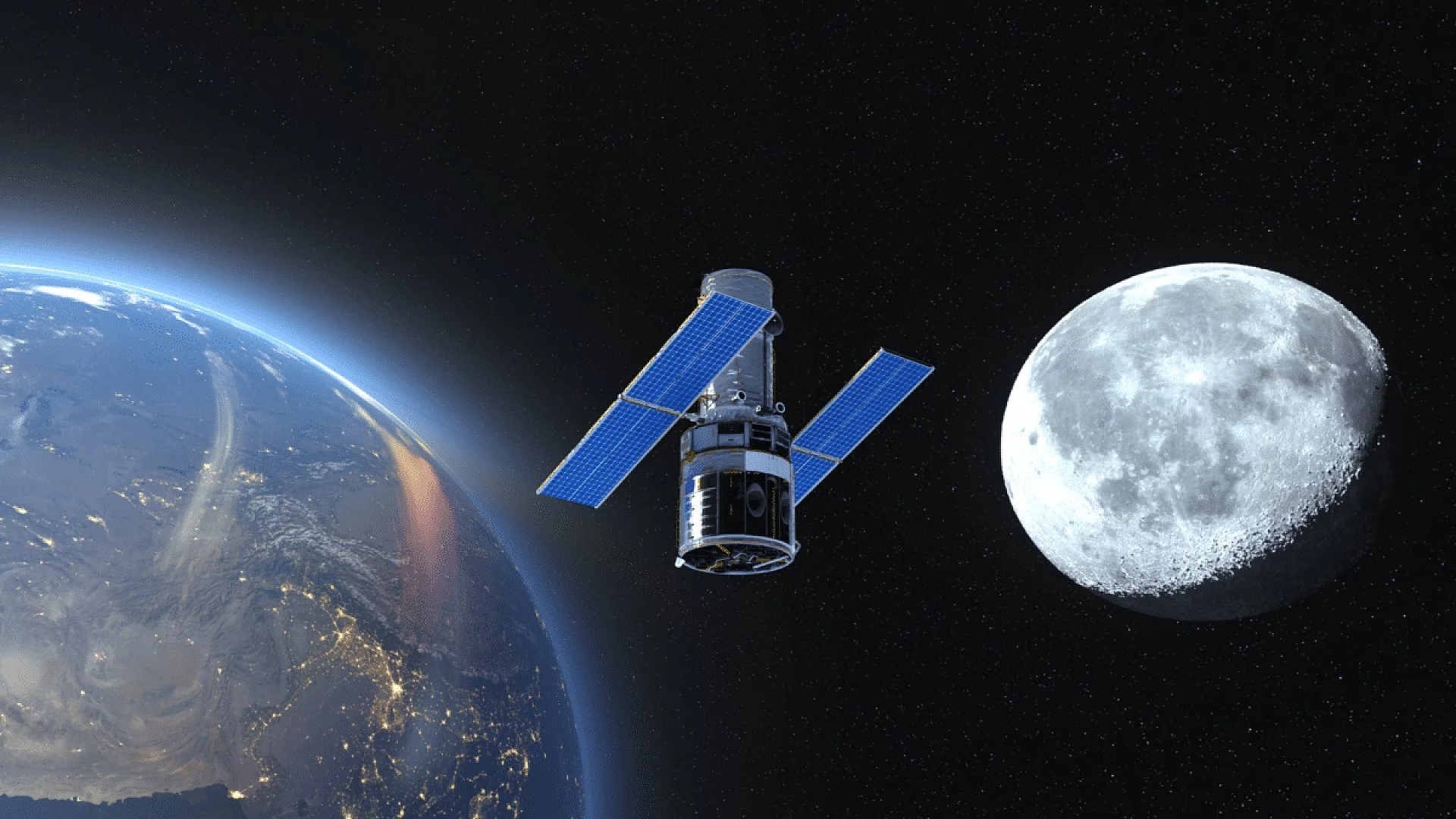
A newly designed, lightweight X‑ray telescope could finally deliver the first truly global map of the Moon’s elemental makeup, shedding light on its origin and long‑term evolution. The study, appearing in Earth, Planets and Space, shows that a single compact instrument in lunar orbit would be able to trace oxygen, iron, magnesium, aluminum and silicon across the entire surface in roughly two years, promising a major leap forward for lunar geology.
Charting Lunar Chemistry From Space
Our Moon preserves clues to the early Solar System, yet its geological story remains fragmented. Apollo‑era rock samples represent only a tiny fraction of the lunar surface, and existing remote‑sensing datasets provide only patchy chemical information. A complete, high‑resolution global map has thus remained out of reach.
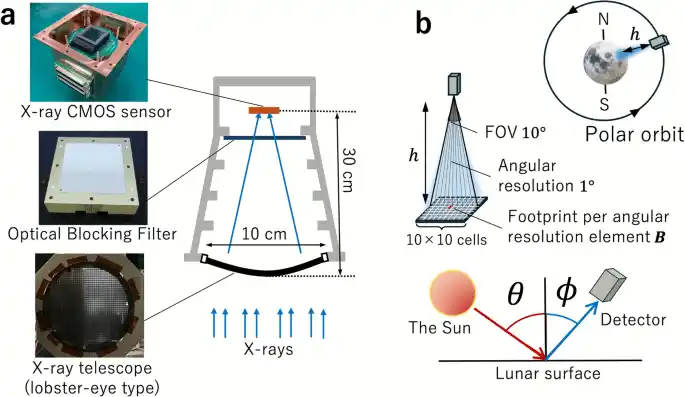
Credit: Earth, Planets and Space
X‑ray fluorescence imaging offers a way forward. When solar X‑rays strike the lunar regolith, specific elements emit their own characteristic X‑rays. By measuring this fluorescence, scientists can infer the distribution of those elements across the Moon. Earlier attempts from Apollo and Chandrayaan missions produced only limited maps, hampered by uneven solar illumination—especially near the poles—and the gradual degradation of detectors in space.
A Tiny, Robust Telescope for Lunar Orbit
Researchers at Tokyo Metropolitan University, led by Airi Toida and Prof. Yuichiro Ezoe, have engineered a sub‑ten‑kilogram X‑ray instrument originally intended to study Earth’s magnetosphere. Its modest mass makes it a practical payload for a dedicated lunar satellite, sidestepping many of the logistical hurdles that accompany larger X‑ray telescopes.
Rigorous testing exposed the detector to radiation levels exceeding those expected in lunar orbit, confirming its ability to operate over extended periods. The compact design also enables the telescope to exploit intervals of intense solar activity—such as the strong solar flares that provide the brightest X‑ray illumination—maximising the quality of elemental measurements.
Simulation Results Reveal a Feasible Mapping Strategy
To gauge performance, the team ran detailed numerical simulations that incorporated the instrument’s specifications. Assuming roughly 300 solar flares per year, a single telescope mounted on a lunar orbiter could generate a 70 × 70 km grid of oxygen, iron, magnesium, aluminum and silicon coverage in about two years.
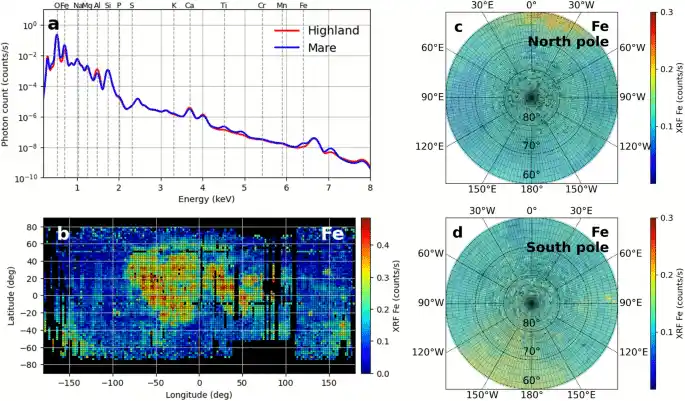
Credit: Earth, Planets and Space
Expanding the concept to a 5 × 5 array of identical telescopes would sharpen the resolution to 30 × 30 km and cut the mapping time to roughly one year. Adding sodium to the target list could be achieved with a two‑year mission, demonstrating that even modest hardware, when optimised, can deliver a comprehensive chemical survey of the Moon.
Implications for Lunar Science and Exploration
A complete elemental atlas would provide unprecedented insight into the Moon’s formation, differentiation and long‑term evolution. Researchers could better constrain the processes that fashioned its crust, mantle and surface layers over billions of years, while mission planners could pinpoint regions rich in specific resources for scientific or commercial purposes.
The findings, published in Earth, Planets and Space, illustrate a cost‑effective pathway to address a long‑standing challenge. By proving that small, durable instruments can achieve high‑resolution coverage, the work opens the door to a new generation of lunar orbital missions.
A Fresh Perspective on the Moon’s Past
If realised, the proposed telescope network would generate the first truly global elemental map, revealing the distribution of iron‑rich maria, aluminum‑dominated highlands and other compositional variations. Such data could refine models of the Moon’s origin—particularly the giant‑impact hypothesis—and deepen our understanding of the coupled evolution of Earth and its satellite.
Beyond the scientific payoff, the project underscores the growing value of small, specialised space instruments. By optimising size, durability and observation strategy, researchers can achieve transformative results without the expense and complexity of traditional large‑scale missions.
This article has been fact checked for accuracy, with information verified against reputable sources. Learn more about us and our editorial process.
Last reviewed on .
Article history
- Latest version
Reference(s)
- Toida, Airi., et al. “Numerical simulation of light-element geochemistry of the lunar surface using a compact and lightweight XRF imaging spectrometer.” Earth, Planets and Space, vol. 78, no. 1, March 27, 2026 Springer Science and Business Media LLC, doi: 10.1186/s40623-025-02326-2. <https://link.springer.com/article/10.1186/s40623-025-02326-2>.
Cite this page:
- Posted by Bilal Abbasi