Quantum Sensing Offers New Path to Find Earth‑Like Exoplanets
Quantum techniques promise to revolutionize astronomers’ hunt for Earth‑like exoplanets, boosting detection of distant habitable worlds.

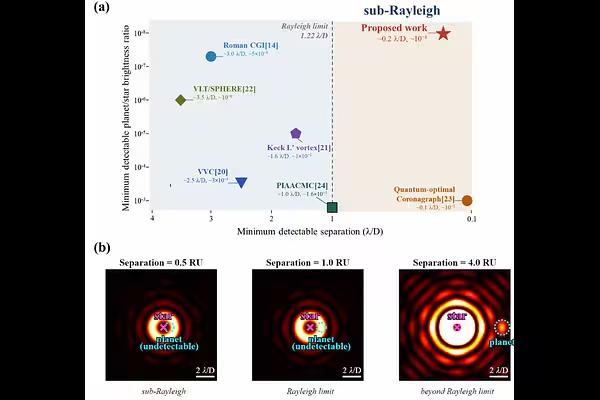
Researchers have put forward a theoretical framework that could let quantum mechanics boost the hunt for Earth‑like worlds far beyond our solar system. The paper, posted on arXiv, proposes that quantum‑enhanced measurement techniques might one day reveal the faint glow of distant planets that current telescopes struggle to detect.
Quantum‑Inspired Strategies for Spotting Remote Planets
Locating a true Earth analogue remains one of astronomy’s toughest quests. Although surveys have catalogued thousands of exoplanets, teasing out a rocky planet that resides in its star’s habitable zone and reflects enough light to be discernible is extremely difficult. The glare from a host star overwhelms the weak signal of a small, potentially habitable world, pushing the limits of even the most powerful observatories.
The new study examines whether quantum measurement concepts can sharpen the way astronomers collect and interpret incoming photons. Rather than relying solely on larger mirrors, the authors suggest that quantum technologies could amplify sensitivity, allowing future instruments to pick up subtle patterns that encode atmospheric composition, surface conditions, and possible signs of habitability.
How Quantum Sensors May Transform Astronomical Observations
Conventional telescopes gather photons and process them through classical optics. Quantum sensing, by contrast, exploits the delicate properties of quantum systems to detect infinitesimal changes with unprecedented accuracy. This capability could make it possible to spot the minute dimming that occurs when a planet transits its star or to capture the faint reflection of starlight off an exoplanet’s atmosphere.
Such tiny variations carry clues about a planet’s chemistry and climate. While quantum devices are already reshaping fields like computing, secure communications, and precision metrology, extending these principles to space‑based instruments could open a window onto signals that are currently below detection thresholds.
The pursuit of habitable exoplanets demands ever‑more sensitive tools, because Earth‑sized bodies around distant stars emit only a faint whisper of information. Quantum‑enhanced sensors may become one piece of a broader technological mosaic that includes larger telescopes, artificial‑intelligence‑driven data analysis, and next‑generation detectors.
Overcoming the Hurdles to an Earth Twin
Identifying a planet that truly mirrors Earth involves more than size alone. Scientists must confirm the presence of an atmosphere, liquid water, stable temperatures, and a chemical environment conducive to life. Instruments such as the James Webb Space Telescope are already probing the atmospheres of distant worlds, yet the faint signatures of true Earth analogues remain elusive.
Future breakthroughs will likely hinge on a convergence of technologies: larger aperture telescopes, cutting‑edge detectors, sophisticated data‑processing algorithms, and novel sensing methods like the quantum approaches under investigation. By tapping into the fundamental behavior of matter and light, quantum research could lift the veil on planets that are presently lost in the glare of their stars.
Beyond engineering, the quest for another habitable world is a profound scientific endeavor that asks where humanity fits within the cosmos.
This article has been fact checked for accuracy, with information verified against reputable sources. Learn more about us and our editorial process.
Last reviewed on .
Article history
- Latest version
Reference(s)
- Choi, Hyunsoo. “Exoplanet Detection Using Adaptive Quantum-Optimal Measurement.” arXiv.org <https://arxiv.org/abs/2607.06931>.
Cite this page:
- Posted by Karan Das