Ancient Bronze Age Mound Revealed As The Site Of A Mysterious Roman Ritual Shrine
Excavations at a Suffolk burial mound reveal a rare sequence of history, from a Bronze Age tumulus to a Roman shrine and a mysterious medieval execution.
Archaeological investigations at a site known as Land East of Kings Warren have revealed a complex, multi-millennial history, tracing human activity from the Neolithic era through the medieval period. Excavated by Archaeology South-East in 2016 prior to residential construction, the site highlights how ancient populations consistently returned to the same landscape for significant cultural and ritual purposes.
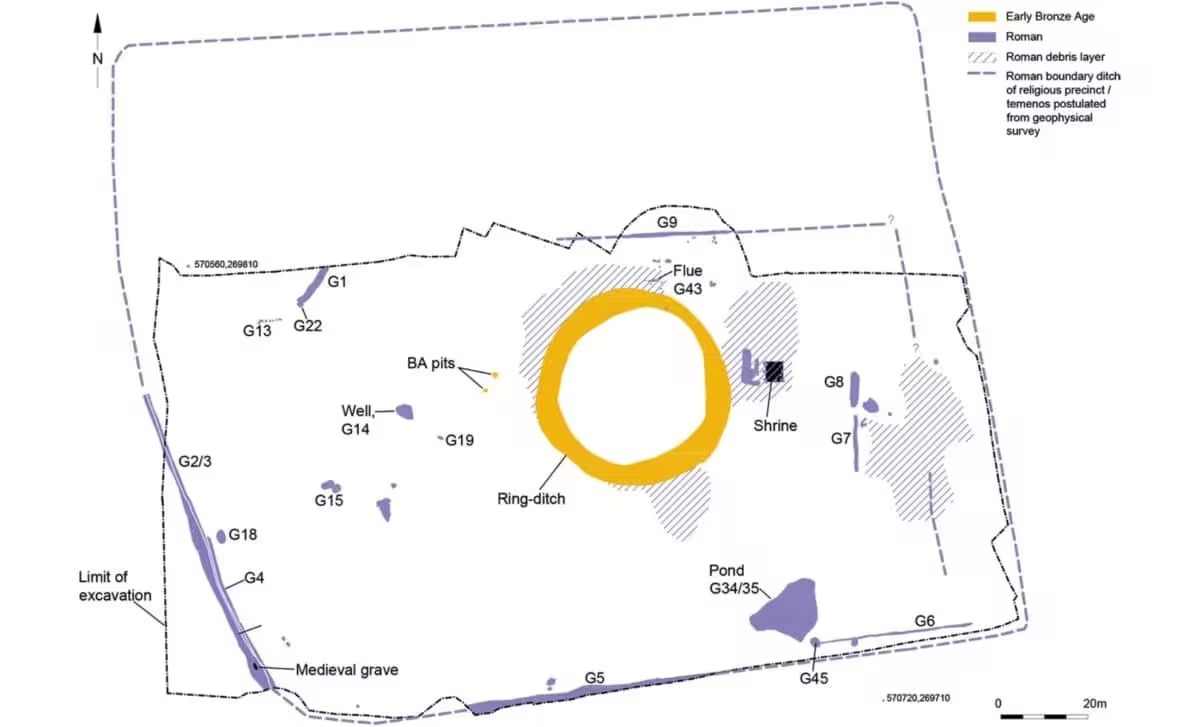
The site’s earliest monumental feature was a round barrow, evidenced by a surrounding ditch roughly 45 meters in diameter. While modern agricultural practices have largely leveled the mound, optically stimulated luminescence dating places the formation of the lower ditch fill between 2200 and 1600 B.C. Although no human remains were recovered from the barrow itself, the structure served as a prominent landmark that influenced later use of the terrain.
A Sacred Roman Precinct
Rather than replacing the prehistoric monument, Roman settlers integrated it into a larger religious complex. As detailed in a study by archaeologist Angus Forshaw published in Britannia, a rectangular enclosure, or temenos, was established around the barrow in the second century A.D. Spanning approximately 3.2 hectares, the site functioned as a dedicated religious space, marked by the absence of domestic infrastructure.
The precinct featured a small shrine measuring roughly 5 by 4.5 meters, situated just east of the barrow. Constructed from timber posts with wattle-and-daub walls and a tiled roof, the building was once adorned with vibrant interior decor; researchers recovered 48 kilograms of painted plaster in shades of red, white, pink, and green. Possible column placements suggest the internal layout included space for an altar.
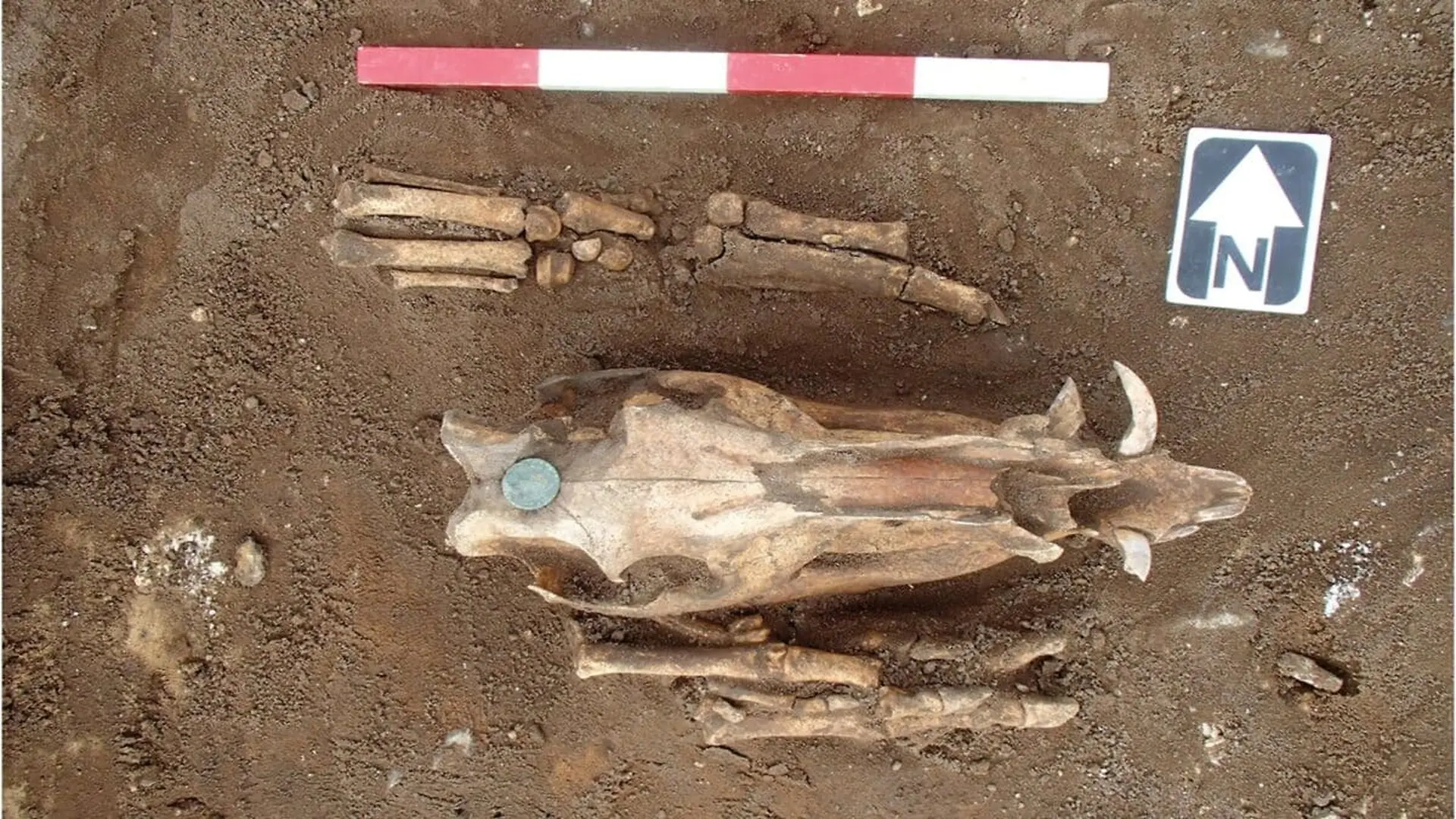
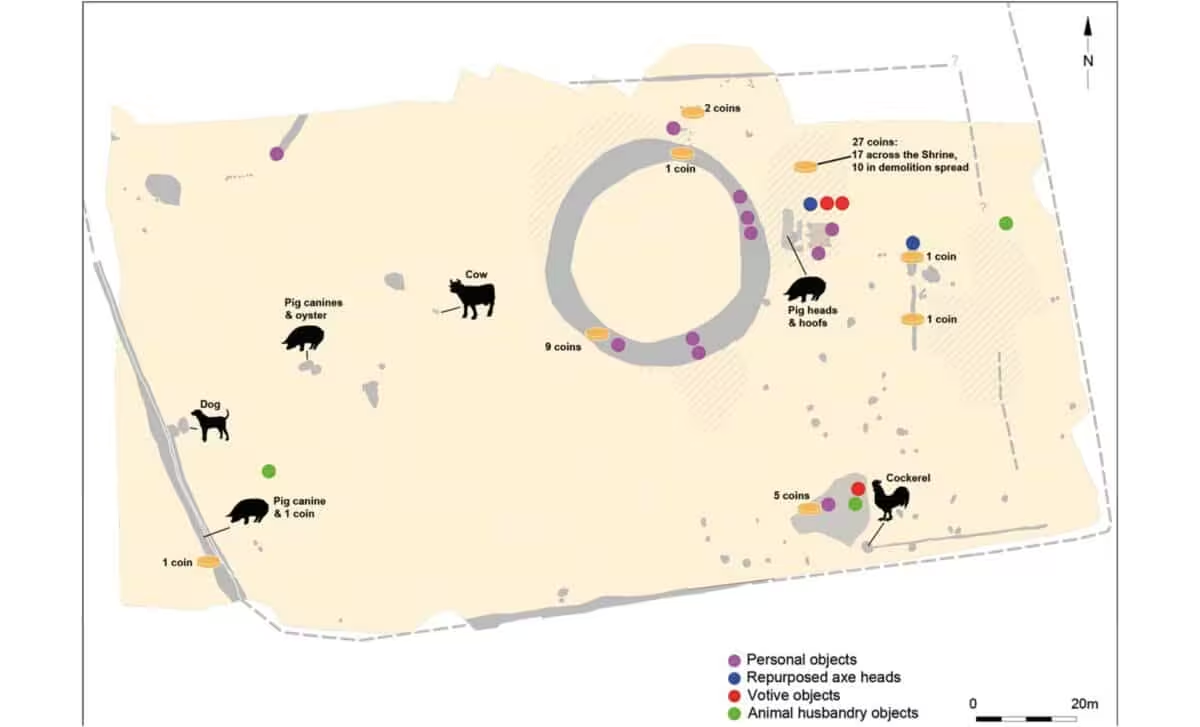
Ritual activity was deeply embedded in the site’s daily life. A series of pits west of the shrine contained pig skulls oriented toward the structure, some featuring Roman coins placed directly on the crania. Radiocarbon analysis indicates these offerings occurred intermittently between the first and fourth centuries A.D. The site also yielded evidence of other symbolic depositions, including a complete dog, a cow carcass, a cockerel, and various personal items such as brooches, bracelets, and votive plaques.
Medieval Echoes of the Past
By the fourth century, the Roman sanctuary appears to have gradually transitioned out of use, with no signs of violent destruction. The site remained significant, however, and in the medieval period, it became a site of finality for an adult male, aged 25 to 35, whose remains were discovered face-down in the fill of the ancient temenos ditch. Radiocarbon dating suggests the burial occurred between A.D. 1169 and 1266.
This burial aligns with historical records documenting a gallows in the vicinity during the 13th century, including legal agreements from 1238 concerning land boundaries between the Bishop of Rochester and the Abbot of St Edmunds. While the lack of skeletal trauma or physical structural remains makes a definitive link to the gallows impossible, the site demonstrates a clear, sustained human preference for this specific location, linking prehistoric funerary traditions to Roman religious practice and later medieval justice.
This article has been fact checked for accuracy, with information verified against reputable sources. Learn more about us and our editorial process.
Last reviewed on .
Article history
- Latest version
Reference(s)
- Forshaw, Angus. “A Reused Bronze Age Barrow and Roman Religious Shrine Site at Red Lodge, Suffolk | Britannia | Cambridge Core.”, October 14, 2307, pp. 1-31. Cambridge Core, doi: 10.1017/S0068113X26100841. <https://www.cambridge.org/core/journals/britannia/article/reused-bronze-age-barrow-and-roman-religious-shrine-site-at-red-lodge-suffolk/FB16F8A007E47E0F4967244E61FC163E>.
Cite this page:
- Posted by Hassan Raza