Nabta Playa: 7,000-Year-Old Stonehenge of the Sahara Linked to Ancient Star Alignments
Archaeologists investigate the mysterious Sahara stone arrangement, aiming to uncover its purpose and hidden secrets after millennia of concealment.
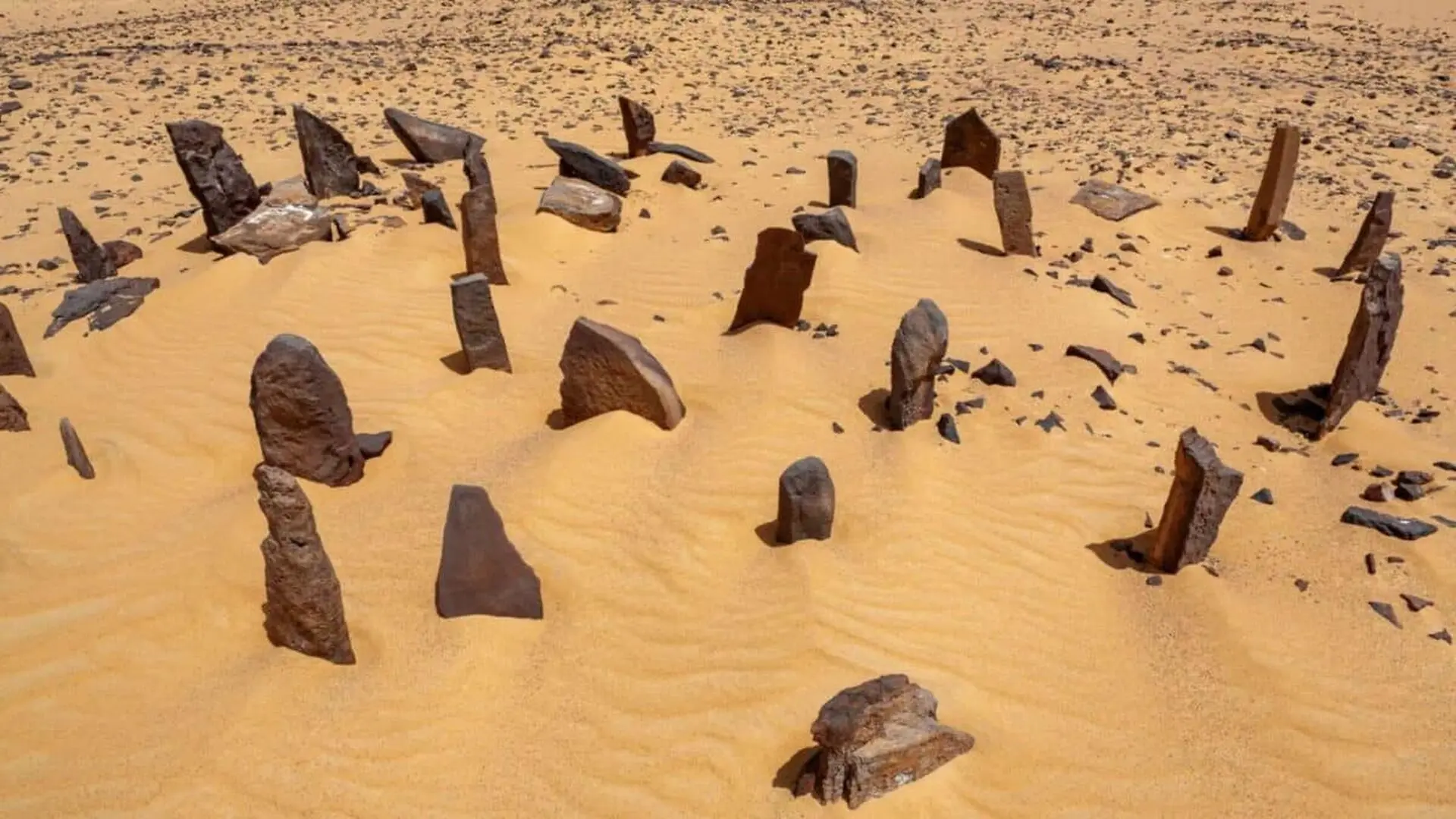
Around seven thousand years ago, peoples living in what is now Egypt’s western desert arranged a circle of stones that may have functioned as an early sky‑watching device, long before the construction of the pyramids.
During the Neolithic era the Sahara was not a barren sea of sand; it featured grasslands and lakes that supported small settlements, livestock herding, and the emergence of new subsistence strategies.
Archaeologists Fred Wendorf and Romuald Schild reported in ArcheoNil that communities occupied the western desert from the early Holocene until roughly 3000 BCE, when increasing aridity forced them to migrate.
Unearthing a Lost Oasis in the Prehistoric Sahara
Excavations revealed a suite of artifacts—stone implements, pottery shards, ornamental beads, decorated eggshell fragments, animal bones, and charred plant remains—together with hearth residues that attest to domestic activities.
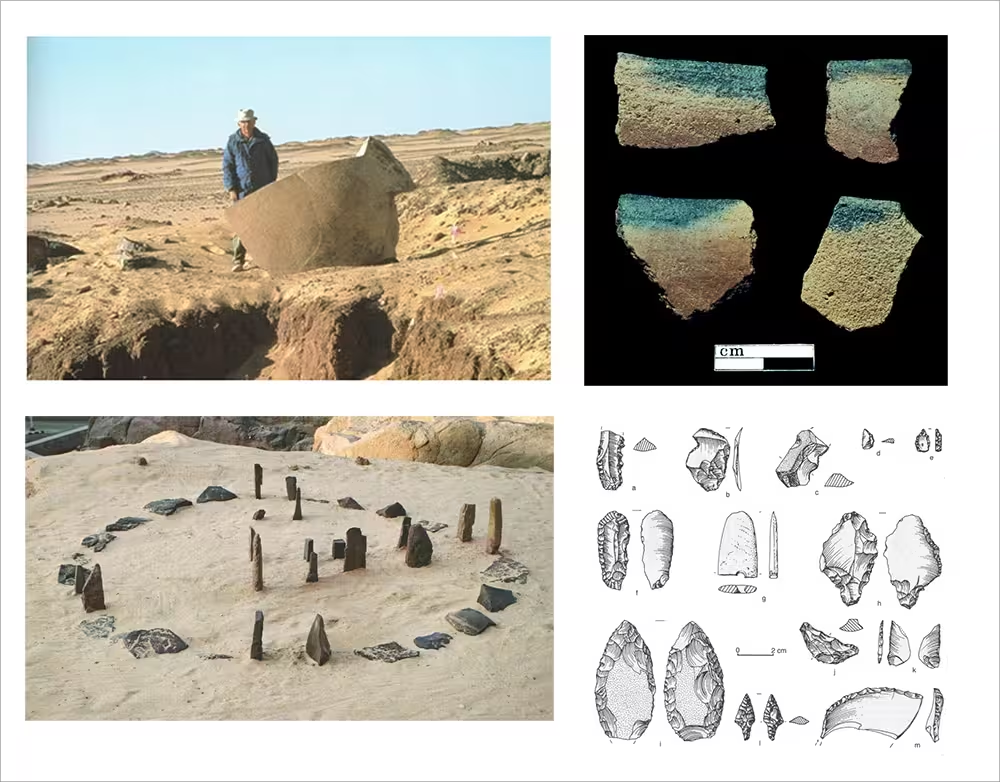
In 1973 a Bedouin guide led Wendorf’s team to a dry lakebed situated about 60 miles west of the Nile, where a cluster of large stones stood in an anomalous pattern. Initial impressions suggested natural formations, but subsequent analysis indicated deliberate placement, as the ancient lake’s waters would have eroded any accidental arrangement.
A Stone Circle Aligned with the Night Sky
Excavations carried out in the early 1990s uncovered a circular arrangement of standing stones whose orientations trace lines toward specific horizon points.
J. McKim Malville, a specialist in archaeoastronomy, described the monument as calibrated to bright stars and key moments of the solar calendar, earning it the nickname “Stonehenge of the Sahara.”
The layout appears to target celestial objects such as Sirius, Arcturus, the Alpha Centauri system, and Orion’s Belt. Although stellar positions shift over millennia, calculations show that the stones line up with the sky as it would have appeared when the monument was erected.
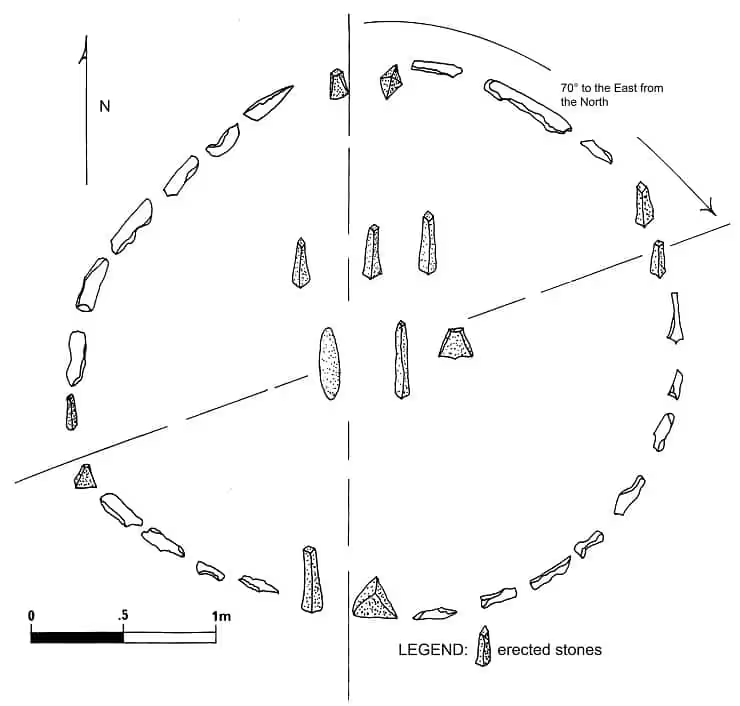
Beyond marking stellar positions, the circle may have served as a seasonal calendar. Reflections of the night sky on the waters of the former lake would have offered a visual cue for tracking rainfall cycles and other critical environmental changes.
Life on the Edge: Cattle, Rituals, and the Desert
The community associated with Nabta Playa is identified as the Ru’at El Baquar, a mobile group that placed cattle at the core of its religious and economic life. Excavated burial zones contain a prominent stone interpreted as a cow figure.
One interment yielded a complete bovine skeleton, indicating that the animal was likely sacrificed as part of a ceremonial rite.
“During much of that time […] people in the desert were domesticating cattle, making fine, decorated pottery and learning how to live in the desert year‑round,” stated Wendorf and archaeologist Romuald Schild.
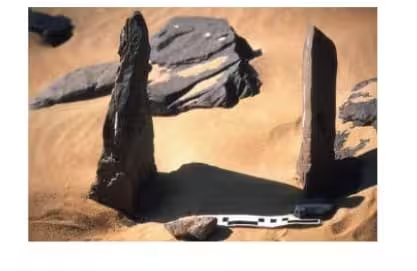
Malville’s 2015 study in the Handbook of Archaeoastronomy and Ethnoastronomy emphasizes that the full significance of the buried stones and their celestial connections remains only partially resolved.
This article has been fact checked for accuracy, with information verified against reputable sources. Learn more about us and our editorial process.
Last reviewed on .
Article history
- Latest version
Reference(s)
- Wendorf, Fred. “The Western Desert during the 5th and 4th millennia BC. The Late and Final Neolithic in the Nabta-Kiseiba Area.”, vol. 14, no. 1, January 1, 2004, pp. 13-30., doi: 10.3406/arnil.2004.1246. <https://www.persee.fr/doc/arnil_1161-0492_2004_num_14_1_1246>.
- <https://jmckimmalville.academia.edu/>.
- “CrowdSec Captcha.” <https://pcma.uw.edu.pl/en/2021/11/24/romuald-schild-1936-2021-2/>.
- <https://www.academia.edu/36832284/Astronomy_at_Nabta_Playa_Southern_Egypt>.
Cite this page:
- Posted by Aisha Ahmed