Giant Crater on Mars Moon Phobos May Reveal Its Hidden Origins
A massive crater on Mars’ moon Phobos may finally reveal if the mysterious satellite is a captured asteroid or debris from the Red Planet.

For decades, Phobos has remained one of the solar system’s most enigmatic bodies. As a small, irregularly shaped moon orbiting in close proximity to Mars, its origin remains a subject of intense scientific debate. Researchers are now looking to the moon’s own gravitational signature for answers, hoping that clues buried beneath its surface might finally clarify how this celestial object came to be.
Cracking the Code of the Stickney Impact
At the center of current investigative efforts is the massive Stickney Crater, which spans roughly 9 kilometers across the Martian moon. Because of its scale relative to Phobos, this impact feature is a prime candidate for holding evidence of the moon’s internal composition. A study published in 2026 in the Monthly Notices of the Royal Astronomical Society by researchers Benjamin Haser and Thomas Andert suggests that the violence of the Stickney impact likely compressed the material beneath the surface, leaving a detectable “density signature” that influences the moon’s local gravitational field.
The mystery of Phobos generally boils down to two competing theories: it was either a passing asteroid captured by Mars’ gravity, or it formed from a debris disc created by a massive collision on the Martian surface. Identifying its internal structure is key to resolving this dilemma, as each scenario suggests a different composition. Current models hint that the interior may be highly porous, potentially containing water ice and vast pockets of empty space.
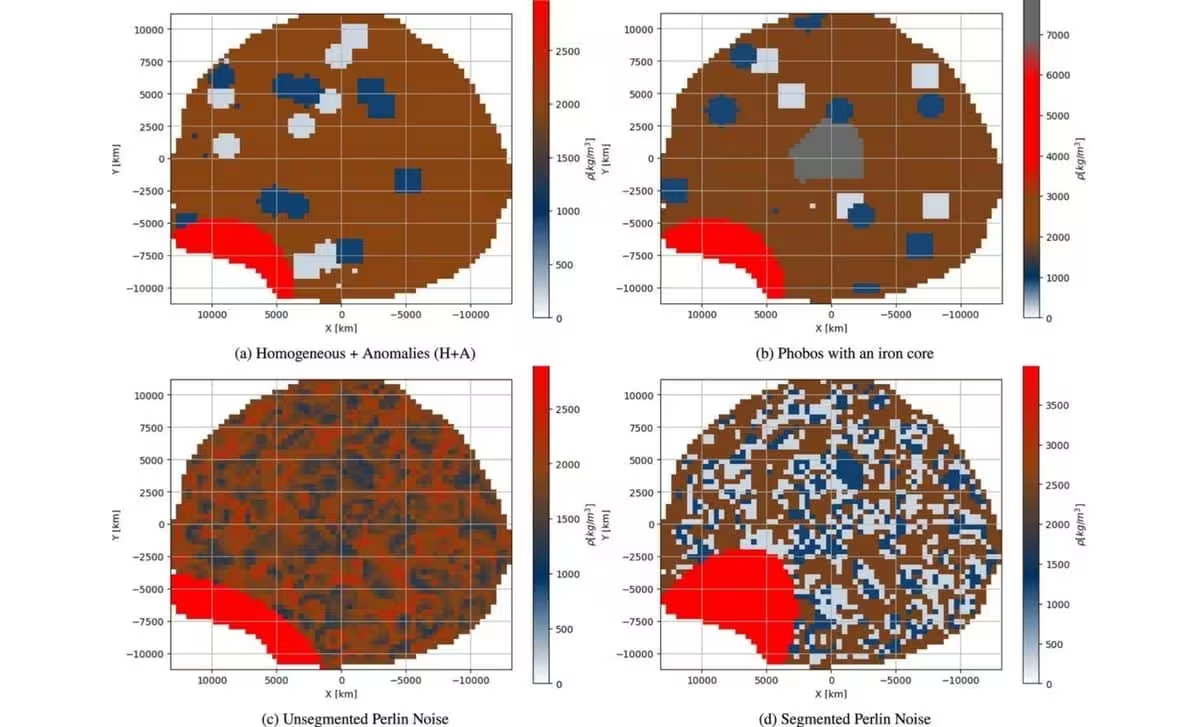
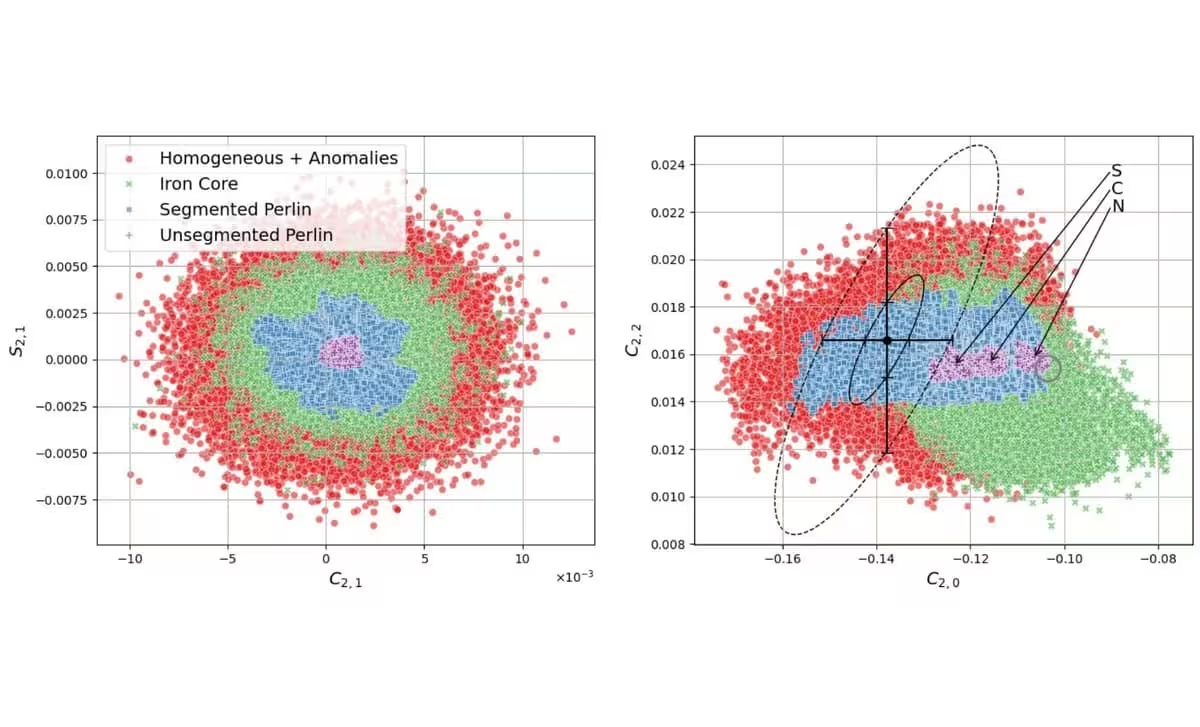
By simulating how shock-compressed materials—such as high-density minerals like coesite and stishovite—would alter the moon’s gravity, the researchers found that such a compressed zone could account for about 7 percent of the moon’s total volume. This finding provides a vital framework for linking surface geology to the moon’s hidden, internal state.
Future Missions to Provide Definitive Answers
While modeling provides a necessary bridge, direct physical evidence is on the horizon. The Japan Aerospace Exploration Agency (JAXA) is currently spearheading the Martian Moons Exploration (MMX) mission, which is specifically designed to bypass the limitations of remote sensing. The mission aims to retrieve pristine surface samples from Phobos and return them to Earth by 2031.
The spacecraft will utilize two specialized collection systems. One is designed to scoop material from the shallow subsurface, while the second, developed in collaboration with NASA, uses a pressurized gas mechanism to lift surface particles into a containment vessel. These samples will allow scientists to analyze the moon’s material in a laboratory setting, offering a definitive look at its mineralogy.
Measuring the gravity of Phobos is notoriously difficult, as the moon is constantly subject to the overwhelming gravitational influence of Mars. Furthermore, the moon is in a state of terminal orbital decay, slowly spiraling toward the planet in a process that will eventually lead to its destruction. Because of this, Phobos acts as a time capsule, preserving a record of ancient planetary interactions while it simultaneously moves toward its own end. Whether it is an captured asteroid or a remnant of a massive Martian collision, the answers are finally within our reach.
This article has been fact checked for accuracy, with information verified against reputable sources. Learn more about us and our editorial process.
Last reviewed on .
Article history
- Latest version
Cite this page:
- Posted by Karan Das