Ancient Mountain Ridges Reveal Charon’s Spin Slowed by Tidal Forces Over Billions of Years
New study examines Pluto’s largest moon’s ancient past, using its pristine surface to uncover what happened billions of years ago.

A fresh analysis of Charon, Pluto’s largest satellite, indicates that the moon retains a record of a primordial process that gradually slowed its spin. By scrutinizing the mountain ridges that dominate the northern hemisphere, scientists have uncovered clues that could illuminate the moon’s early geological evolution.
Because Charon’s surface appears to have remained largely unchanged for roughly four billion years, it offers a rare laboratory for detecting ancient tectonic signatures that have vanished on more active icy worlds. The new work focuses on tidal despinning—a mechanism whereby gravitational interactions steadily reduce a body’s rotation rate—and suggests that traces of this slowdown are still etched into the moon’s crust.
Compression Marks in Oz Terra Reveal Unexpected Tectonics
The investigation, led by Dr. Hanzhang Chen of UCLA and ETH Zurich, targeted Oz Terra, a sprawling region in Charon’s northern highlands. Within this area, the team measured mountain chains extending more than 200 kilometers and discovered ridges with uneven slopes that point toward compressional stress rather than the previously assumed extensional faulting.
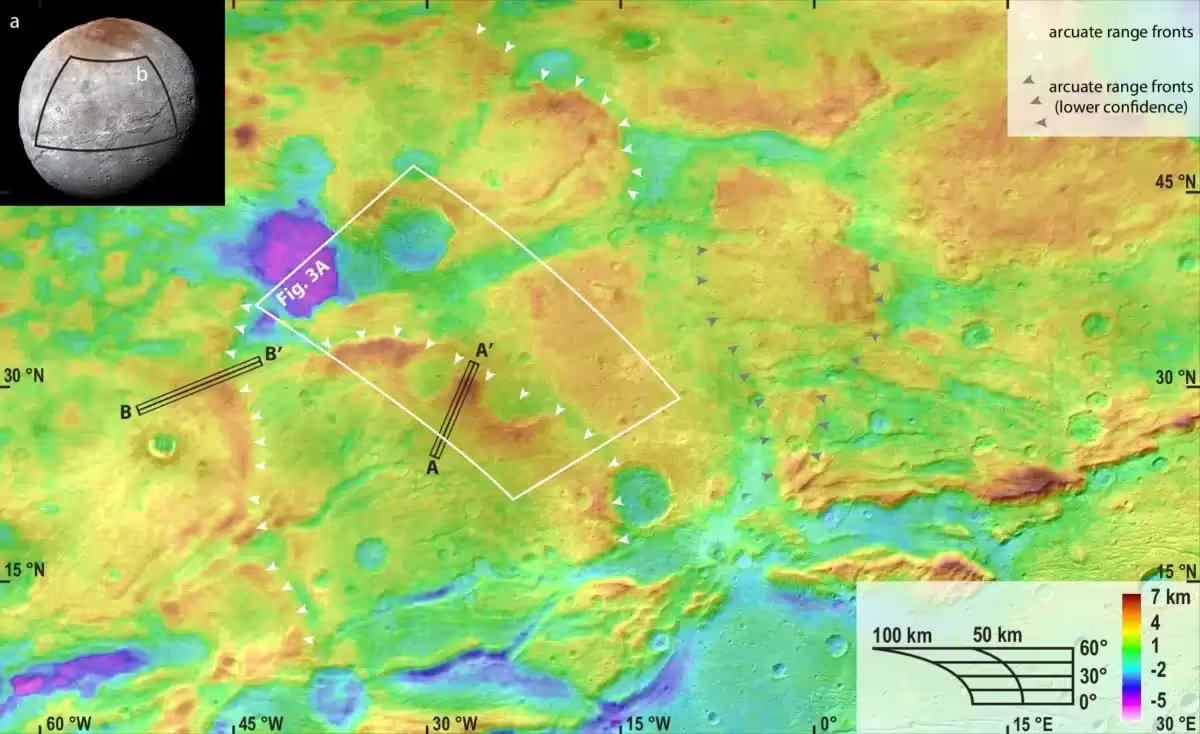
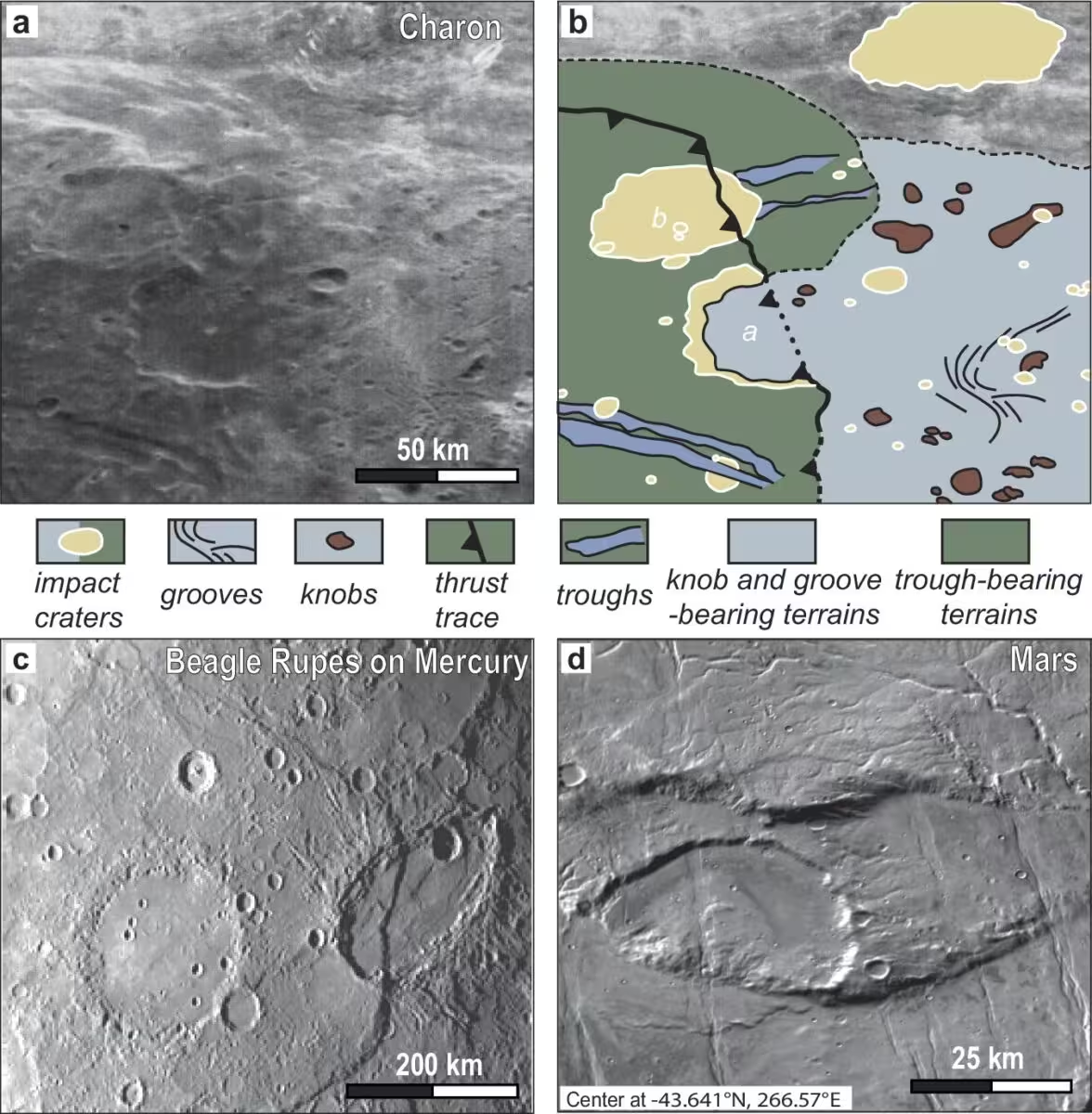
Published on July 14 2026 in Nature Communications, the paper proposes that these ridges formed as sections of Charon’s crust contracted by about 1 percent, forcing pre‑existing faults to absorb the compressional strain. This interpretation contrasts with earlier models that emphasized a globally extensional regime driven by cryovolcanic activity.
“Charon exhibits a topographic dichotomy of rugged northern highlands and smoother southern plains,” Dr. Chen explained. “Previous studies proposed that Charon has undergone global extension accompanied by cryovolcanism.”
Early Rapid Rotation Followed by Long‑Term Despinning
To test the tectonic scenario, the researchers paired field observations with numerical simulations of Charon’s interior. The models indicate that, at the time the ridges formed, the moon possessed an ice shell 30–36 kilometers thick. Simultaneously, the equatorial crust shortened, concentrating compressive forces along the established fault network.
The simulations also suggest that Charon rotated once every 14.3 hours during its youth—a stark contrast to the present 153.3‑hour period, which matches its orbital period around Pluto due to tidal locking. The pronounced slowdown supports a prolonged episode of tidal despinning that gradually erased the moon’s rapid spin.
Cold Early Conditions Shape Charon’s Evolution
The combined evidence of global contraction and rotational deceleration points to a scenario in which Charon began its history relatively cold, allowing a thick, rigid ice shell to develop early on. This thermal environment would have facilitated the observed compressional tectonics without invoking widespread cryovolcanism.
“Our work suggests that Charon’s surface presents an example that records the planetary despinning history, which predates the proposed global extension and cryovolcanism on Charon,” the authors state.
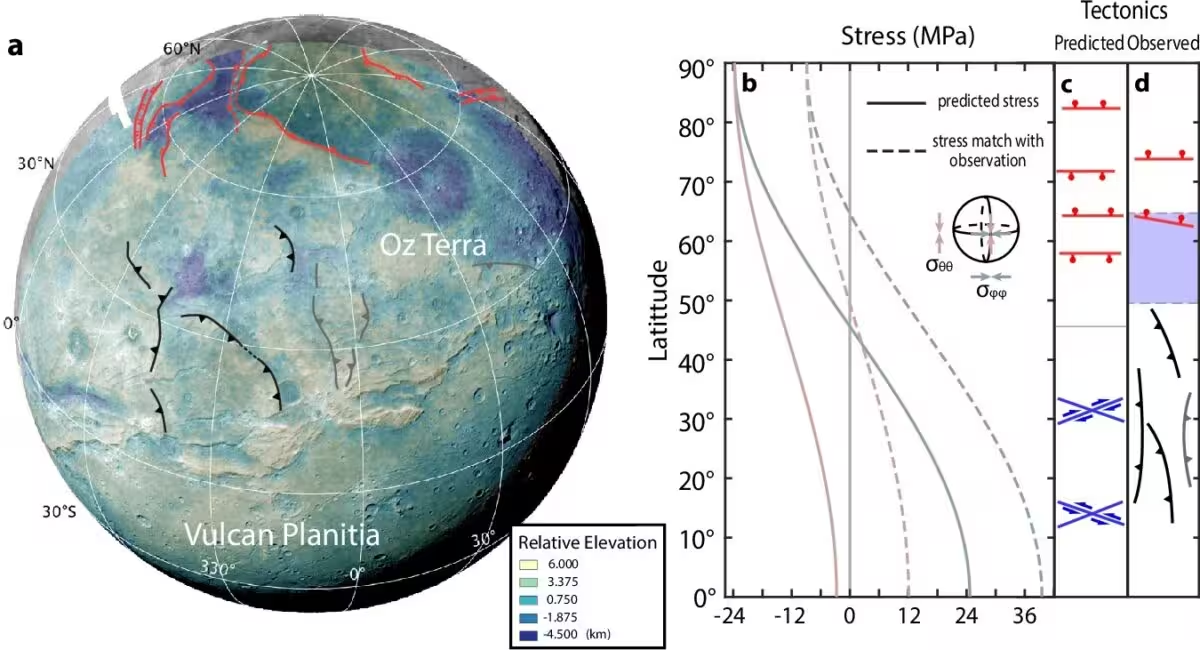
Together, the contraction and despinning signatures reinforce the notion of a chilly inception for this icy satellite and provide a clearer framework for interpreting the early development of outer‑solar‑system moons.
This article has been fact checked for accuracy, with information verified against reputable sources. Learn more about us and our editorial process.
Last reviewed on .
Article history
- Latest version
Reference(s)
- “Dr. Hanzhang Chen | ETH Zurich.” <https://eaps.ethz.ch/en/people/profile.hanzhang-chen.html>.
- Chen, Hanzhang. “Early tidal despinning history recorded in the tectonics of Oz Terra, Charon - Nature Communications.”, vol. 17, no. 1, July 14, 2026, pp. 5978 Nature, doi: 10.1038/s41467-026-75069-7. <https://www.nature.com/articles/s41467-026-75069-7>.
Cite this page:
- Posted by Karan Das