Soviet Venera 13 Survived 465°C Heat on Venus, Sending Color Images for 127 Minutes
Venera 13 survived Venus’s crushing heat and pressure far beyond its 32‑minute design, transmitting data long after the surface threatened to crush it.
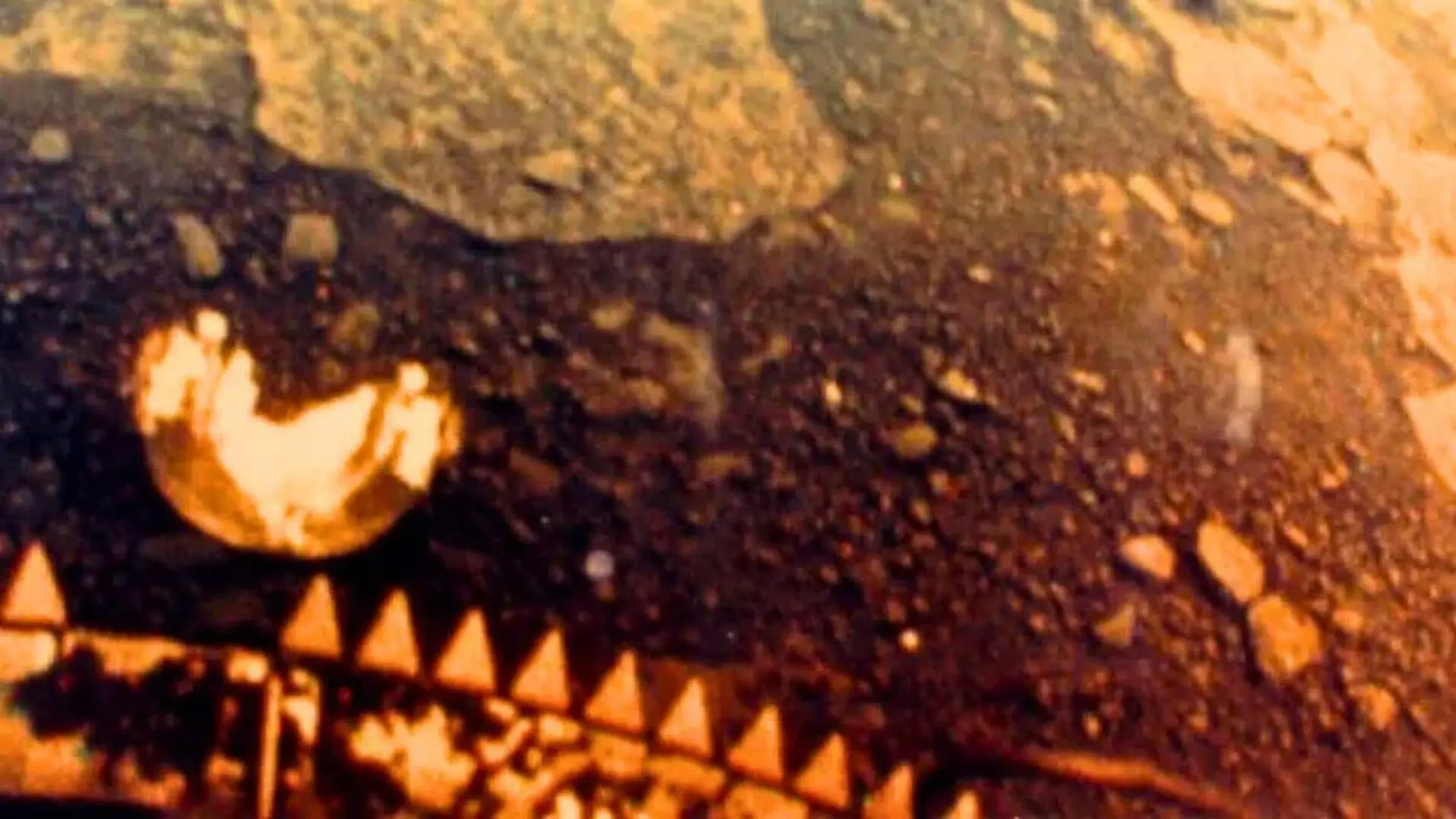
When the Soviet Venera 13 lander touched down on Venus on 1 March 1982, engineers had anticipated only about thirty minutes of activity. Defying those expectations, the probe continued to beam data for more than two hours, delivering images, atmospheric readings, and a drilled rock sample before contact was lost.
The vehicle was originally built for a surface lifespan of 32 minutes; NASA later noted that its actual performance “far exceeded the planned 32‑minute limit.”
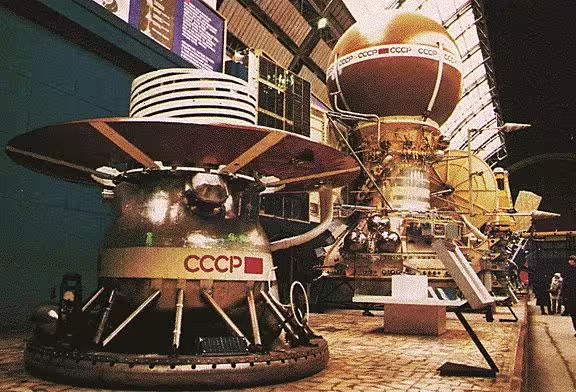
Launched aboard a Proton rocket on 30 October 1981, Venera 13 separated from its carrier on 27 February 1982 and entered the Venusian atmosphere for an approximately one‑hour descent. It came to rest at 03:57:21 UT near 7.5° S latitude and 303° E longitude.
Descent through Venus’s thick atmosphere
The lander’s core was a sealed pressure vessel designed to shield its electronics and scientific payload from the planet’s extreme environment. According to the Lunar and Planetary Institute mission summary, the suite included color cameras, a spectrometer, a drill‑sampler, a penetrometer and a seismometer.
During entry, a parachute slowed the probe until it reached an altitude of roughly 47 km, after which the parachute was jettisoned and aerodynamic drag carried the craft the rest of the way to the surface.
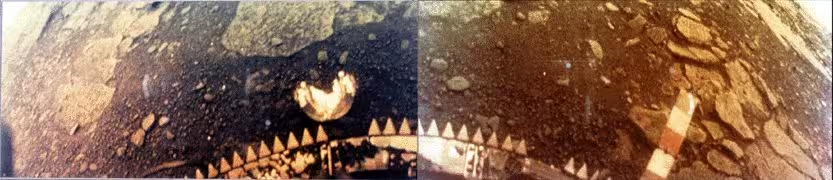
The touchdown point lay just east of Phoebe Regio, on a platform of exposed bedrock fringed by dark, fine‑grained material. Once settled, the lander relayed measurements and images to the orbiting bus, which beamed the data back to Earth.
Despite confronting temperatures and pressures that imposed severe thermal and mechanical stress, Venera 13 kept transmitting for 127 minutes.
First color snapshots of a Venusian landscape
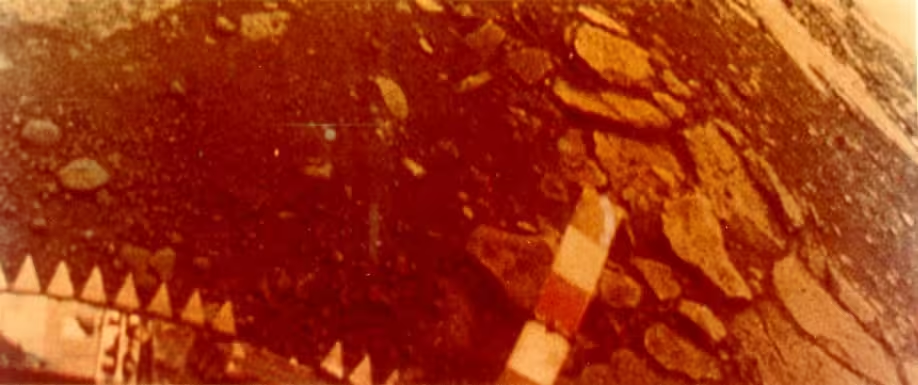
Among the mission’s most celebrated achievements were the inaugural color photographs of Venus’s surface. Earlier Venera 11 and Venera 12 attempts had not produced comparable color data. Venera 13’s camera system employed red, green, and blue filters to construct true‑color views.
NASA archives list eight panoramic mosaics that reveal orange‑brown angular rocks and loose surface material. The Lunar and Planetary Institute also records eight panoramas, together offering a near‑complete color perspective around the probe.
A Space.com article reports a different tally—14 color pictures and eight black‑and‑white frames—reflecting whether individual frames or stitched panoramas are counted.
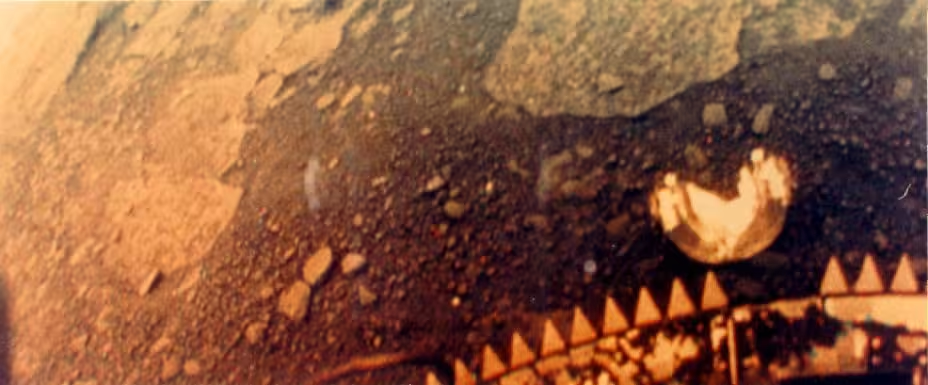
A contemporaneous report in Science News (March 1982) described the site as “smooth but broken, topped around the lander itself by abundant debris of various sizes.”
Interpreting the hue proved challenging because Venus’s dense cloud deck filters out much of the blue spectrum before it reaches the ground, complicating true‑color assessments.
The camera system could resolve objects only a few millimetres across when focused on nearby rocks and parts of the spacecraft.
Drilling, sampling, and chemical analysis
Beyond imaging, Venera 13 deployed a mechanical drill that penetrated the regolith, retrieved a sample, and transferred it to a sealed analysis chamber.
Inside the chamber—maintained at roughly 30 °C and 0.05 atm—the onboard X‑ray fluorescence spectrometer measured the sample’s elemental composition, as detailed in the LPI report.
NASA characterized the rock as resembling terrestrial leucitic basalt, notable for its high potassium content. The Lunar and Planetary Institute offered a slightly different geological classification, grouping the material among weakly differentiated melanocratic alkaline gabbroids.
A separate experiment evaluated the mechanical properties of the surface. NASA’s assessment stated that the results were consistent with compacted ash, akin to volcanic tuff.
In sum, the lander photographed, drilled, and tested the same spot, delivering a comprehensive dataset within its 127‑minute operational window.
Variations in reported temperature and pressure
Published mission summaries differ slightly on the exact surface conditions. NASA’s Deep Space Chronicle cites a temperature of 465 °C and a pressure of 89.5 atmospheres, while the Lunar and Planetary Institute lists 457 °C and 84 atmospheres.
Both sources agree that Venera 13 transmitted for 127 minutes after touchdown. Its near‑twin, Venera 14, launched five days later, reached the surface, and operated for 57 minutes, considerably shorter than Venera 13’s two‑hour span.
This article has been fact checked for accuracy, with information verified against reputable sources. Learn more about us and our editorial process.
Last reviewed on .
Article history
- Latest version
Reference(s)
- “Russian Plan Miss.” <https://www.lpi.usra.edu/vexag/russian_plan_miss.pdf>.
- “Sp 4524.” <https://www.nasa.gov/wp-content/uploads/2023/04/sp-4524.pdf>.
Cite this page:
- Posted by Karan Das