Astronomers Spot a Supernova Shock Breakout 500 Million Light‑Years Away in Real Time
Astronomers observed a star’s first X‑ray flash and, within an hour, its explosion 500 million light‑years away.
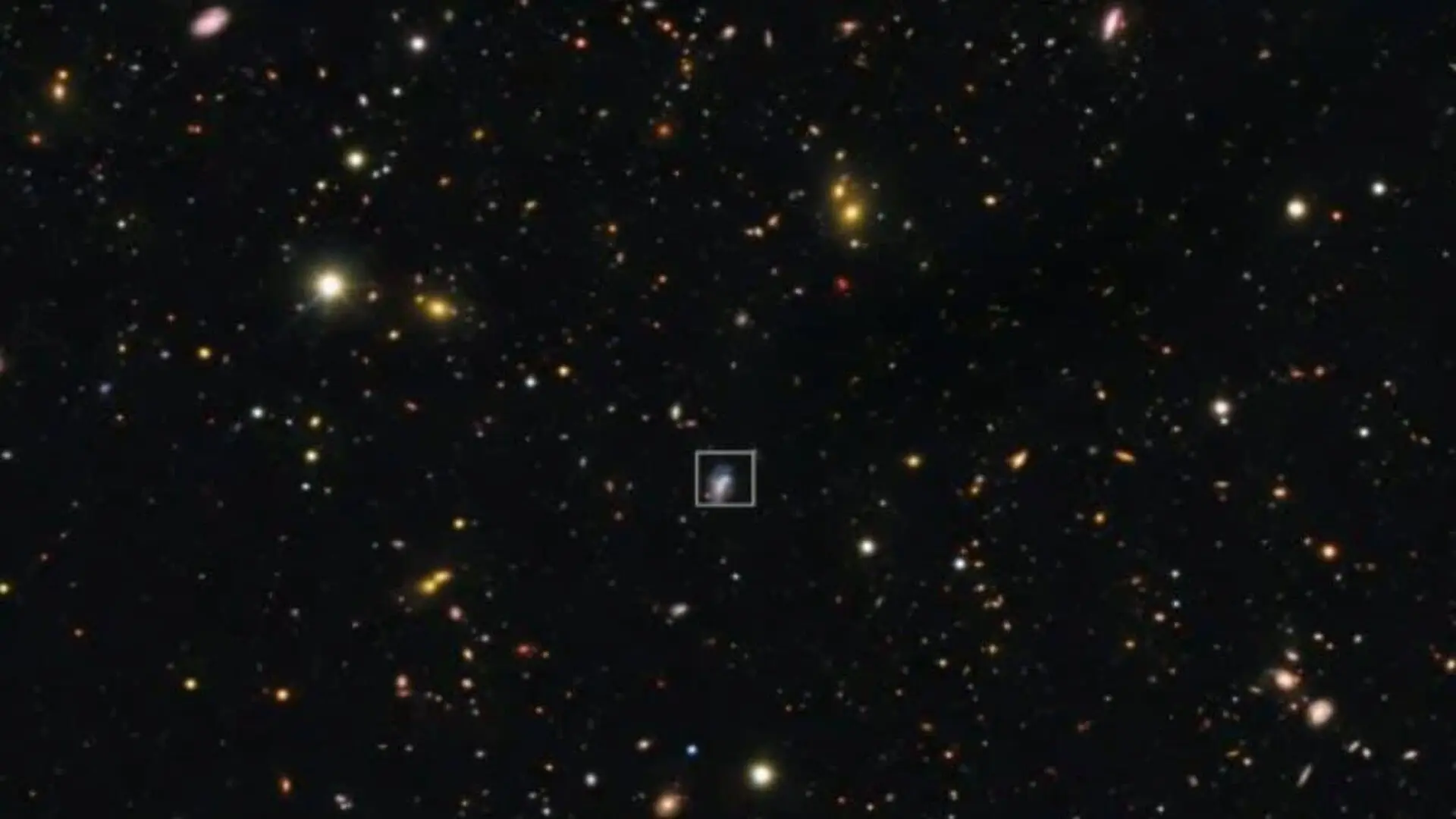
On March 21, 2026, an X‑ray burst recorded by the Einstein Probe marked the emergence of a supernova roughly 500 million light‑years from Earth, giving researchers an unprecedented window into the moment a massive star begins to explode.
X‑ray Pulse Signals the First Light of SN 2026gzf
The transient, labeled EP260321a, was a brief soft‑X‑ray flash that arrived just before ground‑based observatories began monitoring a rapidly brightening point of light in the same sky region. Such early detections are rare because the shock‑breakout phase typically lasts only seconds to a few hours, after which the supernova dominates the emission for weeks.
Analysis by two independent groups—one led by Brendan O’Connor at Carnegie Mellon University and the other by Jillian Rastinejad of the University of Maryland, College Park—converged on the interpretation that the X‑ray signal represented the shock breakout, the first burst of radiation released when the explosion’s shock wave reaches the outer layers of the star.
According to a report from NSF NOIRLab, only one other X‑ray shock breakout has been firmly identified in the past twenty years, underscoring the rarity of the observation.
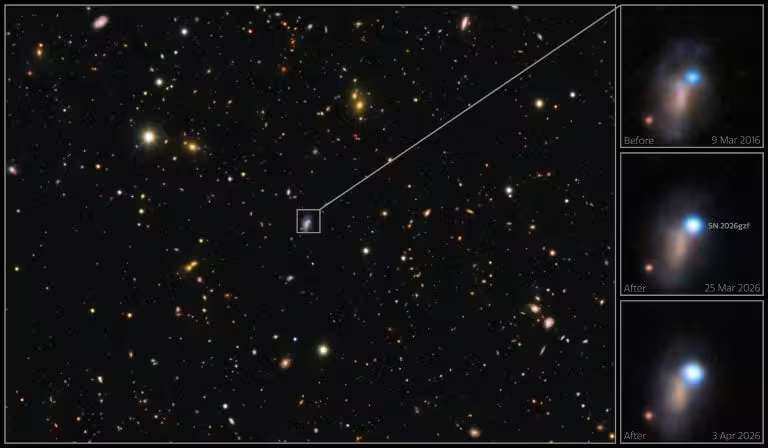
A Broad‑Lined Type Ic Explosion Without a Gamma‑Ray Burst
Subsequent spectroscopy identified the event as a broad‑lined Type Ic (Ic‑BL) supernova, a class that lacks both hydrogen and helium envelopes and exhibits extremely wide spectral features due to high‑velocity ejecta. While many Ic‑BL supernovae are accompanied by gamma‑ray bursts (GRBs) and relativistic jets, SN 2026gzf showed no evidence of a GRB, jet, or lingering afterglow.
“SN 2026gzf looks remarkably similar to other energetic supernovae that have been previously linked to gamma‑ray bursts,” O’Connor explained. “But even sensitive multi‑wavelength observations failed to uncover evidence for the relativistic jet typically seen in those events.”
The X‑ray flash was also noted as the faintest shock‑breakout associated with an Ic‑BL supernova, prompting O’Connor to propose a “choked” jet scenario—where a jet initiates inside the star but is halted before breaking free.
Reconstructing the Star’s Final Decades
Rastinejad’s team concluded that the progenitor was a Wolf‑Rayet star born with roughly twenty times the Sun’s mass. In the centuries preceding collapse, the star experienced irregular mass‑loss episodes that stripped away its outer hydrogen and helium layers, leaving a core dominated by carbon and oxygen.
The expelled material lingered near the star, forming at least two distinct shells: an inner, relatively low‑mass shell linked to the initial X‑ray shock breakout, and a larger, asymmetric shell that later interacted with the expanding supernova ejecta, boosting the optical brightness.
“With this information we were able to map out the structure of the material surrounding the star and understand the star’s violent lifestyle before it collapsed,” Rastinejad said.
Archival DECam observations taken about ten years before the explosion reveal a bright blue source at the same coordinates, likely representing a compact, intense star‑forming region combined with pre‑supernova activity from the progenitor.
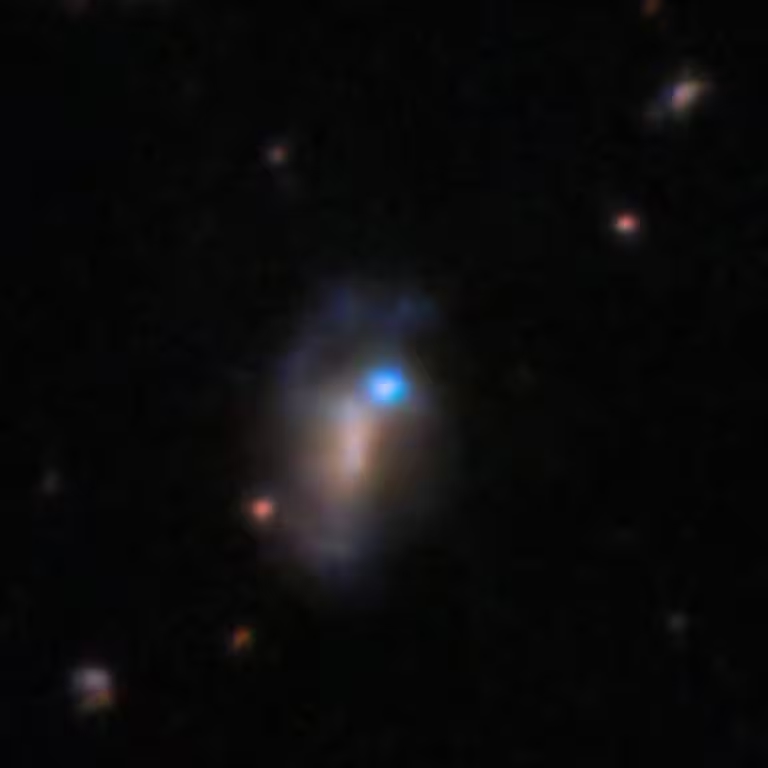
SN 2026gzf therefore offers a comprehensive case study, linking the earliest X‑ray signature to the subsequent multi‑wavelength evolution and providing a detailed glimpse of the star’s pre‑death environment.
This article has been fact checked for accuracy, with information verified against reputable sources. Learn more about us and our editorial process.
Last reviewed on .
Article history
- Latest version
Reference(s)
- “2026gzf | Transient Name Server.” <https://www.wis-tns.org/object/2026gzf>.
Cite this page:
- Posted by Karan Das