The Medieval Forgery That Reshaped Church Power for Centuries
The Donation of Constantine was a forged document that granted the pope immense power for centuries. Discover how scholars finally exposed the deception.
For centuries, the medieval Roman Church wielded a document of immense political leverage: the Donatio Constantini, or the Donation of Constantine. This text claimed that in the fourth century, Emperor Constantine I, in gratitude for being miraculously cured of leprosy by Pope Sylvester I, had transferred supreme political and ecclesiastical authority over the Western Roman Empire to the papacy. It was a narrative of grand surrender, positioning the Church as the legal heir to imperial power.
While the document was a complete fabrication, it successfully exploited a genuine historical foundation. Constantine was indeed a pivotal benefactor of Christianity, bestowing wealth, land, and unprecedented social status upon the burgeoning faith. By weaving this historical reality into a dramatic, fictionalized account, the authors of the Donation created a powerful instrument that allowed the Church to claim territorial and jurisdictional control far beyond what Constantine ever actually granted.
An Imperial Mandate Built on Fiction
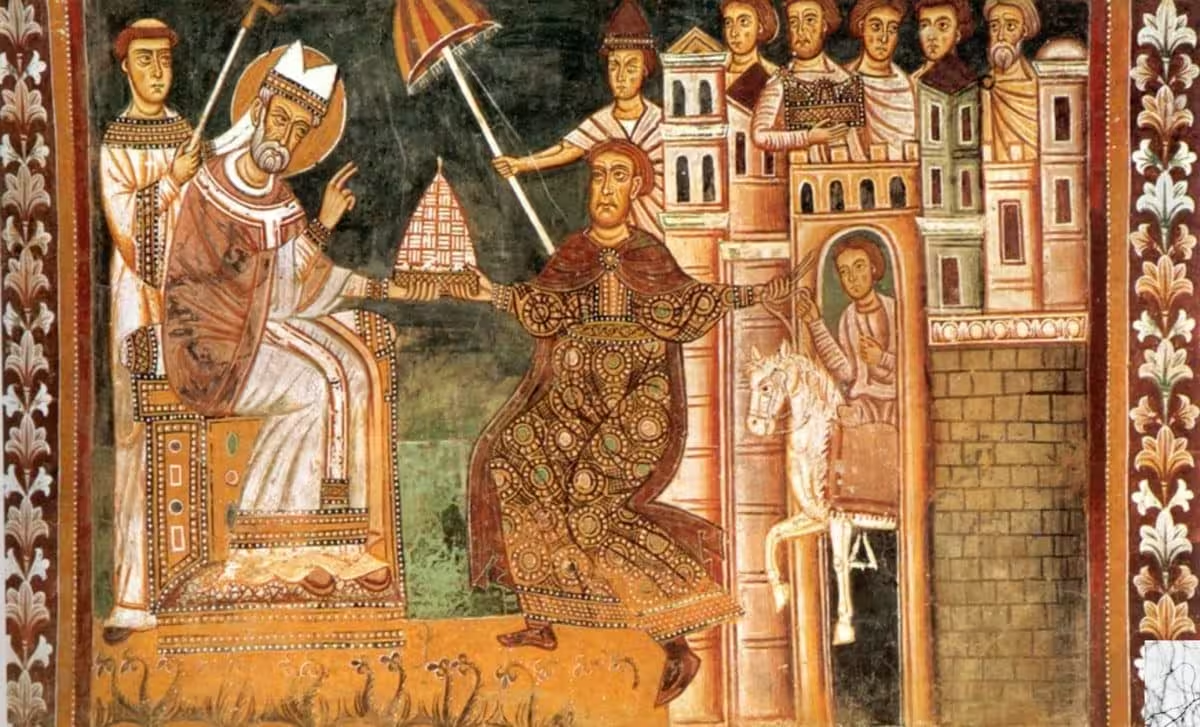
The narrative of the Donation was closely intertwined with the Acts of St. Sylvester, which detailed the emperor’s baptism and subsequent health recovery. This tale eventually permeated Renaissance art, where frescoes in Rome depicted Constantine offering the imperial tiara to the pope as a symbol of his transfer of temporal authority.
As noted by Popular Mechanics, the scope of the document’s claims was vast. It effectively granted the papacy dominion over Rome and the entirety of the Italian peninsula, while asserting religious supremacy over a geographic swathe stretching from Greece through Judea to Africa. For Church officials navigating a landscape of shifting political alliances, the document served as a convenient, all-encompassing legal defense.
The primary flaw in the narrative, however, was its physical evidence. There is no trace of a fourth-century original. The oldest versions available trace back only to ninth-century Frankish manuscripts, leaving a glaring gap between the purported imperial decree and its actual appearance in the historical record.
A Strategic Tool in Ecclesiastical Disputes
For centuries, the discrepancy did not diminish the document’s utility. At least 10 popes leveraged the text to assert their authority in regional and international conflicts. The first documented instance occurred in 778, when Pope Adrian I reportedly alluded to the Donation to encourage Charlemagne to hand over specific territories to the Church.
By the time the East-West Schism fractured Christendom in 1054, Pope Leo IX explicitly invoked the Donation as historical proof of Roman primacy over the Eastern Church. Because the text provided a claim of such significant reach—covering everything from land ownership to ecclesiastical jurisdiction—it remained a standard piece of evidence in the medieval political toolkit.
Deconstructing the Deception
Skepticism did not appear overnight. While Dante Alighieri famously lamented the repercussions of the Donation in his Inferno, his criticism was aimed at the corrupting influence of Church wealth rather than the authenticity of the text itself. In 1433, Nicholas of Cusa formally argued that the document was a fabrication, though his findings failed to gain widespread traction.
The definitive exposure arrived in 1440, courtesy of the Italian humanist Lorenzo Valla. Serving as secretary to King Alfonso of Aragon, who was then embroiled in a territorial dispute with Pope Eugenius IV, Valla applied a rigorous philological analysis to the text. He demonstrated that the Latin used in the document was consistent with a much later era, making it impossible for the text to have originated in the fourth century.
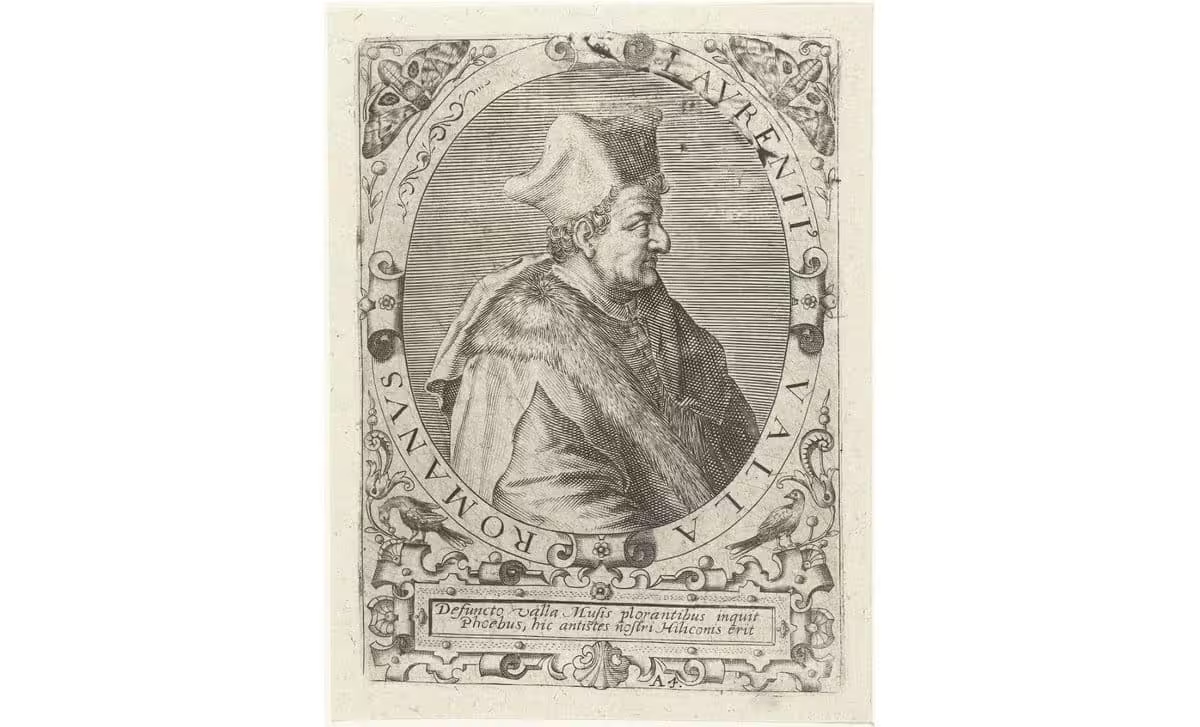
Valla’s work, along with similar critiques from contemporaries like Reginald Pecock, eventually eroded the document’s credibility. By the late 16th century, even within the Vatican, Church historian Cardinal Cesare Baronio conceded in his Annales Ecclesiastici that the document was a forgery. While the mystery of the original author remains unsolved, the Donation of Constantine stands as one of history’s most successful and enduring political ruses.
This article has been fact checked for accuracy, with information verified against reputable sources. Learn more about us and our editorial process.
Last reviewed on .
Article history
- Latest version
Reference(s)
- <https://portal.sds.ox.ac.uk/articles/online_resource/E03229_The_Acts_of_Sylvester_bishop_of_Rome_00397_are_written_in_Latin_in_a_number_of_versions_the_earliest_by_the_5th_c_They_narrate_episodes_of_the_life_of_Sylvester_in_particular_highlighting_his_role_in_the_conversion_and_baptism_of_the/13832693>.
- “Constantine the Great: The First Christian Roman Emperor?.” <https://smithsonianassociates.org/ticketing/programs/constantine-great>.
- Rayne, Elizabeth. “A Single Document Created One of the World’s Greatest Empires. It Was a Forgery..”, October 5, 2026 Popular Mechanics <https://www.popularmechanics.com/science/a73974644/medieval-forgery-donation-constantine/>.
- “Consultation.” <https://archivesetmanuscrits.bnf.fr/ark:/12148/cc60559t>.
- “Dante and the Donation of Constantine: Santi Quattro Coronati, Rome.”, October 8, 2015 Dante's Library <https://sites.duke.edu/danteslibrary/dante-and-the-donation-of-constantine-quattro-coronati-rome/>.
- “Introductory.” <https://history.hanover.edu/texts/vallaintro.html>.
Cite this page:
- Posted by Zara Tariq