Mathematicians Solve Century‑Old 3D Kakeya Puzzle, Unlocking New Horizons in Harmonic Analysis
Two mathematicians solve the 3D Kakeya conjecture after 50 years, a breakthrough hailed as a once‑in‑a‑century discovery.

Picture a pencil suspended in mid‑air and spun so that it points toward every possible orientation, while the region it sweeps out remains as compact as possible. This intuitive picture captures the essence of the three‑dimensional Kakeya conjecture, a question that has defied a definitive answer for fifty years. In March 2025, a pair of researchers released a proof that finally settles the issue.
Hong Wang of NYU’s Courant Institute and Joshua Zahl of the University of British Columbia posted their solution to the three‑dimensional Kakeya problem on arXiv, establishing a sharp lower limit on the minimal volume a rotating needle can occupy. Nets Katz of Rice University summed up the achievement succinctly: “It’s a once‑in‑a‑century kind of result.”
From a Desk‑Top Puzzle to a High‑Dimensional Challenge
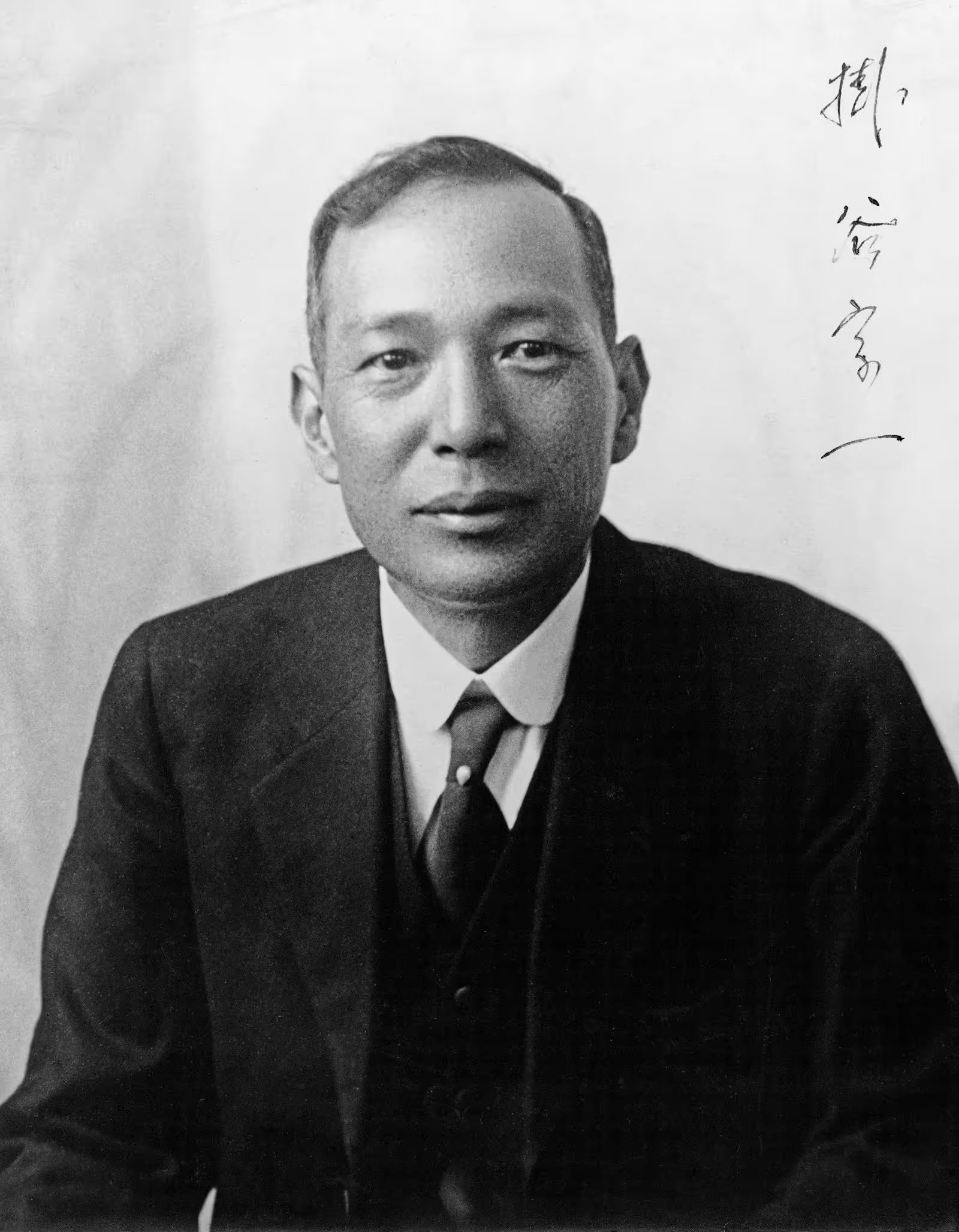
The problem traces back to Japanese mathematician Sōichi Kakeya, who in 1917 asked how small an area an infinitesimally thin needle must cover while turning through every direction on a plane. Two years later, Abram Besicovitch demonstrated that, by arranging a sequence of increasingly narrow turns, the covered area can be made arbitrarily close to zero.

The two‑dimensional case was resolved, but the three‑dimensional analogue emerged in 1971 when Charles Fefferman investigated the Fourier transform—a tool that decomposes functions into wave components. In this spatial version, the needle acquires a finite thickness and moves through three‑dimensional space, prompting the question: as the needle’s thickness diminishes, how slowly does the minimal volume it traces shrink?
Mathematicians quantify this relationship using the Minkowski dimension. The conjecture asserts that this dimension must equal three, implying that the volume cannot decrease faster than the most restrictive rate allowed by geometry. Demonstrating even this modest claim proved to be far more demanding than anticipated.
Incremental Advances That Bridged the Gap
Wang and Zahl’s strategy built on a 1995 breakthrough by Tom Wolff, who proved that any three‑dimensional Kakeya set must have a Minkowski or Hausdorff dimension of at least 2.5. The interval between 2.5 and the conjectured value of 3 became the target of their investigation.
Their method relied on a geometric feature known as “graininess,” introduced by Larry Guth of MIT in 2014. Guth showed that any hypothetical counterexample would exhibit a grainy structure—clusters of compact three‑dimensional zones where many overlapping tubes intersect, each grain roughly one tube thick and only a few times wider, yet much shorter than the tubes themselves.

By focusing on these grains rather than tracking each tube individually, Wang and Zahl were able to simplify the combinatorial estimates governing overlaps. They demonstrated that even under the most favorable grain arrangements, the density of intersections at any point remains bounded.
Starting from Wolff’s 2.5 baseline, they eliminated the possibility of dimensions just above that threshold, then applied the same reasoning iteratively to push the lower bound upward step by step. Terence Tao, who helped outline an earlier roadmap for the problem, remarked: “It’s like perfecting a perpetual‑motion machine. It’s magical. They’re getting more at the output than the input.” Their argument ultimately reached the full Minkowski and Hausdorff dimension of three.
Implications for Harmonic Analysis and Future Work
The Kakeya conjecture underpins a hierarchy of unresolved questions in harmonic analysis—the study of how the Fourier transform operates on various function spaces. This hierarchy is often visualized as a tower, where each level depends on the stability of the one below. A disproof would have collapsed the entire structure; the new proof instead preserves the upper tiers and makes them more accessible.
Jonathan Hickman of the University of Edinburgh captured the current sentiment: “I really think there’s a critical mass of ideas to really revolutionize the whole field coming from here.” Larry Guth echoed that optimism, noting that many long‑standing problems now appear tractable. Wang is already leveraging the new techniques to attack the next conjecture in the tower, co‑authoring a companion paper that reformulates the subsequent challenge in terms of a strengthened version of their current proof.
The arXiv preprint addresses both Minkowski and Hausdorff dimensions in three dimensions. The four‑dimensional analogue remains open, but Guth believes the leap from two to three dimensions posed the greatest difficulty, and that the methods introduced by Wang and Zahl can likely be adapted further. “People understood what’s going on in Kakeya‑adjacent problems really well in two dimensions, but we lacked the tools to study higher dimensions,” Wang explained. “So I feel like this was necessary. It needed to be done.”
This article has been fact checked for accuracy, with information verified against reputable sources. Learn more about us and our editorial process.
Last reviewed on .
Article history
- Latest version
Reference(s)
- Wang, Hong. “Volume estimates for unions of convex sets, and the Kakeya set conjecture in three dimensions.” arXiv.org <https://arxiv.org/abs/2502.17655>.
Cite this page:
- Posted by Zara Tariq