Looters Unearth Bronze Disk That Is the World’s Oldest Accurate Map of the Sky
Explore the Nebra Sky Disk, an Early Bronze Age artifact merging celestial symbols and ancient belief imagery, a top‑studied archaeological treasure.
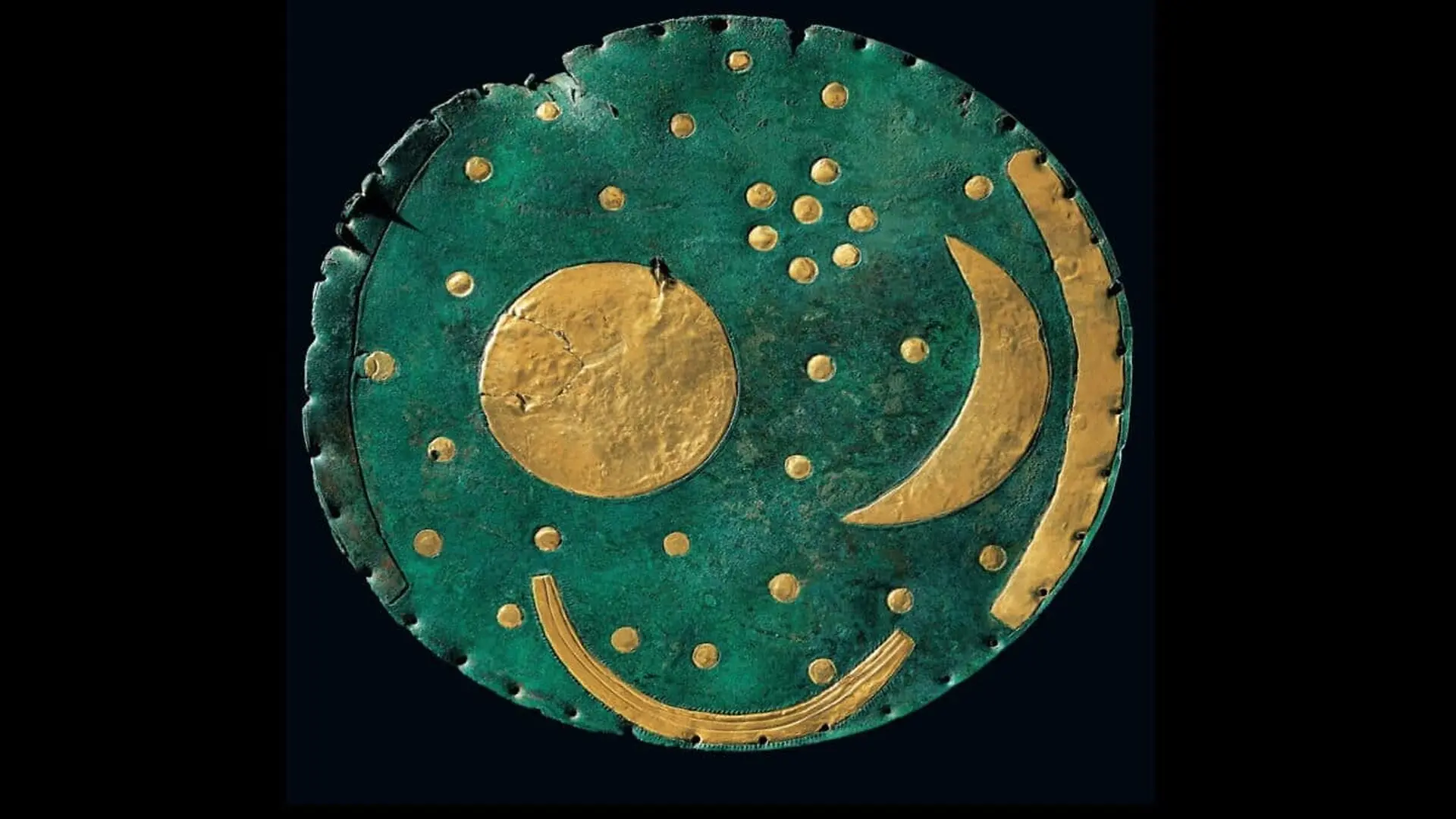
Two looters equipped with a metal detector and a pickaxe uncovered a green‑patinated bronze disk on Mittelberg Hill. Unaware of its importance, they were apprehended during a 2002 police operation, after which archaeologists retrieved the disk along with swords, spiral bracelets, a chisel and flanged axes from the same hoard.
Laboratory analysis places the assemblage around 1600 B.C.E. and associates it with the Únětice culture of the Early Bronze Age in Europe. The disk itself likely predates the hoard by one or two centuries, having been altered over time. In a 2024 study published in Scientific Reports, archaeologist Harald Meller and colleagues describe the Nebra Sky Disk as “the oldest precise depiction of the heavens in human history.”
Bronze Craftsmanship Meets Celestial Mapping
Made from bronze and embellished with gold inlays, the disk appears to have undergone multiple phases of modification rather than being produced in a single step. The earliest layer features a gold crescent interpreted as the moon and a series of gold dots representing stars.
Subsequent additions include two gold arcs along the rim—one now missing—that scholars read as markers of the solstices, highlighting key points in the Sun’s annual trajectory.
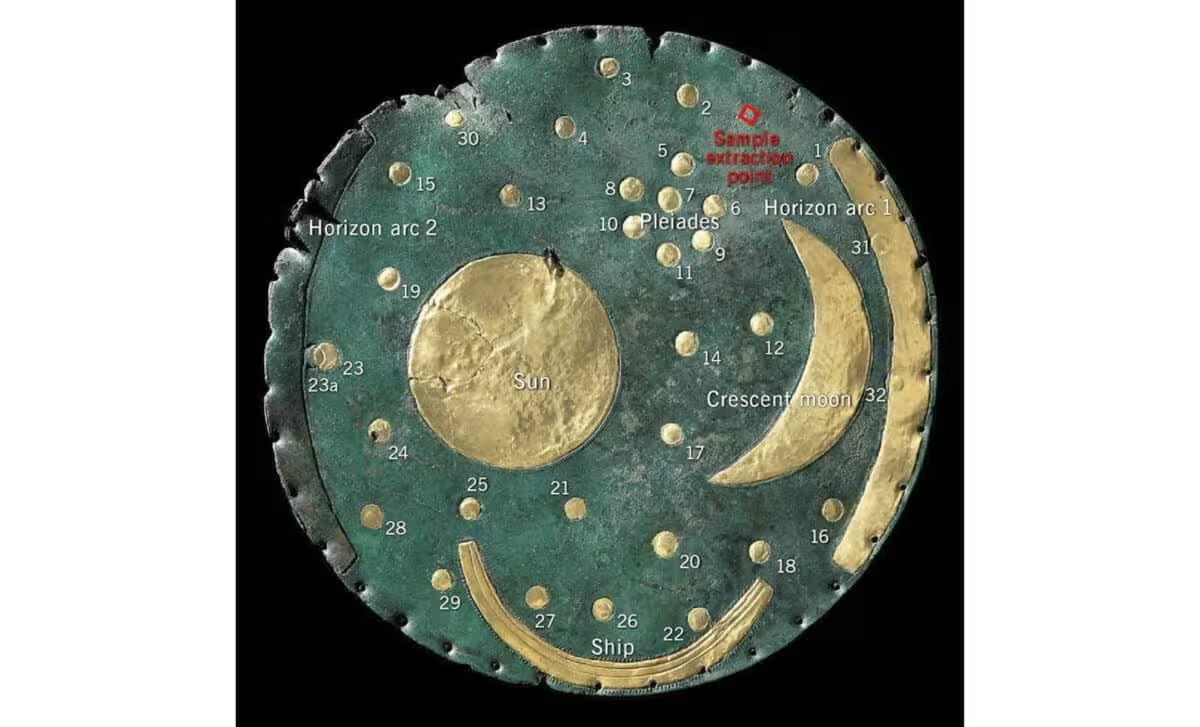
A third curved element affixed to the bottom of the disk has sparked divergent interpretations. Some researchers link it to the solar barge of the Egyptian god Ra, symbolizing the Sun’s journey from sunrise to sunset. Others, drawing on the poetry of Hesiod, suggest it may depict a sickle, reflecting the agricultural calendar tied to the Pleiades star cluster.
The gold stars are not decorative filler; they are widely identified as the Pleiades, known in Greek tradition as the Seven Sisters. Ancient texts advise farmers to commence harvest when the Pleiades rise in late summer and to begin plowing after they set in early spring.
Cross‑Cultural Symbolism in the Disk’s Design
The presence of a solar‑boat motif has prompted scholars to explore Bronze Age cultural exchanges. The lower curve resembles the Egyptian solar barque, an image associated with the daily voyage of Ra across the sky.
Meller’s team argues that Europe during this period was not isolated; similar solar‑boat depictions have been documented in northern Europe, indicating that Egyptian‑inspired iconography could have traveled far beyond the Nile valley.
Some historians propose that the gold curve could represent mother goddesses such as Isis or Hathor, drawing parallels with the Norse goddess Freya. Alternate theories link the motif to Skíðblaðnir, the golden ship of Freyr, emphasizing the shared solar associations of these deities.
The disk may have been deposited as a ritual offering, remaining buried for millennia on a hill where sunrise and sunset observations were especially prominent.
Ongoing Scholarly Disputes on Provenance and Manufacture
Since its emergence, the disk’s authenticity and chronological context have been contested. Archaeologists Rupert Gebhard and Rüdiger Krause questioned whether the findspot truly belongs to a Bronze Age settlement, suggesting a later Iron Age origin and the possibility of intentional re‑burial to enhance its perceived value. Their hypothesis draws on soil residues and comparisons with later star motifs.
The State Museum for Prehistory in Germany dismissed these claims as misleading, defending the established Bronze Age attribution.
Another critic alleged that the green patina resulted from artificial treatment using acid, urine and a blowtorch, though he never examined the artifact firsthand. Subsequent compositional analyses confirmed that the bronze’s copper originated from Alpine mines, while the gold trace was sourced from Cornwall, England.
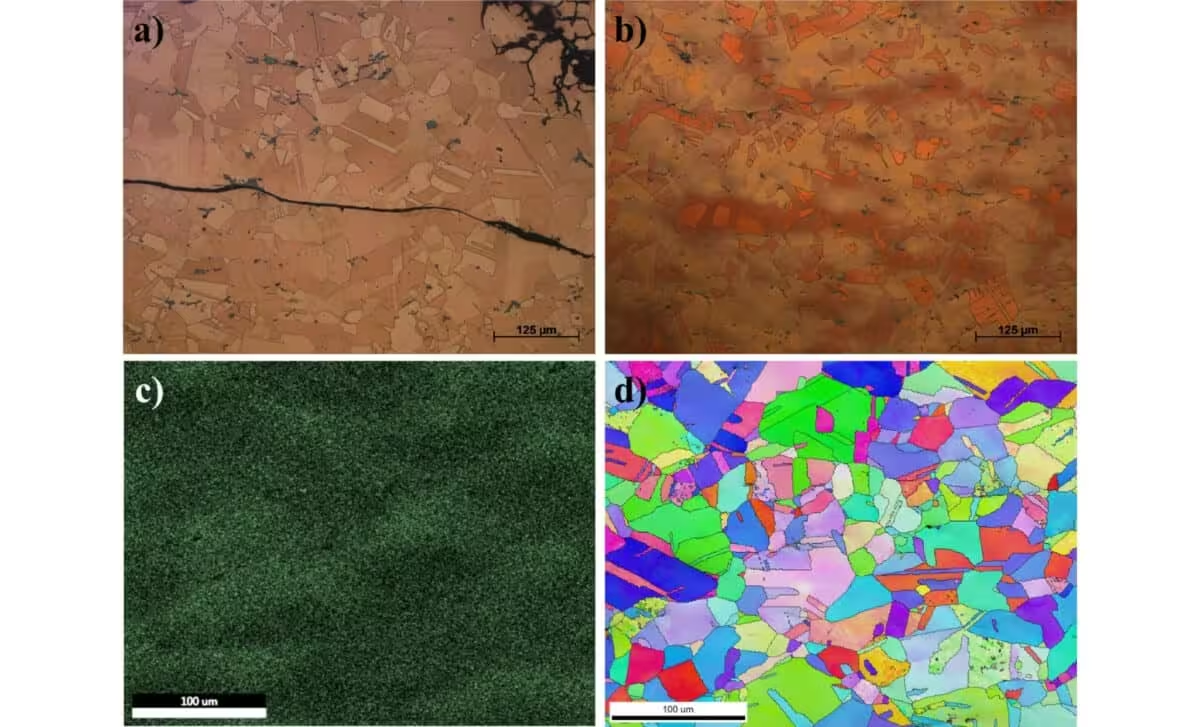
To explore production techniques, Meller’s group collaborated with coppersmith Herbert Bauer to replicate the disk. Microscopic examination revealed hammer‑worked microstructures, indicating that the thin bronze disc was fashioned by reshaping an existing metal sheet rather than by casting, a method consistent with Early Bronze Age metallurgy.
“The influence of the Únětice culture on Early Bronze Age metallurgy has been often discussed, with a particular focus on innovative casting techniques,” Harald Meller said. “In this context, the Nebra Sky Disk documents that the Únětice culture craftsmen were excellent and innovative copper smiths with extensive experience in sophisticated bronze manufacturing.”
Today the Nebra Sky Disk is inscribed on the UNESCO Memory of the World Register, serving as a pivotal reference for scholars investigating Bronze Age astronomical observation, symbolic representation, and advanced metalworking.
This article has been fact checked for accuracy, with information verified against reputable sources. Learn more about us and our editorial process.
Last reviewed on .
Article history
- Latest version
Reference(s)
- Dieck, Sebastian. “Archaeometallurgical investigation of the Nebra Sky Disc - Scientific Reports.”, vol. 14, no. 1, November 21, 2024, pp. 28868 Nature, doi: 10.1038/s41598-024-80545-5. <https://www.nature.com/articles/s41598-024-80545-5>.
- “Unetice Culture.” <https://www.indo-european-connection.com/science/unetice-culture>.
- “Nebra Sky Disc.”, April 28, 2026 <https://www.unesco.org/en/memory-world/nebra-sky-disc>.
Cite this page:
- Posted by Zara Tariq