Scientists Say Earth’s Pole Shifted 31.5 Inches After Humans Extracted 2,150 Gigatons of Groundwater
Scientists identify surprising factor behind Earth’s mysterious rotational drift

Extracting large volumes of groundwater has consequences that extend far beyond regional water availability. A 2023 analysis links the global drawdown of aquifers between 1993 and 2010 to an estimated 31.5‑inch (80‑centimetre) displacement of Earth’s rotational pole.
The planet’s spin axis shifts continuously as masses of water, ice and rock are redistributed. Although the resulting pole motions are minute on a planetary scale, modern geodetic techniques can detect them with high accuracy.
Researchers have long identified melting ice sheets and ocean currents as drivers of polar motion. Recent work now adds groundwater extraction to the roster of forces that can nudge the Earth’s wobble.
Tens of Billions of Tonnes of Aquifer Water Relocated
A paper in Geophysical Research Letters estimates that roughly 2,150 gigatonnes of groundwater vanished from the planet’s subsurface between 1993 and 2010. Most of this volume was pumped for irrigation and domestic use before eventually entering rivers and the world’s oceans.
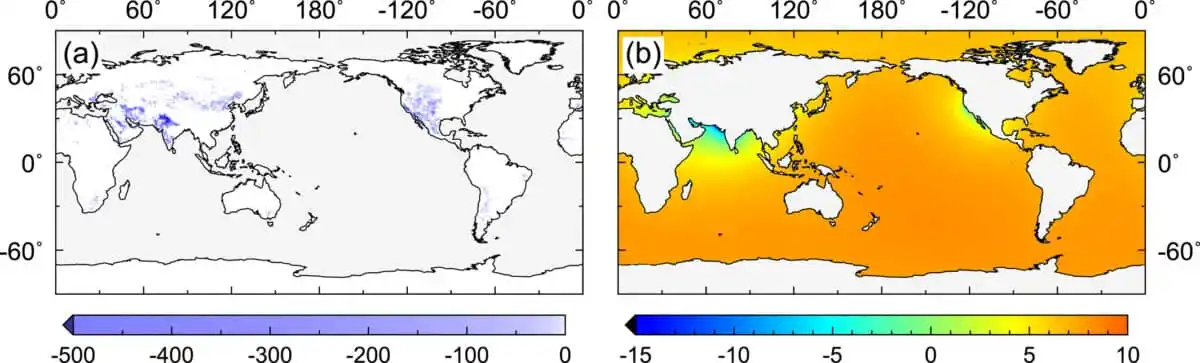
When the researchers incorporated this loss into models of Earth’s polar motion, the simulated drift matched the observed shift. The analysis attributes roughly 31.5 inches (80 centimetres) of pole migration over the 17‑year interval to groundwater depletion, a change that also aligns with an estimated 6.24 millimetres of global sea‑level rise.
“Earth’s rotational pole actually changes a lot,” said Ki‑Weon Seo, a geophysicist at Seoul National University and lead author of the study. “Our study shows that among climate‑related causes, the redistribution of groundwater actually has the largest impact on the drift of the rotational pole.”
How Shifting Mass Alters the Planet’s Spin
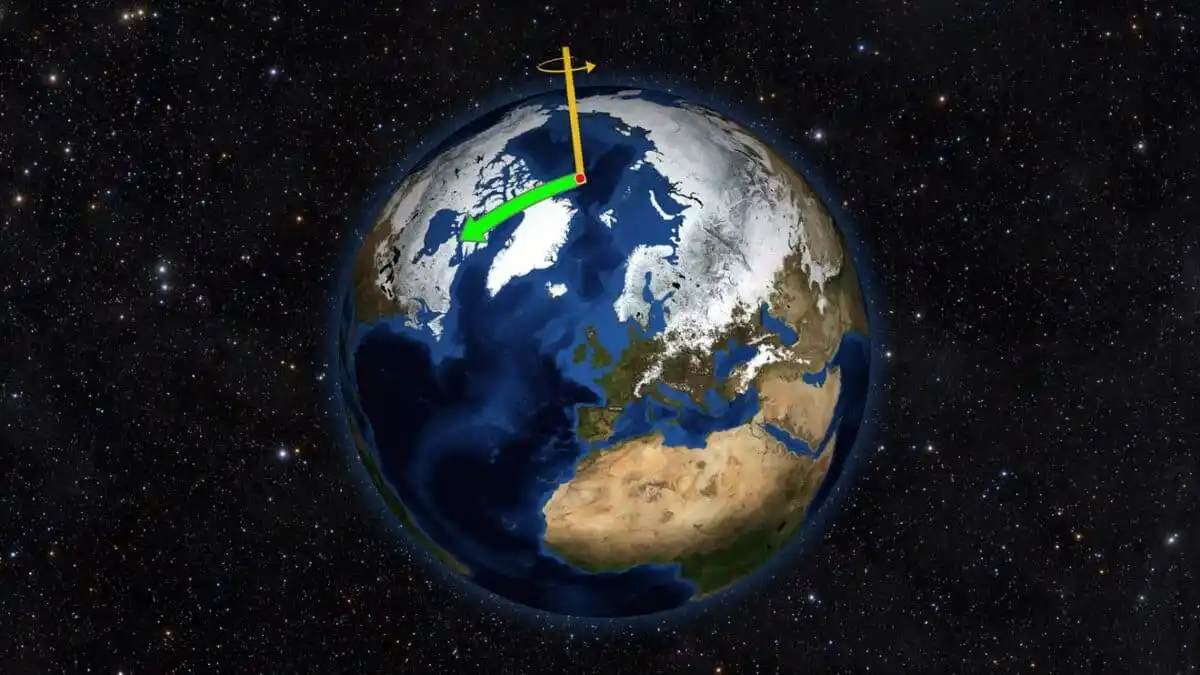
The mechanism is straightforward: Earth’s rotation depends on how its mass is arranged. Adding weight to one side of a spinning top changes its motion without stopping the spin; the same principle applies to our planet.
NASA explains that moving water from underground reservoirs to the oceans modifies the distribution of mass, producing a subtle but measurable adjustment in the spin axis (source).
Groundwater stored beneath the surface counts as part of Earth’s total mass. Once that water is extracted and eventually reaches the sea, the planet’s balance shifts ever so slightly, a change now detectable by precise satellite observations.
The study also highlights regional variations: heavy groundwater drawdown in western North America and northwestern India appears to have a disproportionate influence on pole motion, suggesting that mid‑latitude water losses exert stronger effects than those from other latitudes.
Ongoing Efforts to Clarify the Water‑Pole Connection
A 2026 article in the Journal of Geodesy, the authors note that long‑term polar motion is dominated by changes in snow cover and Greenland ice loss, with groundwater playing a secondary role in their simulations.
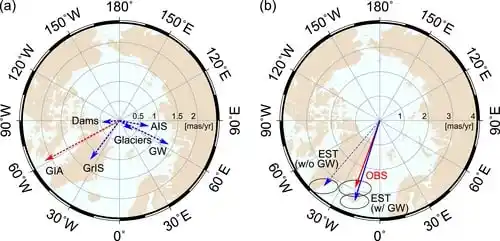
To extend the historical record, scientists introduced two new reconstructions of terrestrial water storage: TWSTORE, beginning in 1984, and ML‑TWiX, covering 1980‑2012. These datasets aim to fill gaps prior to the launch of dedicated satellite missions, offering a longer view of how land‑based water reservoirs evolve.
Despite advances in observation and modeling, uncertainties remain. Polar motion results from a complex interplay of climate, hydrology and geophysical processes. Nonetheless, the groundwater analysis underscores that human water extraction can leave a detectable imprint on the planet’s rotation.
“Observing changes in Earth’s rotational pole is useful,” Seo said, “for understanding continent‑scale water storage variations.”
This article has been fact checked for accuracy, with information verified against reputable sources. Learn more about us and our editorial process.
Last reviewed on .
Article history
- Latest version
Reference(s)
- Seo, Ki‐Weon., et al. “Drift of Earth's Pole Confirms Groundwater Depletion as a Significant Contributor to Global Sea Level Rise 1993–2010.” Geophysical Research Letters, vol. 50, no. 12, June 15, 2023 American Geophysical Union (AGU), doi: 10.1029/2023GL103509. <https://agupubs.onlinelibrary.wiley.com/doi/10.1029/2023GL103509>.
- <https://www.researchgate.net/profile/Ki-Weon-Seo-3>.
- Laboratory, Jet. “NASA Study Solves Two Mysteries About Wobbling Earth.” NASA Jet Propulsion Laboratory (JPL) <https://www.jpl.nasa.gov/news/nasa-study-solves-two-mysteries-about-wobbling-earth/>.
- Kiani Shahvandi, Mostafa. “Excitation of polar motion by terrestrial water storage: a reappraisal using the WaterGAP hydrological model - Journal of Geodesy.”, vol. 100, no. 5, pp. 35 SpringerLink, doi: 10.1007/s00190-026-02060-x. <https://go.redirectingat.com/?id=74968X1525083&url=https%3A%2F%2Flink.springer.com%2Farticle%2F10.1007%2Fs00190-026-02060-x&sref=https%3A%2F%2Fwww.popularmechanics.com%2Fscience%2Fenvironment%2Fa71495673%2Fwhy-has-earth-tilted-science%2F&xs=1&xcust=%5Butm_source%7C%5Butm_campaign%7C%5Butm_medium%7C%5Bgclid%7C%5Bmsclkid%7C%5Bfbclid%7C%5Brefdomain%7C%5Bcontent_id%7C042dc81b-179a-47d7-a8e9-8ef2a5fb39c4%5Bcontent_product_id%7C349df116-392c-452c-9f1a-eef0ed25b9f9%5Bproduct_retailer_id%7Cbc9c2d93-433b-475f-a27d-6ad8b03adbc0%5Blt%7C%5Baxid%7C29cb16d0-791f-4226-9041-f8a4b8491ea1%5D&xcreo=500008>.
Cite this page:
- Posted by Farah Siddiqui