Why Giants Could Never Exist According to 400 Year Old Physics
Galileo’s forgotten work reveals the surprising scientific law that makes giants impossible, explaining why scaling up human size defies physics.

From the one-eyed terror of Homer’s Odyssey to the towering antagonists of fairy tales, giants have captivated the human imagination for millennia. These myths often depict gargantuan beings possessing the same proportions as humans, simply magnified to a massive scale. However, nearly 400 years ago, Galileo Galilei provided a definitive scientific reality check: the physics of our universe makes such creatures impossible.
In his landmark 1638 work, Dialogues Concerning Two New Sciences, the Italian polymath outlined the fundamental constraints of scaling. The core issue lies in the geometric relationship between surface area and volume. As an object grows in size, its mass and weight expand far more rapidly than its structural strength.
The Geometric Limit of Scaling
Galileo illustrated this concept through the mechanics of a wooden beam. If you were to construct a beam that is ten times larger in every dimension, its cross-sectional area would increase by a factor of 100, which theoretically enhances its load-bearing capacity. Yet, because weight is a function of total volume, that same beam would become 1,000 times heavier. The structural integrity would be overwhelmed by the sheer mass of the material.
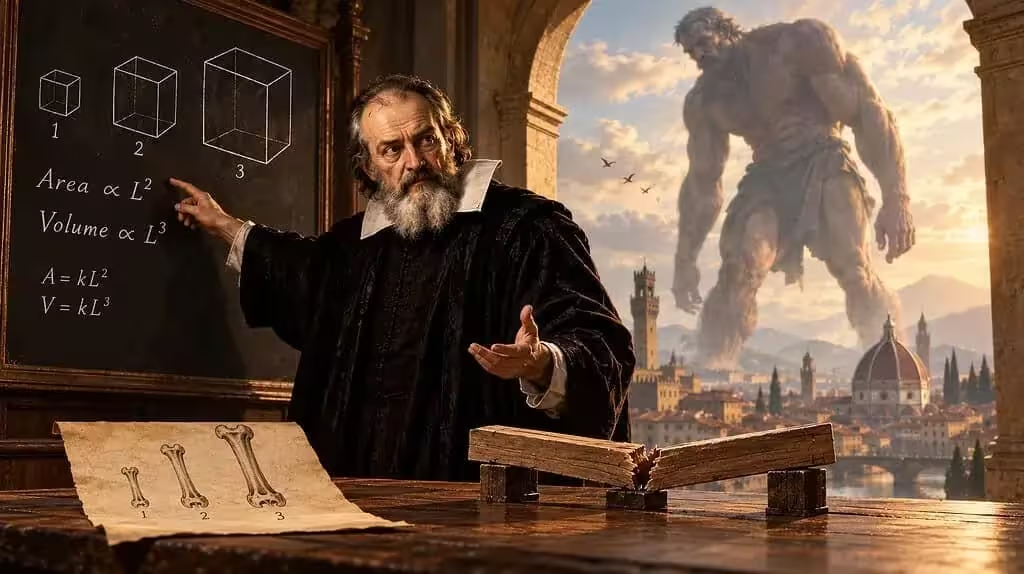
This principle applies directly to the biological architecture of humans. Our skeletons serve as the framework for our mobility and support, but they are not designed to withstand the crushing forces that would result from a linear scale-up. A giant built to human specifications would find its bones snapping under the weight of its own musculature and organs.
Biological Realities and Evolutionary Design
Galileo recognized that for a giant to exist, one of two things would have to be true: the creature would require entirely different, stronger materials for its bones, or it would sacrifice agility and strength to survive. He noted, “Clearly then if one wishes to maintain in a great giant the same proportion of limb as that found in an ordinary man he must either find a harder and stronger material for making the bones, or he must admit a diminution of strength in comparison with men of medium stature.”
Nature offers clear evidence of these physical limitations. Large mammals, such as elephants or rhinoceroses, do not resemble scaled-up versions of smaller quadrupeds like dogs. Their evolutionary path necessitated distinct adaptations, most notably significantly thicker, column-like legs and heavier bone density to support their substantial mass against the pull of gravity.
Conversely, the scaling laws explain why insects can thrive with delicate, spindly limbs. At their size, the gravitational forces that plague larger organisms are largely irrelevant, allowing them to perform feats of locomotion that would be physically impossible for larger creatures. Ultimately, while folklore thrives on the idea of giants, the rigid laws of physics ensure that the world of legends remains firmly detached from the reality of biological design.
This article has been fact checked for accuracy, with information verified against reputable sources. Learn more about us and our editorial process.
Last reviewed on .
Article history
- Latest version
Reference(s)
- Galilei, Galileo. “Dialogues Concerning Two New Sciences | Online Library of Liberty.” <https://oll.libertyfund.org/titles/galilei-dialogues-concerning-two-new-sciences>.
Cite this page:
- Posted by Farah Siddiqui