New Study Challenges Long Held Theory About How Ancient Insects Grew To Massive Sizes
New research reveals the environmental factors that allowed prehistoric giant insects to reach astonishing sizes millions of years ago.

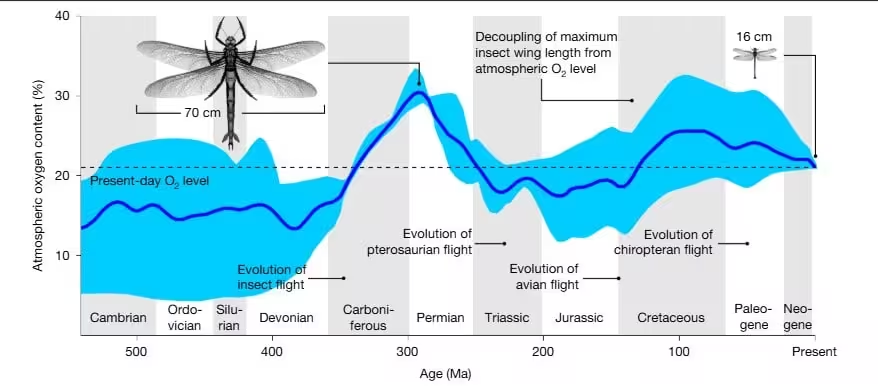
Three hundred million years ago, the skies above Earth’s prehistoric wetlands were dominated by gargantuan insects, including the Meganeura monyi, a creature with a wingspan reaching nearly 70 centimeters. While these griffinflies, members of the extinct Meganisoptera group, have long been the subjects of fascination, a new study is dismantling the prevailing scientific consensus that their massive size was primarily a result of the high oxygen levels characteristic of the Carboniferous period.
Challenging the Oxygen-Driven Growth Hypothesis
For decades, researchers have argued that because insects lack lungs and rely on a network of tubes to transport oxygen directly to their tissues, they faced a physiological ceiling on their growth. It was widely believed that the oxygen-rich atmosphere of the Carboniferous—which soared above 30 percent, compared to today’s 21 percent—enabled these insects to overcome the limitations of their respiratory systems, allowing them to reach such extraordinary proportions.
Fresh Evidence from Insect Physiology
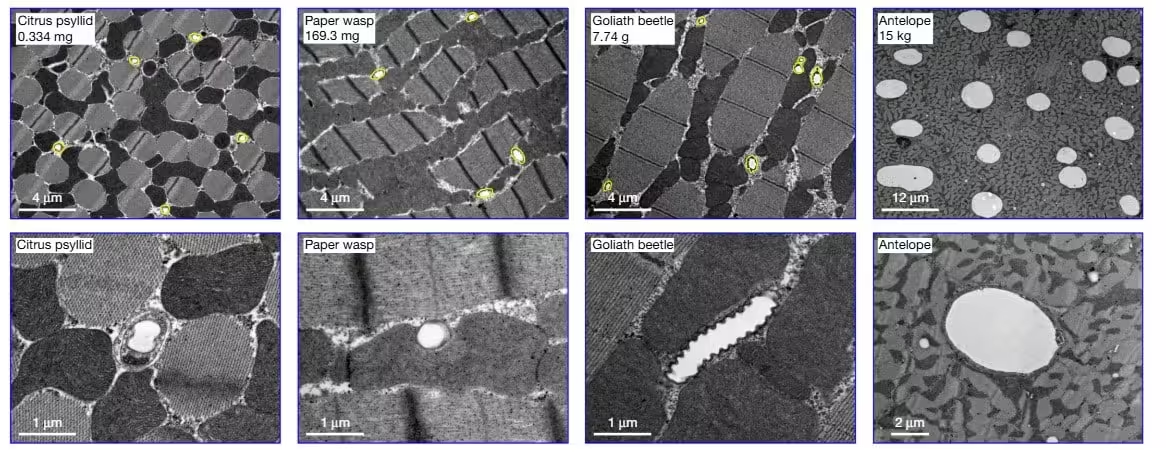
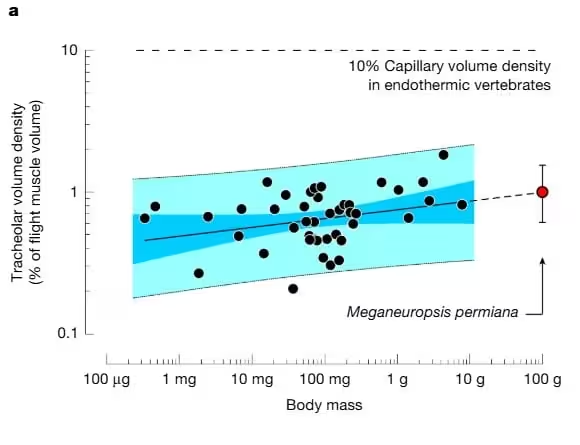
A 2026 investigation published in Nature has cast doubt on this theory by examining how insects adapt their respiration to varying body sizes. Led by Edward Snelling of the University of Pretoria, the team analyzed 1,320 micrographs across 44 different species to measure the volume of tracheoles, the microscopic tubes responsible for oxygen delivery within flight muscles.
The findings revealed that tracheoles typically account for one percent or less of muscle tissue. Most significantly, even as body mass increased by 10,000 times across the species studied, the relative space dedicated to these oxygen-carrying tubes expanded by only 1.8 times. This suggests that the respiratory system does not undergo the drastic structural compensation one would expect if oxygen availability were the primary bottleneck for size.
“If atmospheric oxygen really sets a limit on the maximum body size of insects, then there ought to be evidence of compensation at the level of the tracheoles,” Snelling noted. “There is some compensation occurring in larger insects, but it is trivial in the grand scheme of things.”
Beyond Atmospheric Oxygen
With the oxygen theory losing its status as the sole explanation, biologists are looking toward other variables that may have shaped insect evolution. Factors such as the structural integrity of exoskeletons, the biomechanics of flight, and shifting environmental pressures are now considered more heavily.
One compelling theory shifts the focus toward the developmental stage of these creatures. Researcher Wilco Verberk has suggested that examining aquatic larvae, rather than adults, might provide a clearer picture of why these giants flourished and why they eventually vanished from the fossil record.
Furthermore, ecological pressures likely played a decisive role. As birds evolved and began occupying the skies, the need for agility likely favored smaller, more maneuverable insects over their massive, slow-flying predecessors. This transition occurred even while atmospheric oxygen remained relatively high, suggesting that while the Carboniferous climate may have facilitated their rise, the rise of aerial predators and changing niches ultimately pushed these giants toward extinction.
This article has been fact checked for accuracy, with information verified against reputable sources. Learn more about us and our editorial process.
Last reviewed on .
Article history
- Latest version
Reference(s)
- Snelling, Edward. “Oxygen supply through the tracheolar–muscle system does not constrain insect gigantism.”, vol. 653, no. 8114, pp. 439-443., doi: 10.1038/s41586-026-10291-3. <https://www.nature.com/articles/s41586-026-10291-3.epdf?sharing_token=1QgH-JLFZx5GGbo2UzOrVNRgN0jAjWel9jnR3ZoTv0NGR_Kh_lkQpAJnUkfZc5hxhO3F4AXoa2xAxIXDbjw-VFnCSUGA4HVPel2Gq3xj4WdvGpfNFY83JHlMoU2mW5kvWXo3-1Hbuv4aakOeXYMVasBEpv2e9u4IDnoe0bvUMBf8uDIDPglcwZ3PGZatVdXZB840ENF_56OowWAambEw_SLSew7BosSEfjjxEpVlIsU%3D&tracking_referrer=spacedaily.com>.
Cite this page:
- Posted by Hassan Raza