Construction Crew Digs Up Massive 120 Million Year Old Dinosaur Hidden Beneath Brazil Road Site
Construction workers in Brazil have unearthed the remains of a massive, previously unknown dinosaur species, marking a rare paleontological discovery.
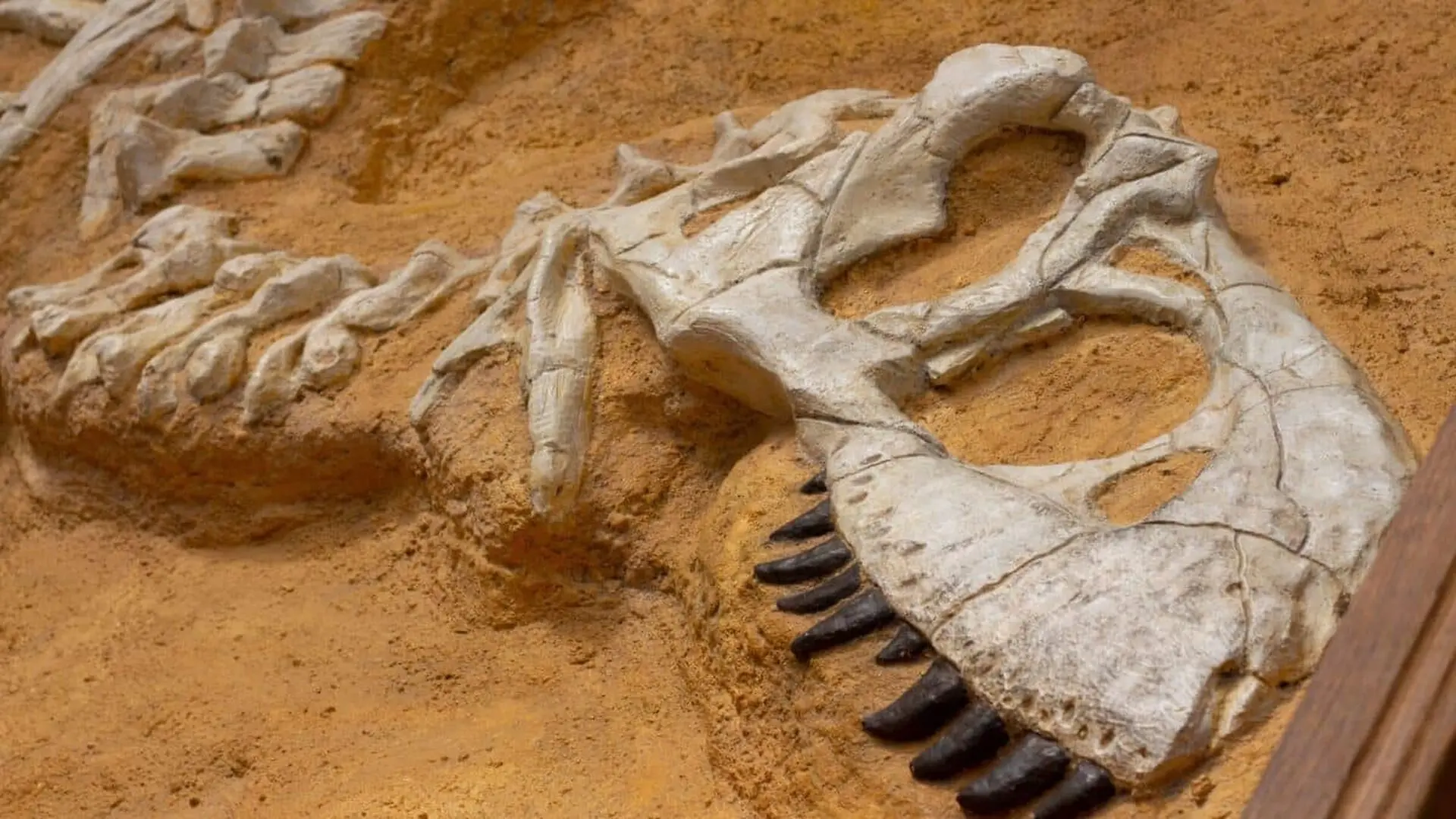
A routine construction project for a road-rail terminal in Davinópolis, Brazil, has unearthed a prehistoric secret hidden for 120 million years. During excavation in the state of Maranhão, workers uncovered the remains of a massive, previously unknown sauropod, now officially identified as Dasosaurus tocantinensis. Measuring approximately 20 meters in length, the discovery is challenging established understanding of the dinosaur populations that once roamed the region.
The findings, detailed in the Journal of Systematic Paleontology, mark a significant departure from the typical fossil record in Maranhão. Before this discovery, the region was primarily known for smaller sauropods, such as the 10-meter-long Amazonsaurus maranhensis. The presence of a giant specimen in such an excellent state of preservation has elevated the site to a discovery of major importance.
Rewriting the Evolutionary History of Maranhão
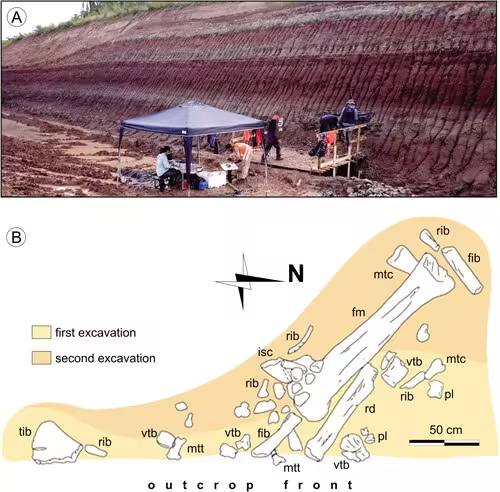
The path to identifying Dasosaurus tocantinensis began in 2021 when environmental monitors at the terminal site flagged bone fragments they initially mistook for relatively modern megafauna. Elver Luiz Mayer, a professor at the Federal University of the São Francisco Valley who led the study, realized the significance of the find when he observed that the bones were buried eight meters deep, placing them squarely in the transition period between the Lower and Upper Cretaceous.
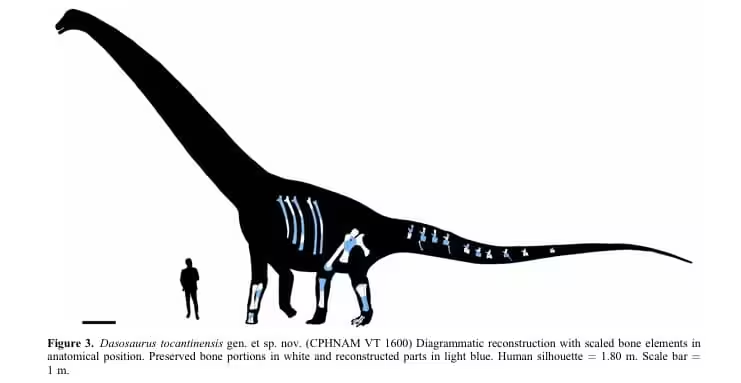
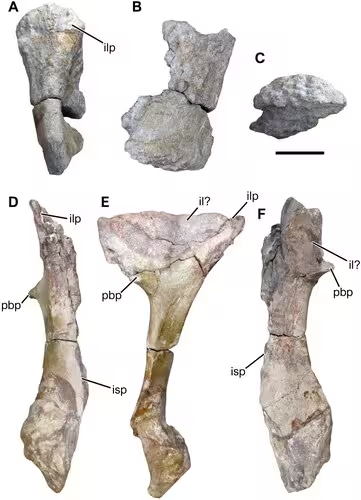
The skeleton is notably complete, featuring a 1.5-meter femur, ribs, vertebrae, and various limb bones. According to Max Langer of the University of São Paulo, who participated in the research, the team expects to find even more of the specimen buried at the site. The remains are now being held at the State Center for Natural History and Archaeology Research in São Luís.
An Unexpected Transatlantic Connection
Perhaps the most intriguing aspect of Dasosaurus tocantinensis is its lineage. Genetic and physical analysis indicates that its closest relatives were located in what is now Spain. Researchers propose that the ancestors of this species traveled from North Africa into South America between 140 and 120 million years ago, a time when these landmasses were still connected within the supercontinent Gondwana.
The name Dasosaurus pays homage to the local landscape, derived from the word for “forest” to reflect the dense, tangled woodlands of the region, while tocantinensis honors the nearby Tocantins River.
Decoding Massive Growth
Insights into how this creature achieved such immense proportions came from bone microstructure analysis performed by Tito Aureliano and Aline Ghilardi of the Federal University of Rio Grande do Norte. The study revealed a hybrid growth pattern, combining ancestral sauropod traits with those seen in later titanosaurs. This suggests that the evolutionary mechanisms for rapid size gain were established earlier in the dinosaur timeline than previously documented.
Langer emphasizes that the accidental nature of this discovery highlights a larger issue in paleontology: the vulnerability of fossil sites to infrastructure development. “If we map Brazil’s fossil sites, we’ll see highways and quarries,” he notes. Researchers are now advocating for more robust cooperation between construction developers and the scientific community to ensure that future infrastructure projects act as opportunities for discovery rather than destruction.
Efforts are currently underway to organize further excavations at the Davinópolis site, where experts believe more of the Dasosaurus skeleton remains waiting to be brought to light.
This article has been fact checked for accuracy, with information verified against reputable sources. Learn more about us and our editorial process.
Last reviewed on .
Article history
- Latest version
Reference(s)
- Mayer, Elver L.., et al. “A new titanosauriform with European affinities in the Early Cretaceous of Brazil: insights on Somphospondyli phylogeny, histology and biogeography.” Journal of Systematic Palaeontology, vol. 24, no. 1, February 12, 2026 Informa UK Limited, doi: 10.1080/14772019.2025.2601579. <https://www.tandfonline.com/doi/full/10.1080/14772019.2025.2601579>.
- <https://www.researchgate.net/profile/Elver-Luiz-Mayer>.
- “ORCID.” <https://orcid.org/0000-0003-1009-4605>.
- <https://www.researchgate.net/profile/Tito-Aureliano>.
- <https://www.researchgate.net/profile/Aline-Ghilardi>.
Cite this page:
- Posted by Hassan Raza