Scientists Have Finally Recreated The Lost Sounds Of Jurassic Forests From Fossilized Wings
Scientists have brought the Jurassic forest to life by reconstructing the prehistoric songs of insects using 165-million-year-old fossil wing structures.

For more than 165 million years, the soundscapes of the Jurassic period have remained locked in silence. Now, a multidisciplinary study published in the Proceedings of the National Academy of Sciences has finally peeled back the veil on this lost acoustic environment. By analyzing fossilized insect wings, researchers have determined that prehistoric forests were far from quiet, playing host to sophisticated communication networks that included ultrasonic frequencies long before the evolution of bats.
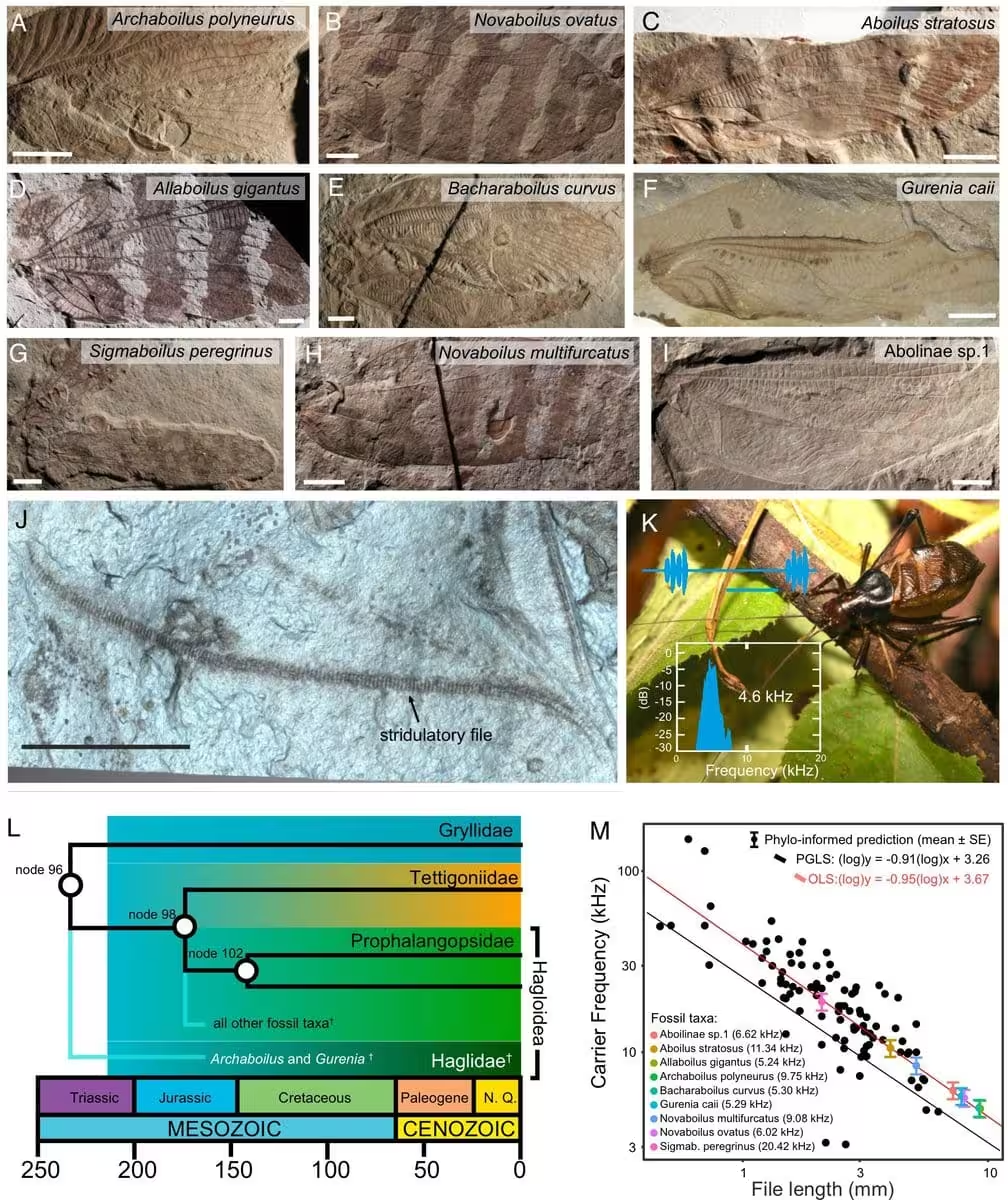
While paleontologists have spent decades cataloging the physical remains of dinosaurs and early mammals, the sonic history of our planet has largely been a mystery. Sound does not fossilize, leaving scientists to rely on modern analogues to reconstruct the auditory life of the past. To bridge this gap, the research team examined 20 fossilized wings belonging to nine distinct species of crickets and katydids unearthed in Inner Mongolia.
Decoding the Mechanics of Prehistoric Song
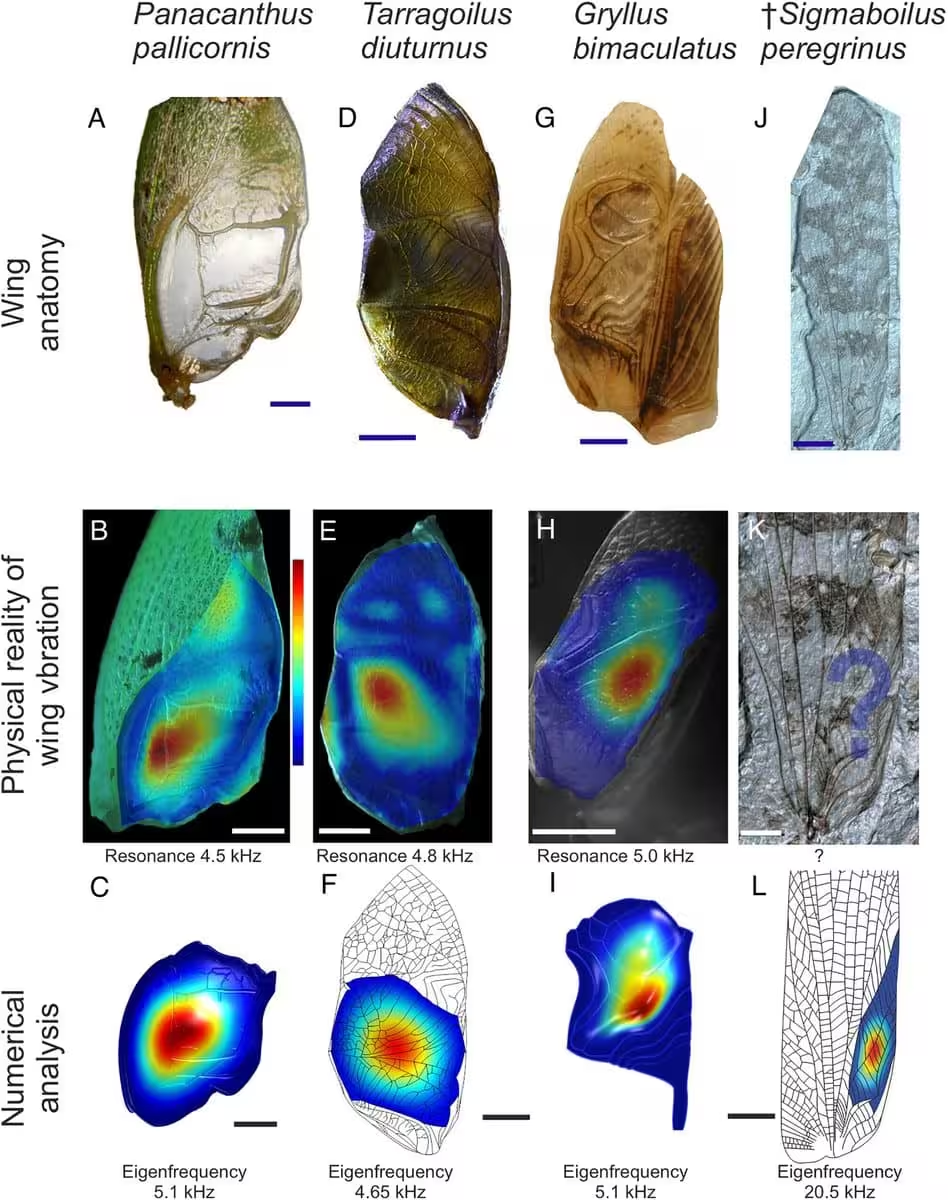
The researchers utilized a combination of laser vibrometry, machine learning, and computer modeling to reverse-engineer the sound-producing capabilities of these extinct insects. Like their modern descendants, these Jurassic creatures generated noise through stridulation, a process involving a serrated “file” on one wing rubbing against a “scraper” on the other. By comparing the geometry of these fossilized structures to those of living species, the team successfully simulated the resonance frequencies of the ancient insects.
The analysis revealed that several species produced calls remarkably similar to those of contemporary crickets. Most notably, the species Sigmaboilus peregrinus appears to have generated sounds between 20 and 22 kilohertz. Because this range sits just above the threshold of human hearing, it represents the earliest known instance of ultrasonic signaling in the animal kingdom.
An Evolutionary Arms Race Before Bats
The existence of ultrasonic signals in the Jurassic era complicates traditional evolutionary theories, which largely attribute the development of high-frequency communication to the defensive need for insects to evade echolocating bats. However, bats did not emerge for another 100 million years, suggesting that early mammals or other small predators likely drove this acoustic shift. This ancient evolutionary pressure may have forced insects to refine their calls, moving toward clearer, more precise tones that allowed for private communication within a crowded and noisy forest ecosystem.
“A pure tone is a musical tone,” noted Fernando Montealegre-Zapata, a sensory biologist at the University of Lincoln and lead author of the study. He suggests these sounds likely mimicked high-pitched whistles or digital beeps, providing a strategic advantage in a landscape dominated by the low-frequency thrum of larger animals.
The Limits of Fossilized Audio
While this research offers an unprecedented glimpse into the past, experts acknowledge the inherent limitations of studying bioacoustics through the fossil record. Behavioral elements—such as the rhythmic pulses, intensity, and specific calling sequences—are dictated by soft tissue and neural patterns that do not survive the passage of millions of years. Robin Tinghitella, a behavioral ecologist at the University of Denver who was not involved in the project, emphasized that while the findings are groundbreaking, the nuances of insect song rely heavily on these missing biological components.
Despite these challenges, the study fundamentally reshapes our understanding of the Jurassic environment. It depicts a world that was sonically vibrant, characterized by a complex interplay of signals that were, for eons, entirely beyond the reach of human perception.
This article has been fact checked for accuracy, with information verified against reputable sources. Learn more about us and our editorial process.
Last reviewed on .
Article history
- Latest version
Reference(s)
- Gu, Jun-Jie., et al. “Reconstruction of an extinct soundscape reveals ultrasonic communication in the Jurassic.” Proceedings of the National Academy of Sciences, vol. 123, no. 36, August 25, 2026 National Academy of Sciences, doi: 10.1073/pnas.2615107123. <https://www.pnas.org/doi/10.1073/pnas.2615107123>.
- “Staff Directory.” <https://staff.lincoln.ac.uk/11e2cfbe-7c8c-4ba8-bb96-d1592a3508f8>.
- “Robin Tinghitella | Natural Sciences and Mathematics.” <https://science.du.edu/about/faculty-directory/robin-tinghitella>.
Cite this page:
- Posted by Hassan Raza