Transparent-Headed Deep-Sea Fish Filmed for First Time at 710 m in Atlantic Abyss
An Atlantic expedition captured rare footage of a bizarre deep‑sea fish, giving an unprecedented glimpse of one of the ocean’s most unusual creatures.
During a month‑long voyage into the Doldrums Megatransform and Fracture Zone, a team of deep‑sea researchers recorded unprecedented footage of a rare barreleye fish living 710 meters beneath the Atlantic surface. The expedition, conducted aboard the research vessel Falkor (too), targeted tectonic fractures, vents and seamounts across an area roughly 60,000 square kilometers (23,000 square miles) that slices through the Mid‑Atlantic Ridge.
Live Imaging of a Transparent‑Headed Barreleye at Depth
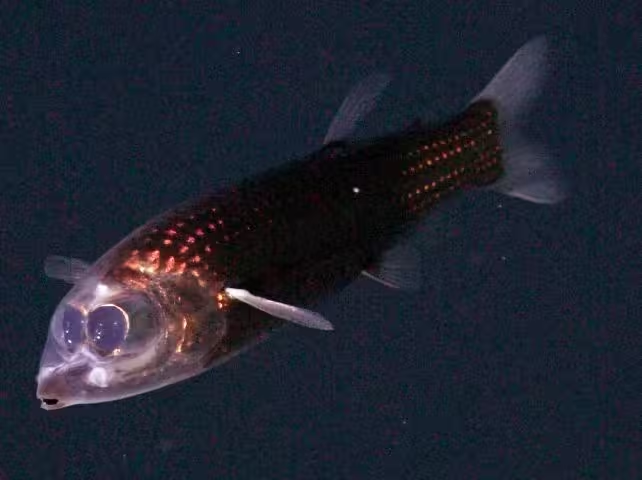
The cameras on the remotely operated vehicle SuBastian captured Winteria telescopa in its twilight‑zone habitat, marking the first time the species has been filmed in situ. Barreleye fish are known for a fluid‑filled dome that encases tubular eyes, a structure so delicate that it typically collapses when a specimen is retrieved. Observing the animal alive allows scientists to study this transparent covering without damaging it, a feature that had previously escaped detection.
According to the Schmidt Ocean Institute, the footage provides a rare glimpse into an anatomy that often disintegrates during collection, offering new insight into the fish’s visual adaptations.
“This discovery shows why exploration still matters,” Aaron Micallef said. “Even in the Atlantic Ocean, where plate boundaries have been studied for decades, there are still places where the first close look can reveal something entirely new.”
Deep‑Sea Vents Reveal New Hydrothermal Systems
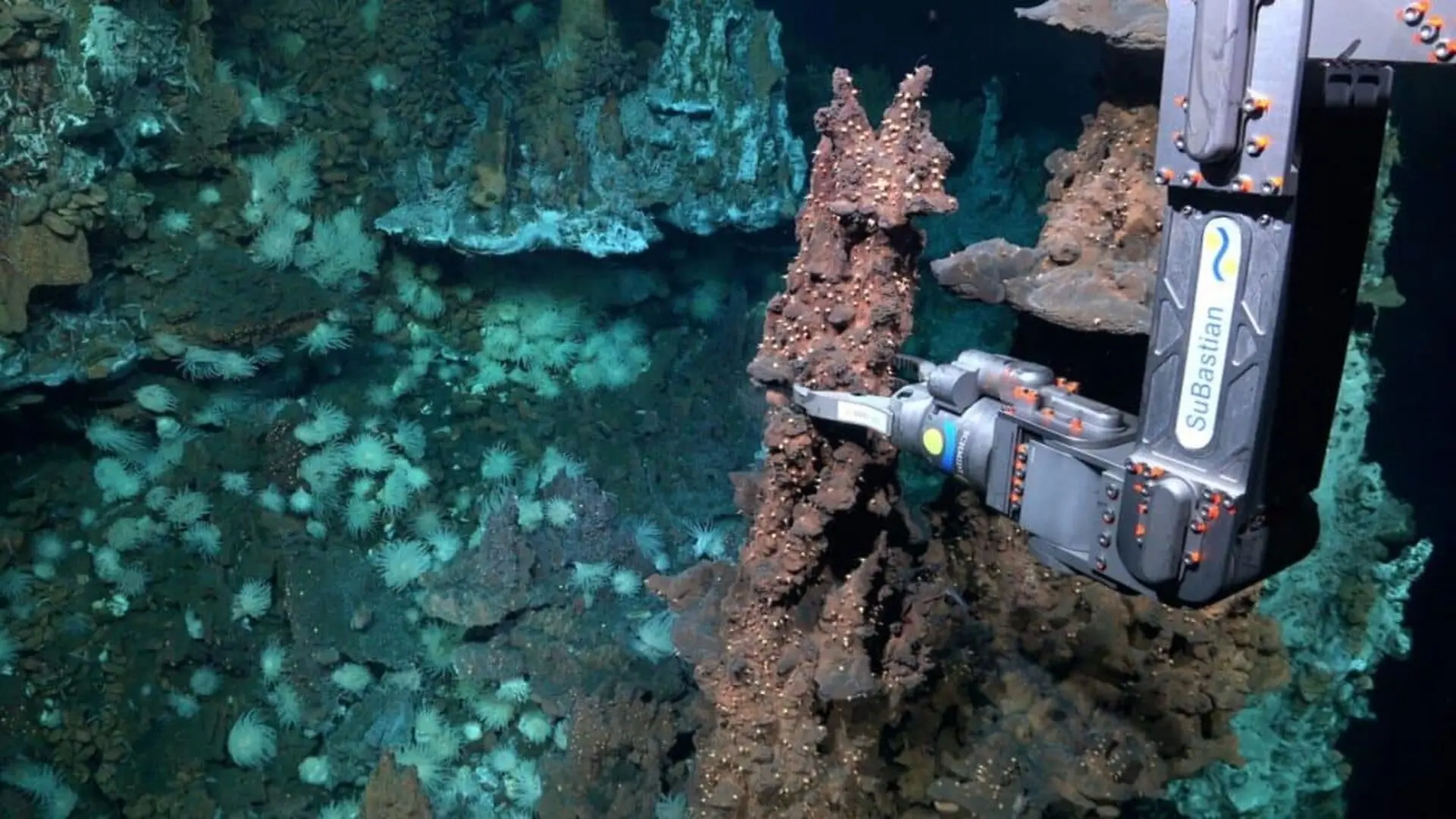
Beyond the fish, the team identified two previously undocumented hydrothermal fields at nearly 4,000 meters (13,123 feet) depth. These vents appear linked to serpentinization—a reaction between seawater and peridotite that generates hydrogen and other reduced chemicals, sustaining chemosynthetic microbial communities.
Only a handful of serpentinization‑driven fields are known, the most famous being the Lost City hydrothermal field. Jyotika Virmani, executive director of the Schmidt Ocean Institute, noted that these systems “provide heat and chemical energy that allow life to thrive in the deep ocean without sunlight, so a better understanding of these systems could provide clues for finding life on other planets.”
Footage from the vents showed swarms of shrimp, ghost‑like crabs and delicate anemones clustering around shimmering chimneys, confirming that these isolated oases host vibrant communities despite the absence of sunlight.
Giant Squid Sightings at Over 3,600 Meters
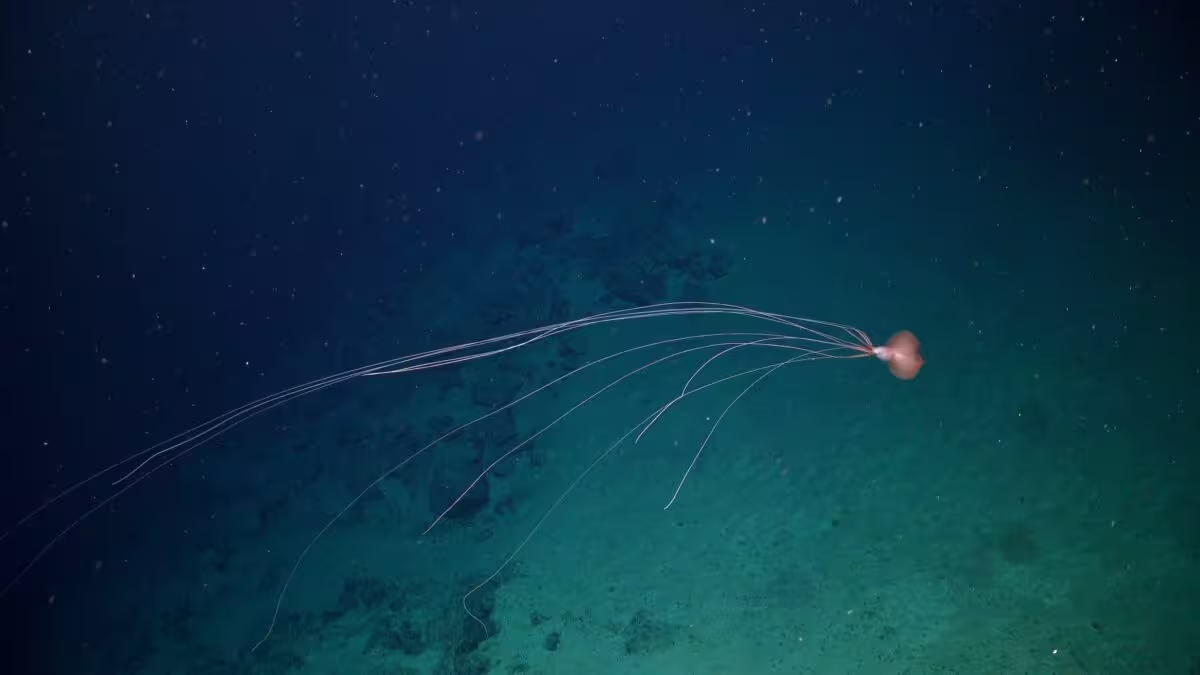
At a depth of 3,634 meters, the expedition encountered two specimens of the enigmatic bigfin squid (Magnapinna spp.). These rare cephalopods, noted for their elongated, filamentous arms, added a striking biological component to a mission initially focused on geological mapping.
The observations underscore how little is known about the Atlantic’s deepest basins, a region that has received scant direct exploration despite its extensive tectonic activity.
“We arrived searching for vents, faults, and seamounts. We leave with something even more valuable: a deeper understanding of ecosystems in one of the least explored regions of the Atlantic Ocean,” said Paula Zapata Ramirez of the Universidad Pontificia Bolivariana. “Every sample, every image, and every discovery brings us one step closer to understanding the hidden parts of our planet.”
Scientific papers detailing the findings are forthcoming, but the expedition has already provided a rare window into a hidden landscape that remains largely unknown to science.
This article has been fact checked for accuracy, with information verified against reputable sources. Learn more about us and our editorial process.
Last reviewed on .
Article history
- Latest version
Reference(s)
- Mock-Bunting, Logan. “The Doldrums Fracture Zone is Anything but Dull.”, July 7, 2026 Schmidt Ocean Institute <https://schmidtocean.org/the-doldrums-fracture-zone-is-anything-but-dull/>.
- “Aaron Micallef • MBARI.”, May 8, 2023 MBARI <https://www.mbari.org/person/aaron-micallef/>.
- Pincus, Maya. “The Lost City Hydrothermal Field – JOIDES Resolution.” <https://joidesresolution.org/expedition/the-lost-city-hydrothermal-field/>.
- “Dr. Jyotika Virmani - Schmidt Ocean Institute.”, April 7, 2020 Schmidt Ocean Institute <https://schmidtocean.org/person/dr-jyotika-virmani/>.
- “Paula Andrea Zapata Ramirez - Schmidt Ocean Institute.”, May 15, 2026 Schmidt Ocean Institute <https://schmidtocean.org/person/paula-andrea-zapata-ramirez/>.
Cite this page:
- Posted by Hassan Raza