Scientists Discover Marine Heatwaves Last Far Longer Than We Previously Thought
A new study suggests that ocean heatwaves hold hidden complexities, revealing critical insights scientists previously overlooked in climate research.
Coastal ecosystems are enduring significantly more thermal stress than previously recognized, according to a new study suggesting that marine heatwaves are not isolated events but rather components of extended periods of elevated temperatures. While traditional scientific metrics define these heatwaves by specific start and end dates, researchers have discovered that the surrounding water often remains abnormally warm for weeks or months, vastly compounding the cumulative heat exposure for marine life.
A team from William & Mary’s Virginia Institute of Marine Science (VIMS) and the Batten School of Coastal & Marine Sciences conducted the research, which was published in Communications Earth & Environment. By evaluating two decades of temperature records from 20 U.S. estuaries, the authors developed a more holistic framework for quantifying heat stress that accounts for the warming trends that precede and follow the official heatwave duration.
The Hidden Duration of Marine Heatwaves
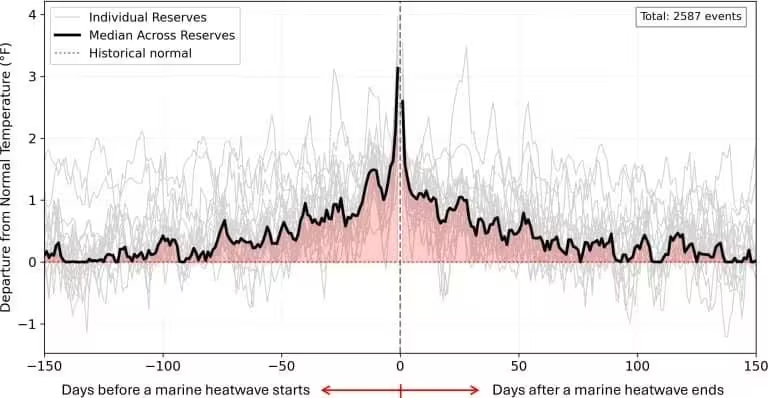
The investigation into over 2,580 individual marine heatwaves revealed that the standard “snapshot” approach used in climate science frequently underestimates the actual biological toll on aquatic species. By focusing exclusively on the peak intensity period, many studies fail to capture the broader, sustained warming context.
“We started to notice these warm-water anomalies on either side of marine heatwaves and realized that they’re actually embedded within larger periods of warm water,” explained lead author Ricardo Utzig Nardi. “It sounds obvious, but studies usually focus only on the marine heatwave window, and that’s not an accurate representation of real-world conditions.”
Quantifying Cumulative Biological Stress
To illustrate the discrepancy, Nardi compares the phenomenon to human sun exposure. Just as a sunburn is determined by both the intensity of the sun and the total duration of exposure, marine organisms suffer the consequences of long-term thermal pressure rather than just the peak temperature spikes. This cumulative approach, supported by data from NOAA’s National Estuarine Research Reserve System, indicates that the “pre” and “post” heatwave periods often add as much, or more, total heat energy as the defined heatwave itself.
“We can no longer look at marine heatwaves in isolation when assessing the impact of warming events on coastal and oceanic ecosystems,” said Piero Mazzini. “We must acknowledge the larger framework in which they exist, and this research provides a way to do just that.”
Categorizing Warming Patterns
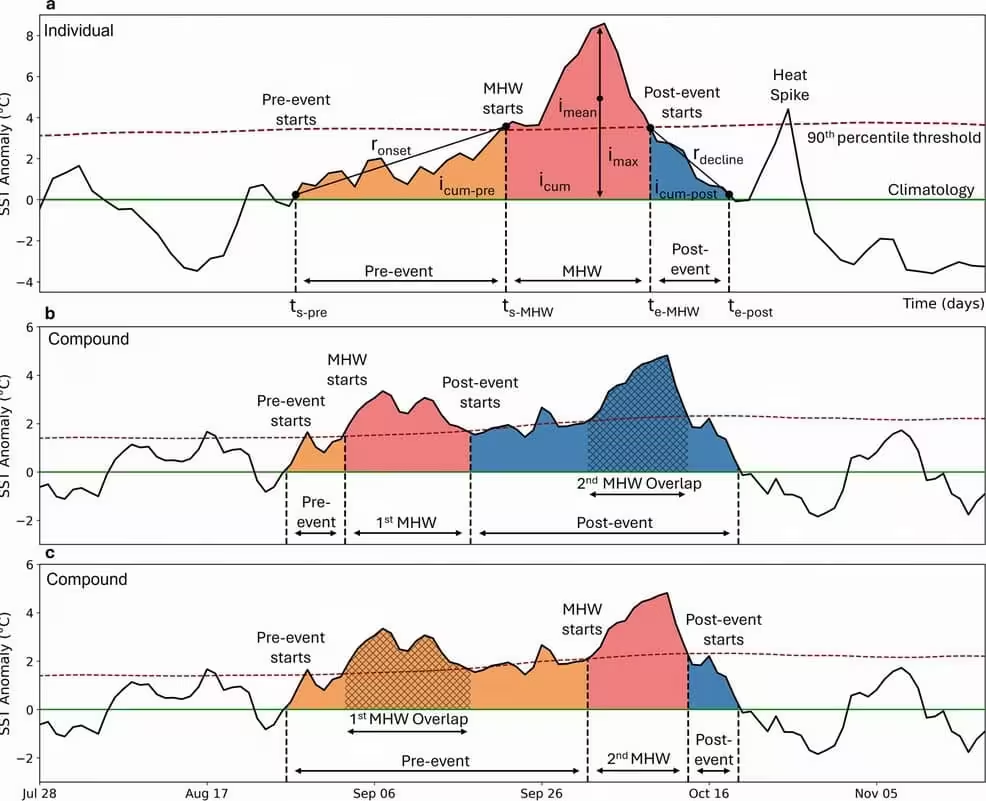
The research team identified two distinct profiles for these events. The first, labeled “individual” heatwaves, typically sees elevated temperatures persist for approximately 60 days beyond the official window. The second, “compound” heatwaves, occurs within much broader warming cycles, with unusual temperatures lingering for about 90 days before and after the central event. These compound episodes generate more than three times the total cumulative heat exposure than a standard model would predict.
By shedding light on these prolonged thermal footprints, the authors of the Virginia Institute of Marine Science study hope to improve how future laboratory experiments are designed. Standard simulations, which often use short-term temperature increases, may consistently fail to replicate the exhausting, long-term environmental stress that marine organisms encounter in the wild.
This article has been fact checked for accuracy, with information verified against reputable sources. Learn more about us and our editorial process.
Last reviewed on .
Article history
- Latest version
Reference(s)
- <https://www.researchgate.net/profile/Ricardo-Nardi>.
- “National Estuarine Research Reserve System.” <https://www.noaa.gov/national-estuarine-research-reserve-system>.
- “Piero Mazzini.” Virginia Institute of Marine Science <https://www.vims.edu/about/directory/faculty/mazzini_plf.php>.
- “A longer, hotter reality surrounds marine heatwaves, new study finds.” Virginia Institute of Marine Science <https://www.vims.edu/newsandevents/topstories/2026/embedded-marine-heatwaves.php>.
Cite this page:
- Posted by Divya Iyer