Bizarre Coral-Like Patterns Discovered On Mars Reveal A Secret Ancient History
Newly discovered layered deposits on Mars could hold the key to unlocking the secrets of the Red Planet’s ancient, shifting climate history.
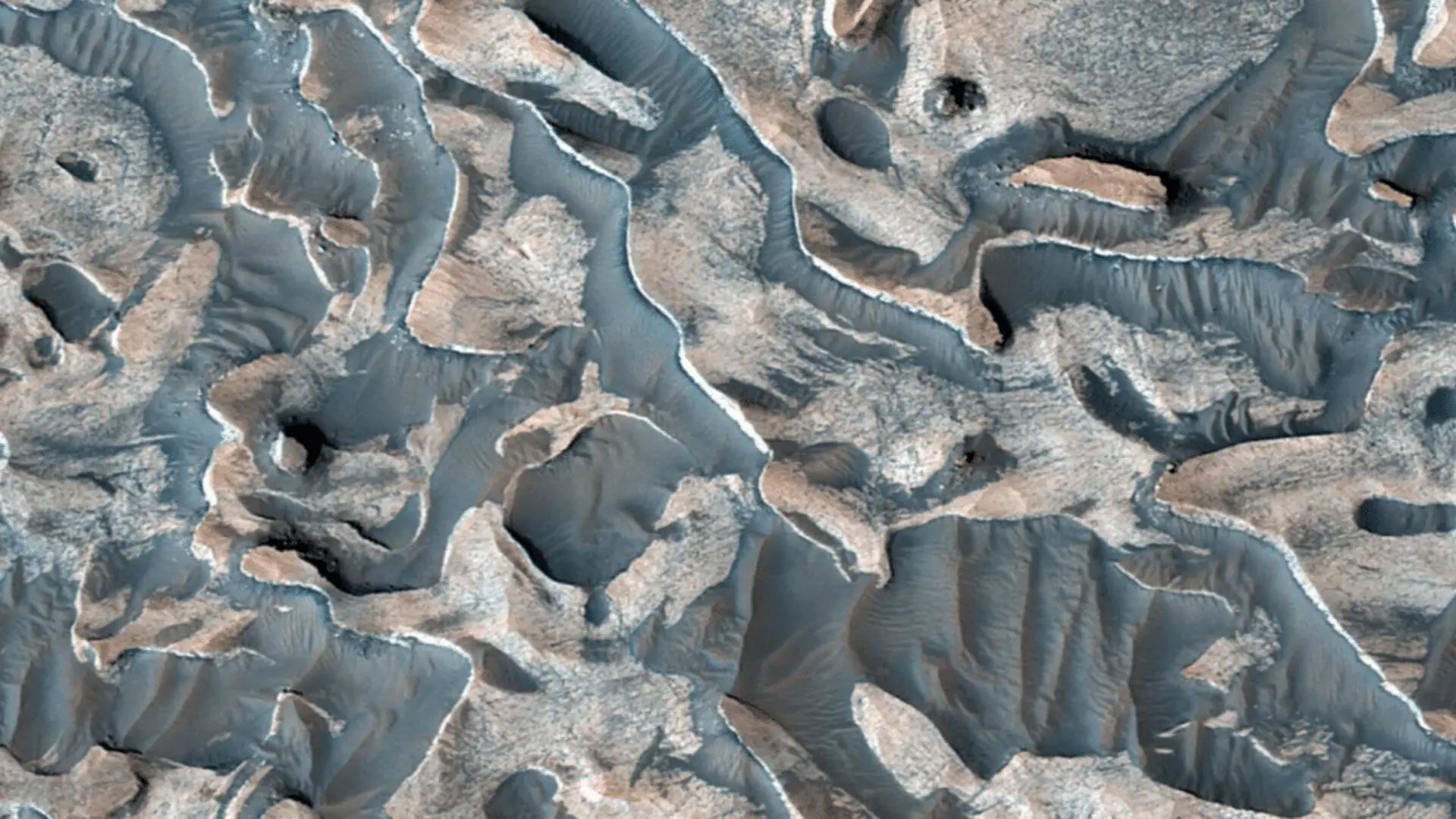
Striking, coral-like patterns etched into the surface of Mars are offering researchers a fresh perspective on the Red Planet’s deep geological history. Captured by the HiRISE camera aboard NASA’s Mars Reconnaissance Orbiter, these intricate, layered deposits serve as a massive archive, potentially documenting long-term environmental shifts that occurred over billions of years.
Deciphering the Rhythmic Geology of Arabia Terra
The unusual formations are situated within Arabia Terra, a region recognized as one of the oldest and most heavily scrutinized terrains on Mars. From a vantage point in orbit, the landscape reveals a complex network of winding ridges and repeated layers that bear a superficial resemblance to Earth’s coral reefs. Despite their organic appearance, these features are purely geological, forged by persistent planetary processes.
The regularity of these layers is particularly compelling to scientists. Their consistent spacing suggests they were not the product of isolated, catastrophic events, but rather the result of recurring environmental cycles. These sequences potentially trap data regarding atmospheric fluctuations, surface modifications, and the migration of materials across the Martian crust throughout the planet’s infancy.
Because these deposits are widespread across a significant portion of Arabia Terra, they indicate that the forces at play were not merely local, but regional or perhaps even global. Currently, these layers are exposed at the surface, providing a rare window into strata that would otherwise remain buried beneath layers of ancient dust and debris.
High-Resolution Insights into Martian Erosion
The HiRISE instrument has provided unprecedented clarity, allowing researchers to analyze the erosion patterns and textural nuances of these deposits at a scale previously unattainable. By examining the jagged edges and pitting characteristic of this region, scientists are gaining insight into how wind, atmospheric dust, and potentially even ancient groundwater once interacted to sculpt the surface.
“Researchers have proposed that the rhythmic nature of the layers and their extensive coverage across much of Arabia Terra could be due to global cyclic processes, such as dust storms, perhaps involving groundwater,” noted HiRISE co-investigator Cathy Weitz.
Contemporary Forces on an Ancient Surface
While the internal structure of these deposits was determined long ago, they are not static. Current observations show that aeolian processes—primarily the constant movement of wind-blown dust—are actively modifying these features. Darker ripples and debris have settled into the pits and eroded crevices, suggesting that even in its current, desiccated state, the Martian surface remains subject to active, albeit slow, change.
By contrasting these Martian formations with similar geomorphological features found on Earth, scientists are working to determine the extent of water-driven activity in the planet’s distant past. The evidence continues to mount that these layers reflect a complex environmental narrative, one that saw a transition from a world potentially capable of supporting liquid water to the harsh, frigid desert that characterizes Mars today. As investigations continue, these coral-like patterns remain a vital piece of the puzzle in reconstructing the climatic evolution of our neighboring world.
This article has been fact checked for accuracy, with information verified against reputable sources. Learn more about us and our editorial process.
Last reviewed on .
Article history
- Latest version
Reference(s)
- “HiRISE | Rhythmic Layering in Arabia Terra (ESP_092890_1825).” <https://www.uahirise.org/ESP_092890_1825>.
Cite this page:
- Posted by Divya Iyer