Bizarre Deep-Sea Hitchhikers Spotted Riding Giant Spiders 3,000 Meters Below the Surface
Deep-sea cameras have captured tiny hitchhikers clinging to giant spiders, potentially solving a long-standing mystery about life on the ocean floor.
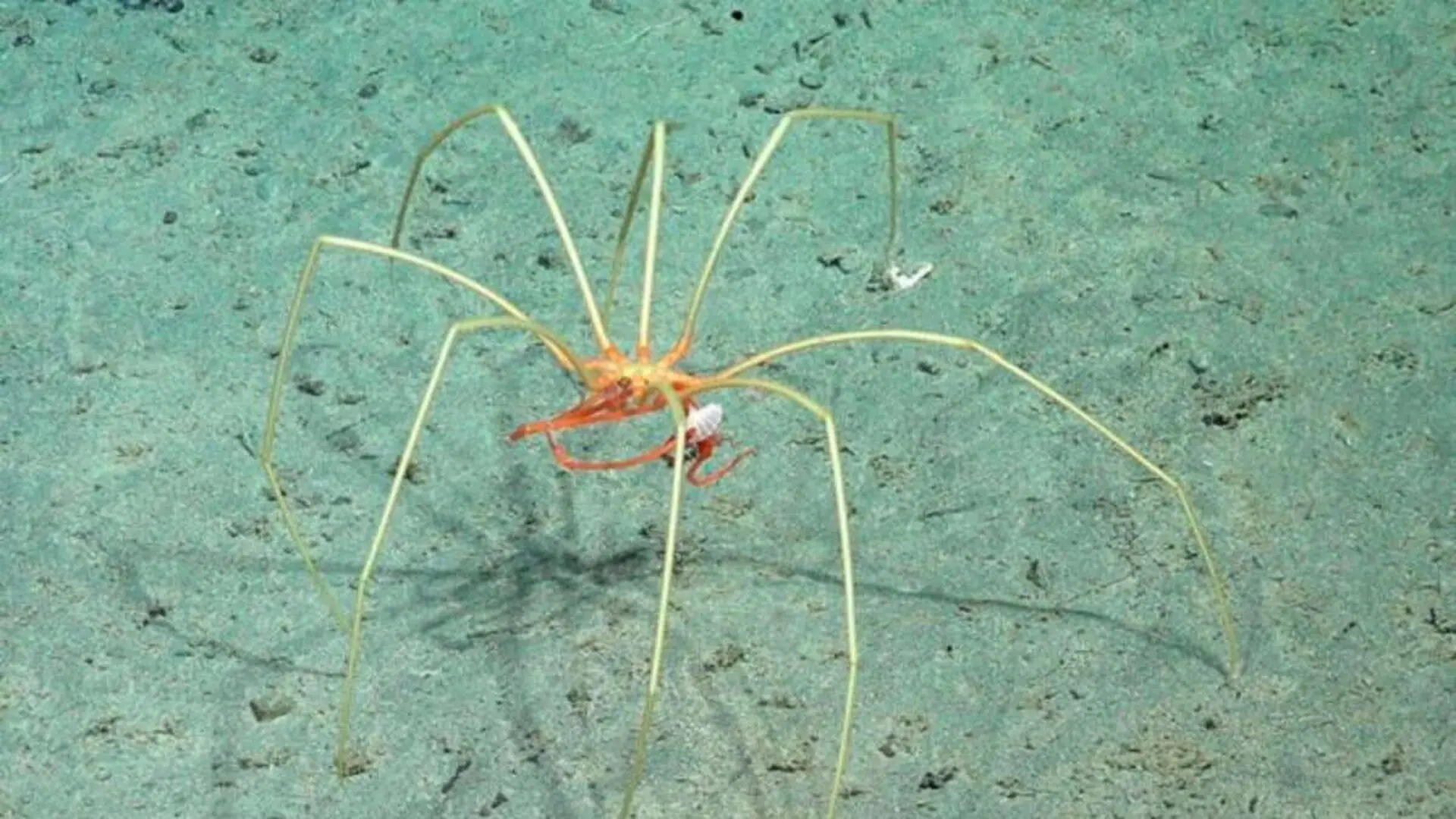
Deep-sea explorers have captured rare footage of tiny amphipods hitching a ride on the limbs of giant sea spiders thousands of meters below the surface of the Southeast Pacific Ocean. The discovery, documented during an expedition along the Chilean margin, offers a potential glimpse into how some creatures navigate the vast, sparsely populated depths of the abyss.
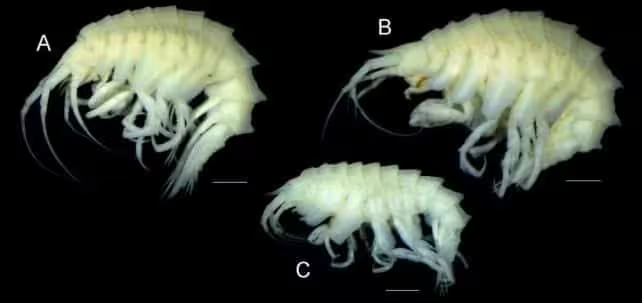
The interactions involved the amphipod Mesopleustes abyssorum and the large, long-legged sea spider Colossendeis colossea. Researchers observed the behavior twice in four days using the Schmidt Ocean Institute’s remotely operated vehicle, SuBastian. The recurring nature of these events suggests that the association may be more than a mere chance encounter.
Solving a Deep-Sea Distribution Mystery
For marine biologists, M. abyssorum has long presented a significant biological puzzle. As a species, it is not a particularly adept swimmer and lacks the planktonic larval stage typically required for widespread dispersal via ocean currents. Despite these limitations, it has been recorded across the Pacific, Atlantic, Indian, and Southern oceans at depths ranging from 690 to 3,500 meters. Whether this represents a single, remarkably expansive species or a group of look-alike cryptic species remains an open question.
The recent observations provide a possible answer: phoresis. This is an ecological relationship where one organism uses another as a vehicle for transportation. Because giant sea spiders like Colossendeis are capable of swimming by spreading their expansive limbs to harness deep-sea currents, they could act as long-distance ferries for the amphipods.
Observations from the Abyss
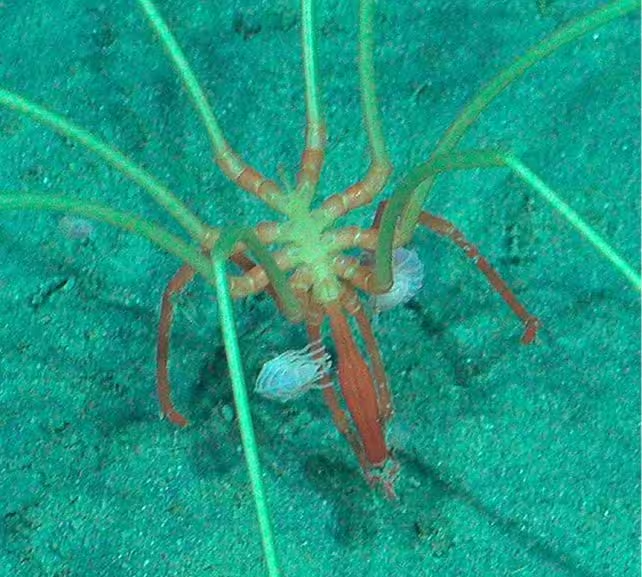
The first encounter occurred on November 24, 2024, at a depth of 3,155 meters. The team observed three amphipods clinging to a single sea spider, with two individuals positioned near the front and a smaller female attached further down a walking leg. Just four days later, approximately 225 kilometers away at a depth of 2,698 meters, the team witnessed the same behavior again, with two amphipods gripping another Colossendeis specimen.
Lead researcher Jorge Pérez-Schultheiss and his colleagues noted in their study, published in the journal Ecology, that the amphipods used specialized claw-like structures at the ends of their limbs to maintain a secure grip, which remained firm even after the specimens were collected by the ROV.
While an anecdotal report of a similar interaction exists from 1927, it lacked visual documentation and received little scientific attention. The recent high-definition records have reignited interest in the potential benefits of this behavior.
A Meeting Point in the Deep
Beyond simple transport, the researchers suggest the giant sea spiders could serve as social hubs. In the vast, dark expanse of the deep ocean, finding a mate is notoriously difficult. By congregating on a mobile host, the amphipods—which included mixed-sex pairs in the observed instances—may be increasing their chances of reproductive success.
The team remains cautious, acknowledging that the sample size is small and the behavior could still be incidental. However, they emphasize that in extreme environments where energy and resources are scarce, even minor ecological associations can be vital for survival. Future research will focus on determining whether these amphipods actively seek out their giant hosts or simply latch onto whatever suitable structure they encounter in the gloom.
This article has been fact checked for accuracy, with information verified against reputable sources. Learn more about us and our editorial process.
Last reviewed on .
Article history
- Latest version
Reference(s)
- Pérez‐Schultheiss, Jorge., et al. “Hitch‐hiking in the deep sea: Amphipods embrace sea spiders in the Southeast Pacific Ocean.” Ecology, vol. 107, no. 9, September 11, 2026 Wiley, doi: 10.1002/ecy.70443. <https://esajournals.onlinelibrary.wiley.com/doi/10.1002/ecy.70443>.
Cite this page:
- Posted by Divya Iyer