China’s 66 Billion-Tree Great Green Wall Grows Faster Than Natural Forests, Study Shows
China’s massive reforestation accelerates tree growth, but scientists say the long‑term climate effects are far more complex than they appear.
China’s sweeping Great Green Wall initiative has already seen the planting of about 66 billion trees across millions of acres, and a new study shows that these man‑made woodlands are shedding leaves at a faster rate than nearby natural forests. Published in Geophysical Research Letters, the research provides fresh evidence that large‑scale reforestation can temporarily accelerate carbon uptake, while also raising questions about the durability of such gains.
Accelerated Foliage Production in China’s Reforested Areas
Since 1978, China has rolled out the Three‑North Shelterbelt Program, commonly referred to as the Great Green Wall. The scheme was designed to curb the spread of the Gobi and Taklamakan deserts and to rehabilitate degraded land throughout northern China.
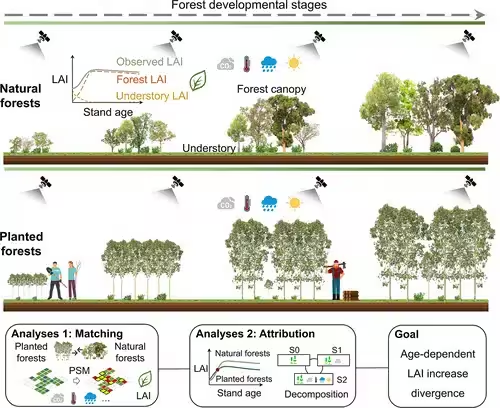
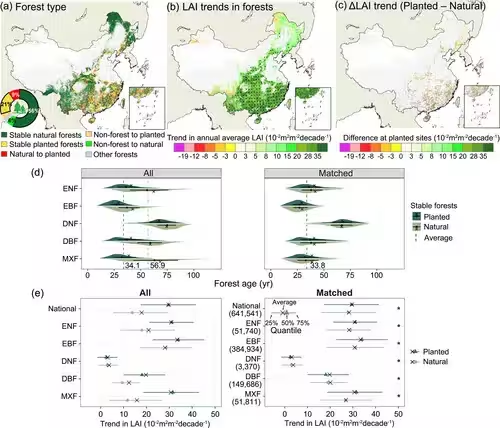
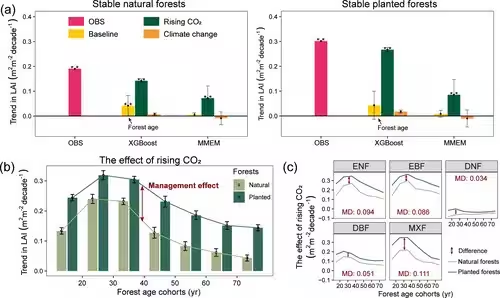
Using decades‑long satellite records combined with forest‑age and environmental datasets, the authors discovered that planted stands consistently outpaced adjacent natural forests in seasonal leaf‑area growth. Younger, managed plantations responded more strongly to rising atmospheric CO₂, fueling rapid canopy development during the growing season. Variations in tree age, species mix, and silvicultural practices all contributed to the observed differences, underscoring that planted and natural forests are not interchangeable carbon sinks.
Lead author Luo highlighted the relevance of these nuances for climate science.
“Planted forests are widely used in climate mitigation strategies, but most global ecosystem models do not distinguish between forest types or represent age-related dynamics adequately,” Luo said. “So we felt it was important to clarify how these factors interact — not just for scientific understanding, but also for improving the models and assumptions that underpin real‑world forest policy and carbon accounting.”
Rethinking Climate Model Assumptions
The study, appearing in Geophysical Research Letters, points out that many existing climate‑earth system models lump forests together, ignoring the distinct characteristics of young, managed plantations versus mature, biodiverse stands.
Because policy decisions increasingly hinge on model outputs, overlooking these distinctions could lead to over‑optimistic carbon‑budget forecasts. If planted forests deliver a surge of carbon capture in their first few decades but then level off, accounting frameworks must reflect that temporal shift rather than assuming a steady rate of sequestration. Luo and colleagues argue that future simulations should embed forest age, species composition, and management history to sharpen climate projections and guide more effective reforestation policies.
Rapid Growth Is Not Synonymous With Long‑Term Storage
While the heightened leaf production in plantations is encouraging, the authors warn that it does not guarantee lasting carbon sequestration. Young stands naturally grow quickly, but this momentum wanes as trees age. In contrast, mature natural forests, though slower to generate foliage, lock away carbon for centuries in trunks, roots, and soils.
Luo stressed that the temporary boost should not be mistaken for a permanent climate fix.
“Planted forests can be a powerful short‑term tool for carbon uptake, but this advantage is temporary,” Luo said. “For long‑term carbon storage and resilience, natural forests remain irreplaceable.”
The authors also note that satellite‑derived canopy greenness captures only part of the carbon story. David Orwig, a forest ecologist not involved in the study, cautioned that leaf‑area metrics alone cannot fully quantify ecosystem carbon stocks.
“It’s not a bad proxy, but it doesn’t give you the full picture,” he said. “The canopy is just the top of the tree and the carbon is stored in all sorts of different places like wood, bark, roots and soil.”
Because soils and mature woody tissue often hold the bulk of long‑term carbon, a focus on canopy greenness can overlook the most durable reservoirs.
Precision Management Trumps Pure Tree Numbers
The findings suggest that future climate strategies should move beyond simple tree‑count targets. Selecting species suited to local conditions, accounting for forest age, and implementing adaptive management throughout a stand’s life cycle appear crucial for maximizing climate benefits. While fast‑growing plantations can deliver short‑term carbon draws, diversified natural forests provide stability, biodiversity, and resilience that are hard to replicate.
Luo underscored the need for a more nuanced approach to land‑use planning.
“Land use management works in more subtle and specific ways than we had assumed,” he said. “It is not just about planting more trees. It is also about when you plant them, what species you choose, and how you manage them over time.”
The authors hope their analysis will inform more realistic climate‑action roadmaps, offering guidance on planting timing, species selection, benefit longevity, and model improvements.
As nations scale up reforestation to meet climate goals, the study underscores that success will hinge less on sheer tree counts and more on understanding how different forest types develop, mature, and retain carbon over decades to centuries.
This article has been fact checked for accuracy, with information verified against reputable sources. Learn more about us and our editorial process.
Last reviewed on .
Article history
- Latest version
Reference(s)
- Luo, Yuhang., et al. “Enhanced CO 2 Response and Aging‐Related Dynamics Drive a Greater Leaf Area Index Increase in China's Planted Forests in Comparison to Natural Forests.” Geophysical Research Letters, vol. 53, no. 11, May 28, 2026 American Geophysical Union (AGU), doi: 10.1029/2025GL121544. <https://agupubs.onlinelibrary.wiley.com/doi/10.1029/2025GL121544>.
Cite this page:
- Posted by William Moore