Hidden Chambers Detected Behind Tutankhamun Tomb Walls Spark New Nefertiti Mystery
When Howard Carter discovered Tutankhamun’s tomb in 1922, one mysterious detail left him puzzled. Egyptologists are still debating the significance today.
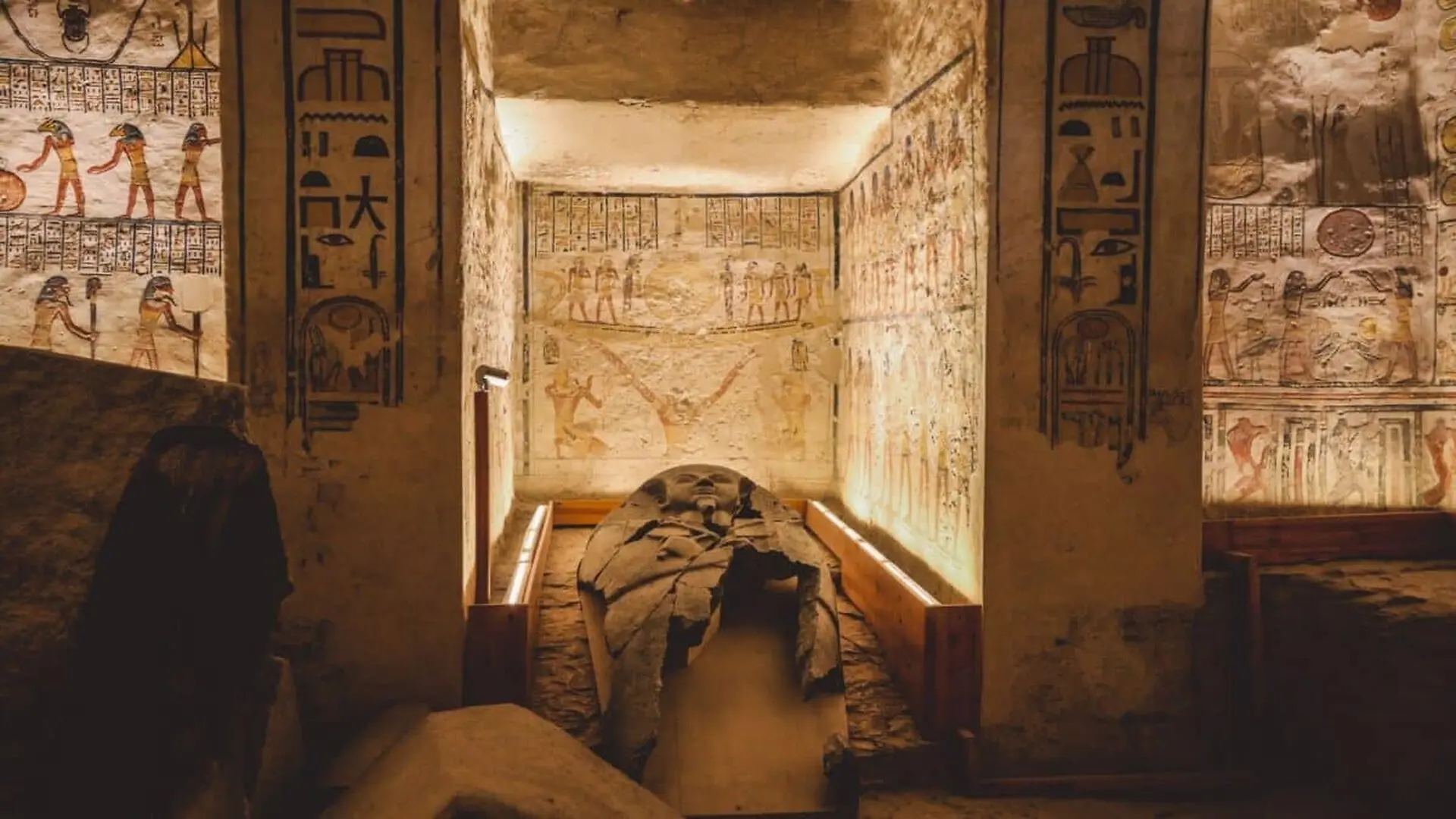
Advanced geophysical surveying has revealed potential voids hidden behind the walls of KV62, the famous final resting place of King Tutankhamun. A research initiative directed by former Egyptian antiquities minister Mamdouh Eldamaty suggests that the relatively compact burial site may actually be a fragment of a much larger, subterranean architectural complex, fueling long-standing speculation that the tomb could conceal the remains of Queen Nefertiti.
Ever since Howard Carter first breached the sealed tomb in 1922 and famously described seeing the glint of gold, the site has been a focal point for researchers. Even then, Carter noted that the tomb’s dimensions were atypically small compared to other royal burials in the Valley of the Kings, leading him to wonder if the structure was merely an anteroom to a larger, undiscovered chamber.
Recent fieldwork conducted between late 2023 and early 2024 by Eldamaty’s team, with authorization from Egypt’s Supreme Council of Antiquities, has provided new data to test that theory. The findings, detailed in a recent report, suggest that these century-old suspicions may have been well-founded.
Advanced Imaging Reveals Subsurface Anomalies
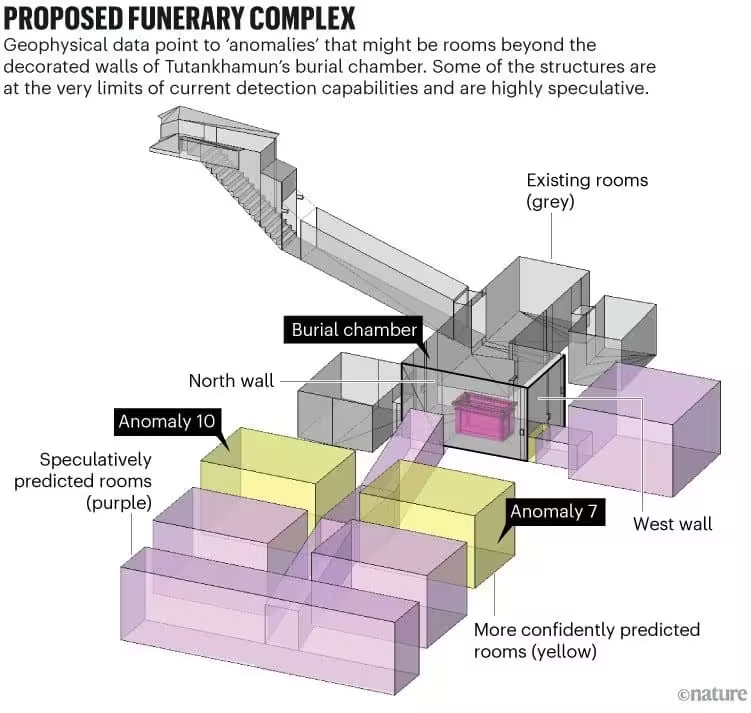
The latest investigation expanded upon 2015 observations by archaeologist Nicholas Reeves, who initially analyzed 3D scans suggesting the presence of blocked doorways. By employing a combination of ground-penetrating radar, electrical resistivity tomography, and microgravity measurements, the researchers mapped potential gaps behind the north and west walls of the chamber.
The data indicates the presence of empty spaces that could represent corridors or secondary rooms. Radar signatures suggest material voids behind the west wall, while microgravity readings outside the tomb’s footprint mirror these anomalies. Eldamaty posits that these features are consistent with the structural patterns of royal tombs, where debris-filled corridors were often used to deter grave robbers, suggesting that KV62 could be the entryway to a significantly more expansive royal site. Eldamaty maintains that these structural hints align with the possibility of a much larger complex.
The Case for a Nefertiti Connection
The hypothesis that Nefertiti might be buried within or near the site rests on several inconsistencies in the tomb’s iconography. Experts have pointed out that Tutankhamun’s iconic golden death mask features the cartouche of Ankhkheperure Neferneferuaten—a name associated with Nefertiti’s co-regency with Akhenaten. This has led some to suggest that the burial equipment may have been repurposed, or that the tomb was modified in haste following the young king’s unexpected death.
Furthermore, an analysis of the wall paintings suggests that they were altered over time. Images depicting Tutankhamun performing burial rites for his successor, Ay, appear to have been painted over earlier depictions of the king officiating the funeral of Nefertiti. Comparative analysis of the facial profiles on the north wall bears a striking resemblance to known busts of the queen, who was sometimes represented in the male guise of the pharaoh Smenkhkare in afterlife imagery.
“With none but Nefertiti in her ultimate manifestation as Smenkhkare meeting these criteria, it comes as no surprise to find the north wall’s ownership imagery replicating the precise profile of this very lady,” Eldamaty stated in his report.
Architectural Anomalies and Remaining Mysteries
The orientation of the tomb itself deviates from standard Egyptian funerary architecture. While pharaonic tombs typically feature a right-hand turn from the burial chamber, KV62 turns to the left—an arrangement historically associated with female burials. This structural anomaly continues to fuel speculation about the original intent behind the site’s construction.
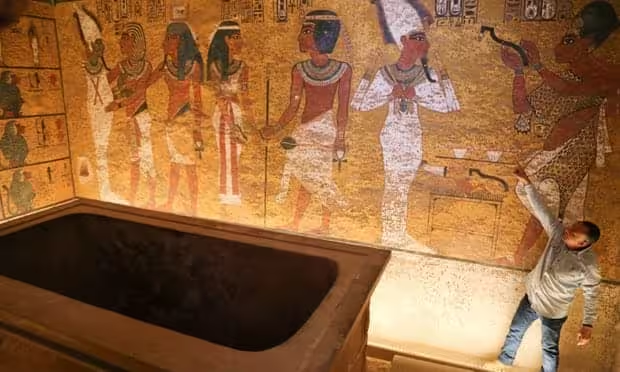
The west wall also reveals a complex history of modification. Historical records show that the mural once displayed a mummiform Nefertiti as Smenkhkare, only to be updated to show Tutankhamun as the deceased sovereign. Howard Carter himself famously disturbed parts of this wall, driven by the belief that he was missing a secondary entrance.
Despite the persistent lack of documentation regarding Nefertiti’s death and the absence of her mummy, researchers remain focused on the potential for more discoveries. Eldamaty emphasizes that the current evidence strengthens the link between KV62 and the inner circle of the Amarna royal family, suggesting the site may eventually reveal secrets that have remained buried for millennia.
This article has been fact checked for accuracy, with information verified against reputable sources. Learn more about us and our editorial process.
Last reviewed on .
Article history
- Latest version
Cite this page:
- Posted by Vikram Desai