Greek and Egyptian Deities Unite on Ancient Tombstones Revealed at Tell el-Deir
Egyptian archaeologists uncover ~20 limestone tombstones, sarcophagi and funerary artifacts at Tell el‑Deir necropolis near New Damietta.

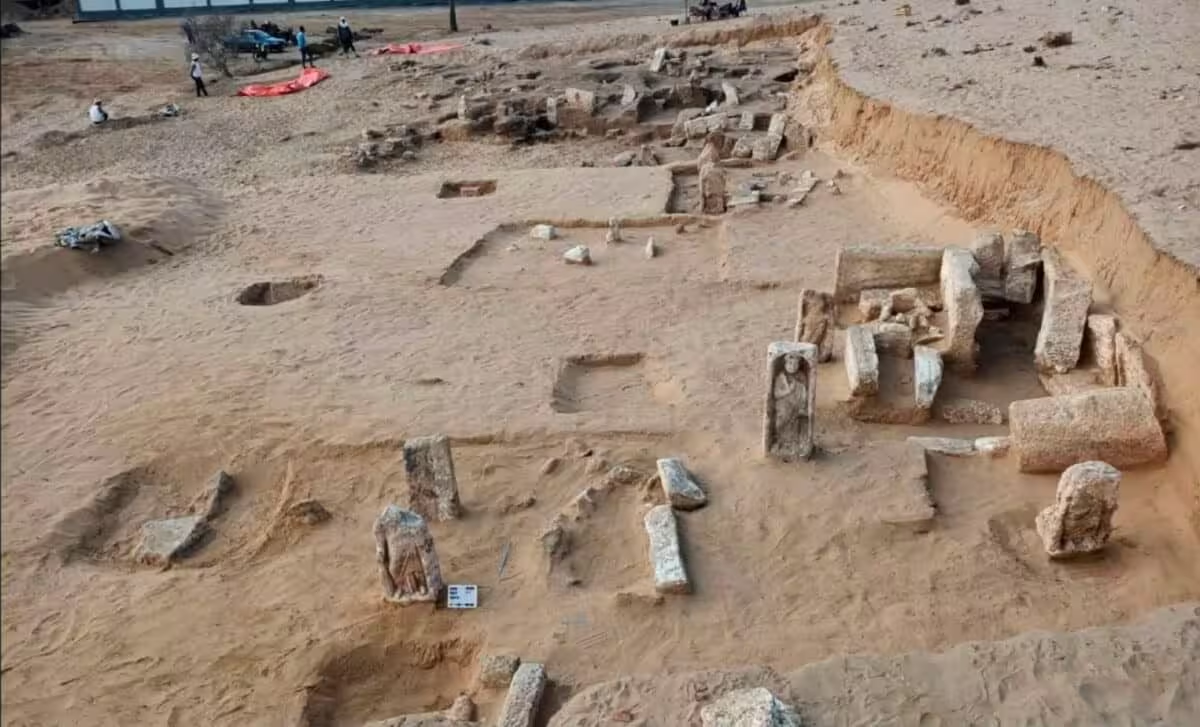
Recent excavations at the Tell el‑Deir necropolis have uncovered a suite of limestone tombstones and funerary objects that illuminate the site’s long‑term role as a sophisticated burial hub, evolving from the Late Period into the Roman era.
Hybrid Iconography Highlights Greek‑Egyptian Syncretism
Archaeologists recovered roughly twenty limestone slabs adorned with finely rendered human figures. The stone surfaces also display a range of divine motifs, including a griffin, the protective serpent Agathodaemon, and a composite deity linking Isis with the harvest goddess Renenutet.
Mohamed Abdel‑Badie, head of the Egyptian Antiquities Sector at the Supreme Council of Antiquities, explained that the blend of Egyptian, Greek and Roman symbols points to the high status of those interred and to the cultural interplay that defined the Delta’s communities during the Ptolemaic and Roman periods.
Agathodaemon, known in Greek lore as a lucky serpent, and the griffin—originally a Mesopotamian creature later adopted by Greek art—appear alongside Egyptian deities, underscoring the eclectic religious language used in local funerary rites.
These combined motifs are not decorative afterthoughts; they record how Nile Delta societies reinterpreted ancient Egyptian beliefs while integrating iconography introduced by Greek settlers, a trend that persisted under Roman governance.
Artifacts Trace Centuries of Burial Rituals
The team also uncovered elaborately painted incense burners, a variety of oil lamps, anthropoid sarcophagi fashioned from barrel‑shaped ceramics, and numerous amulets intended to protect the dead. Together, these items map the evolving ritual landscape of Tell el‑Deir across multiple epochs.
The Supreme Council of Antiquities notes that the ongoing excavation supports the interpretation of the site as a comprehensive funerary complex with a distinct social and religious identity. Secretary‑General Hisham El‑Leithy added that the stratigraphic record could refine the mapping of ancient settlements and cemeteries throughout the Damietta basin.
Systematic digging at Tell el‑Deir resumed in 2007, yielding thousands of artifacts primarily linked to Egypt’s 26th Dynasty—the last native ruling house before Persia’s conquest in 525 BC. Subsequent phases revealed Ptolemaic tombs with more than sixty interments and numerous gold sheets bearing images of Isis, Bastet and the falcon‑headed Horus.
Earlier limestone sarcophagi bearing human faces have been transferred to the Egyptian Museum in Cairo, while additional finds are slated for display at the forthcoming Grand Egyptian Museum in Giza.
Abdel‑Badie emphasized that the latest discoveries extend Tell el‑Deir’s chronological span from the Late Period through the close of Roman rule, and that the mission will continue to probe the site, though the council has not disclosed the total number of future excavation seasons planned.
This article has been fact checked for accuracy, with information verified against reputable sources. Learn more about us and our editorial process.
Last reviewed on .
Article history
- Latest version
Cite this page:
- Posted by Vikram Desai