Tiny Garnet Crystals in Martian Meteorite Hint at Unexpected Metamorphic Past
Scientists find a new mineral in a Martian meteorite that reveals surprising clues about ancient geological forces shaping Mars.
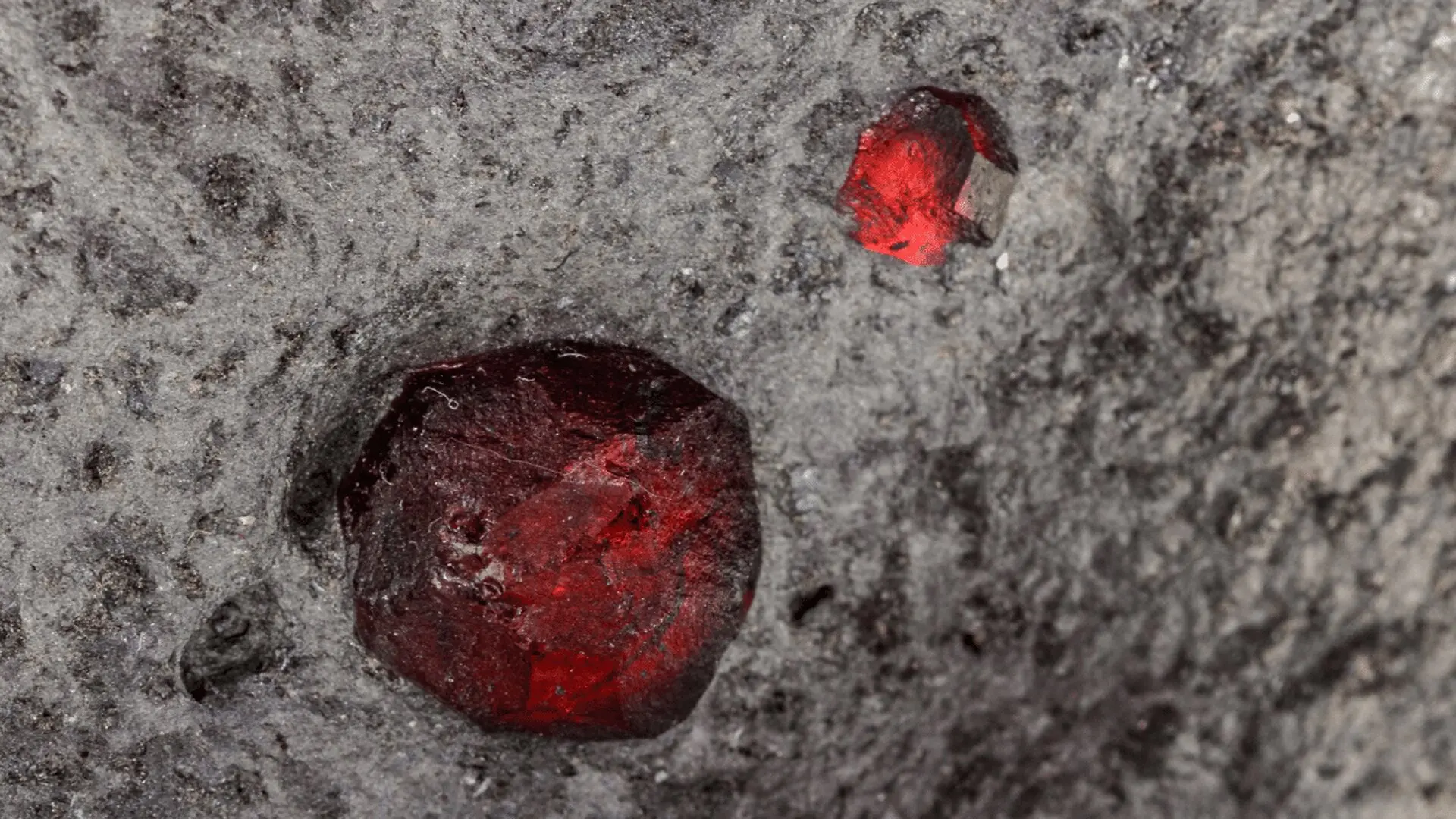
A minuscule mineral embedded in a Martian meteorite has opened a new chapter in planetary science. A team of researchers identified microscopic grains of the iron‑rich garnet variety andradite inside a rock fragment that fell to Earth from Mars, a mineral never before confirmed in a Martian sample. The work, first highlighted by ScienceAlert and published in Geochemical Perspectives Letters, points to geological processes on the Red Planet that have remained hidden for billions of years.
Microscopic Garnet Found Inside a Martian Rock
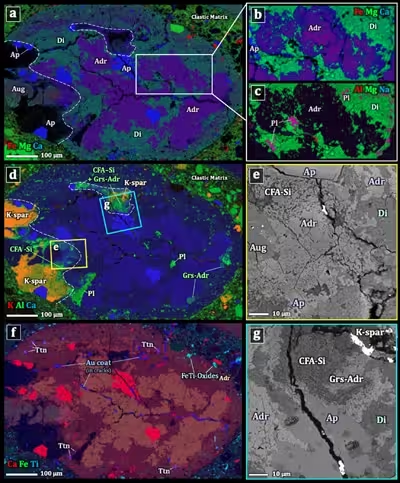
The specimen, catalogued as NWA 8171, resides in the Royal Ontario Museum’s meteorite collection. Though the stone looks ordinary at first glance, a fragment measuring roughly 0.8 × 0.5 mm contains several tiny crystals of andradite, an iron‑rich garnet that had not been recorded in any Martian material until now.
Garnets are prized by geologists because they lock in the temperature, pressure and chemical environment of their formation, offering a direct glimpse into a planet’s deep history. The absence of such a mineral in prior Martian samples made this discovery a significant milestone for scientists piecing together the planet’s geological timeline.
Credit: Geochemical Perspectives Letters
Planetary geologist Tanya Kizovski of Brock University emphasizes the broader impact. “This discovery is going to expand our knowledge of the geologic processes that are possible on this planet,” she says.
“This new garnet‑bearing rock type could give us clues to how Mars has changed throughout its history and new insights into the ancient environments that could have formed the garnet and related minerals.”
A Near‑Miss: How the Mineral Almost Went Unnoticed
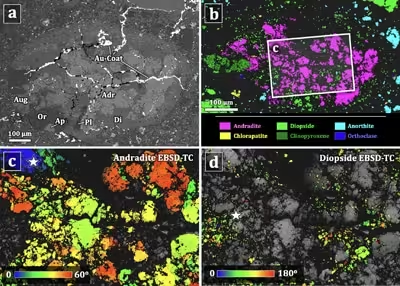
The grain’s subtle coloration—yellow‑green rather than the deep reds typical of Earth garnets—made it easy to mistake for more common minerals. Initial scans identified the particles as pyroxene, a mineral frequently encountered in meteorites and volcanic rocks.
“This little section of the meteorite looked really interesting, and the chemistry was a bit odd,” Kizovski recalls. “At first, we assumed it was a mineral called pyroxene, which is very common, but then we decided to take a second look.”
A follow‑up analysis using advanced chemical mapping revealed the true identity of the grains as garnet, underscoring how even well‑studied collections can conceal surprises awaiting modern instrumentation.
Credit: Geochemical Perspectives Letters
What the Garnet Suggests About Mars’ Early Environment
On Earth, garnet forms under intense heat, high pressure, or chemical alteration—conditions typical of metamorphic settings. The presence of andradite on Mars raises the question of which processes could have produced it.
“Garnet is a classic example of a mineral often found in metamorphic rocks on Earth. The process of metamorphism transforms igneous or sedimentary rocks into a new form through exposure to extreme heat, high pressure, or hot fluids,” Kizovski explains.
Researchers are evaluating three main scenarios: impact‑generated shock that heated and compressed crustal material, magmatic intrusions that introduced hot fluids, or a combination of both mechanisms.
“On Mars, the heat and pressure needed to produce garnet through metamorphism could have come from the impact of a meteorite hitting the surface of Mars, magma rising up into the Martian crust, or both.”
If any of these pathways proved viable, they would imply that Mars experienced more complex tectonic and thermal regimes than many current models predict, potentially reshaping ideas about the planet’s interior evolution.
Why NWA 8171 Is a Key Martian Sample
Even before the garnet was recognized, NWA 8171 attracted attention as a basaltic breccia—a rock composed of fragmented pieces from diverse sources bound together by molten material. Scientists liken its texture to a fruitcake, where the basaltic matrix serves as the cake and assorted mineral clasts act as the embedded fruit.
This heterogeneous makeup means the meteorite archives multiple episodes of Martian geology in a single stone. The newly identified garnet grains could therefore serve as time stamps, recording thermal events, impact episodes, or volcanic activity that occurred deep within the planet long before the rock was ejected.
The study, appearing in Geochemical Perspectives Letters, proposes that NWA 8171 may represent a previously unrecognized Martian rock type, enhancing its value for future investigations.
Next Steps: Pinpointing the Garnet’s Provenance
A remaining question is whether the garnet formed on Mars or was introduced from another source before the breccia assembled. While the mineral’s chemistry aligns with Martian signatures, definitive proof requires isotopic comparison with established Martian materials.
Upcoming isotope analyses aim to match the garnet’s ratios to those of confirmed Martian samples. A close correspondence would solidify the case for an indigenous Martian origin and unlock a detailed record of the planet’s ancient interior processes.
“The findings add a striking new dimension to our understanding of the geology of Mars,” says planetary scientist James Darling of the University of Portsmouth. “They open an exciting new window into the evolution of our planetary neighbor.”
This article has been fact checked for accuracy, with information verified against reputable sources. Learn more about us and our editorial process.
Last reviewed on .
Article history
- Latest version
Reference(s)
- T.V. Kizovski, L.F.. “Expanding Mars’ lithologic diversity: discovery of a garnet-bearing clast in NWA 8171.”, vol. 40, no. 40, pp. 30-37. <https://www.geochemicalperspectivesletters.org/article2619/>.
Cite this page:
- Posted by Vikram Desai