What Secrets the Unreadable Phaistos Disc Holds After a Century of Study
Mystery spiral disc with undeciphered symbols fuels 100‑year debate: poem, hymn, or ancient board game?
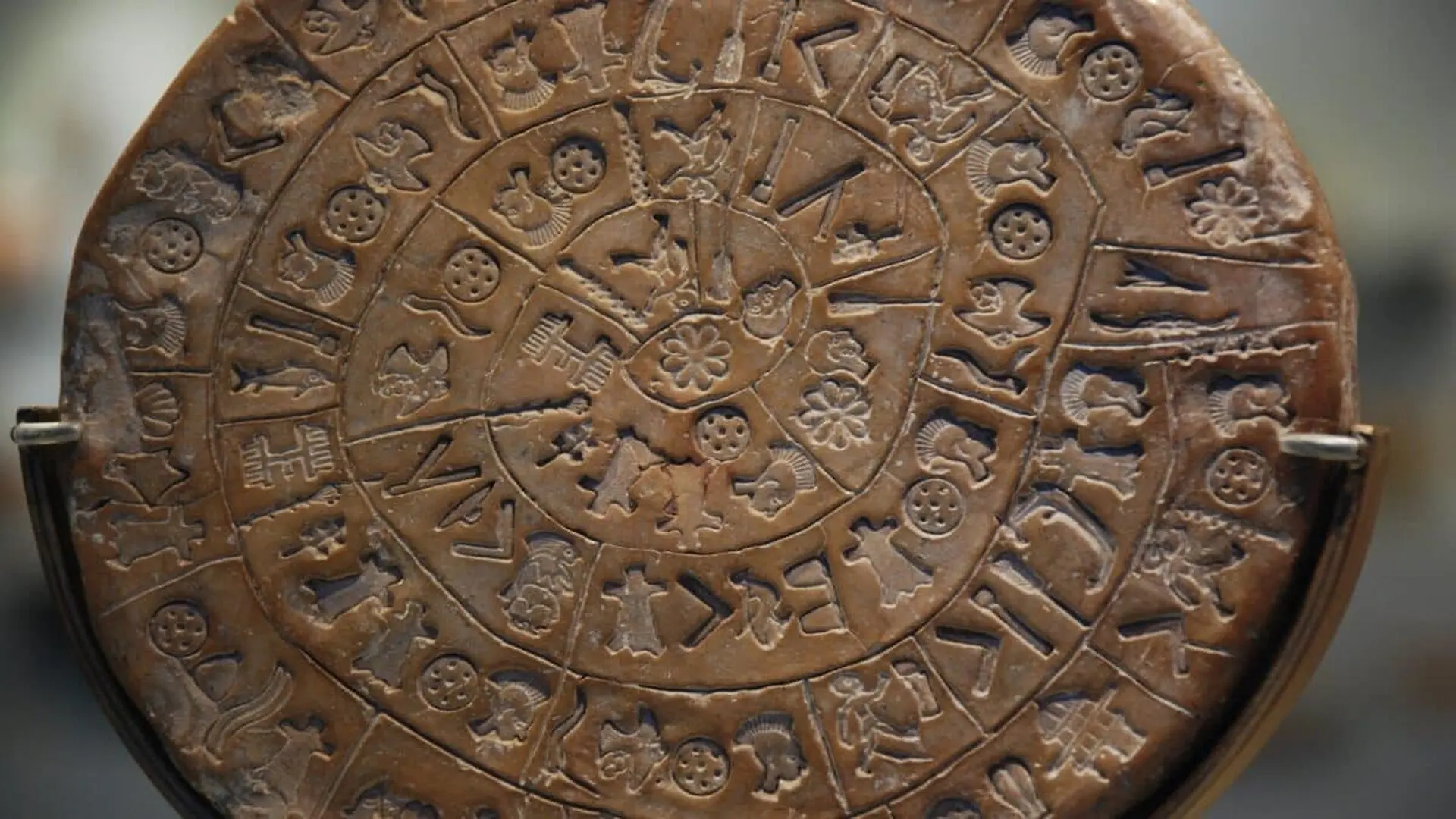
On 3 July 1908, Luigi Pernier, an Italian archaeologist, uncovered a circular clay object while excavating the Palace of Phaistos—one of the chief sites of the ancient Minoan culture on Crete. The find quickly turned into a focal point of scholarly debate over a Bronze‑Age artifact whose purpose remains unresolved.
Measuring roughly 16 cm (about 6.3 inches) across, the disk is displayed at the Heraklion Archaeological Museum. Its surface bears 241 individual signs that follow a spiral layout, a design that has led many researchers to propose a reading direction that starts at the rim and proceeds inward.
The disc contains 45 unique symbols, ranging from stylized human figures and animals to depictions of tools, weapons and armor. As noted by Popular Mechanics, the variety of signs exceeds the modest inventory of typical alphabetic scripts (usually 20‑30 characters) yet falls far short of the hundreds of glyphs found in classic hieroglyphic systems, such as those discussed in hieroglyphic texts.
Unconventional Production Methods Revive Game Hypothesis
The disk was recovered from a charred layer inside a storage chamber of the palace, suggesting that it may have originally been formed from unfired clay and later solidified by fire. Potential sources of the heat include the catastrophic Santorini eruption around 1700 BCE and a subsequent destructive episode, possibly linked to Mycenaean incursions circa 1450 BCE.
Unlike most inscriptions that are incised, the signs on the Phaistos Disc appear to have been impressed into the pliable clay—a technique known as blind printing. In a 1997 article for the German journal Gutenberg‑Jahrbuch, linguist Herbert Brekle argued that, if the object encodes language, it should be regarded as a “printed” text that satisfies the core principles of typography (source).
A recent preprint (see study) reexamines these manufacturing clues and argues that the disk’s layout and production technique align more closely with a gaming device than with a conventional text. The authors propose that the unfired clay composition points to a prototype that never entered widespread use.
Could the Disk Encode a Verse or Sacred Chant?
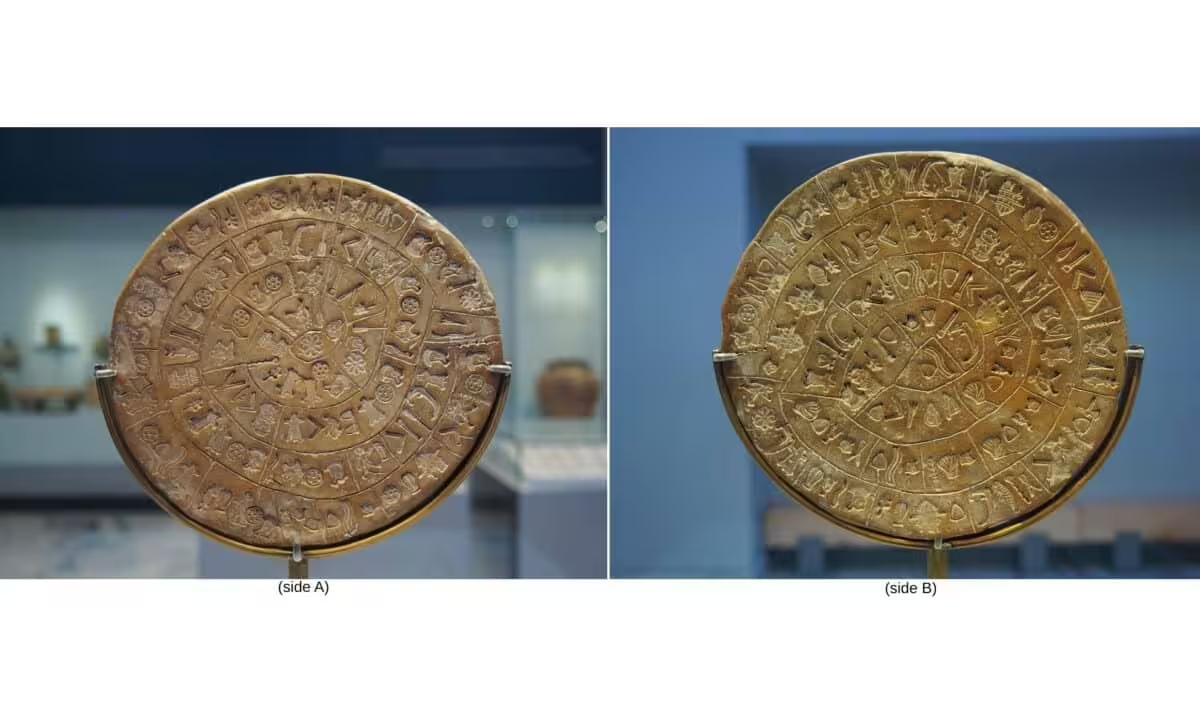
Among the many speculative frameworks, a prominent line of thought posits that the artifact preserves a structured literary composition. In 2008, John Younger and Paul Rehak highlighted recurring patterns on both faces of the disk, interpreting them as evidence of poetic organization. They wrote that “the phrases on side A begin with similar signs, and those on side B end in similar signs, suggesting repetitious phrases on A and rhyming phrases on B” (source).
Based on this observation, the scholars concluded that the disk most plausibly records a poem, a song, or—if it serves a ritual function—a chant or hymn. Their hypothesis rests on the apparent symmetry of symbol clusters and the way the inscriptions are arranged across the two sides.
More than a century after Luigi Pernier first lifted the enigmatic object from the ruins of Phaistos, scholars continue to grapple with its true nature. Whether it represents a textual message, a lyrical piece, a religious hymn, or an ancient board game, the original intent behind the disk remains an open question.
This article has been fact checked for accuracy, with information verified against reputable sources. Learn more about us and our editorial process.
Last reviewed on .
Article history
- Latest version
Reference(s)
- Orf, Darren. “The Phaistos Disc Has Stumped Experts for 100 Years. An Old Theory Might Have Nailed Its Purpose..”, June 22, 2026 Popular Mechanics <https://www.popularmechanics.com/science/archaeology/a71619703/phaistos-disc/>.
- <https://web.archive.org/web/20110716022750/http:/www.typeforum.de/news_332.htm>.
- <https://www.researchgate.net/publication/399329972_The_Phaistos_Disk_as_a_Board_Game_Evidence_from_Manufacture_Spatial_Design_and_Context>.
- “Chapter%207.%20Minoan%20Culture.” <https://e-edu.nbu.bg/pluginfile.php/746238/mod_resource/content/1/Chapter%207.%20Minoan%20Culture.pdf>.
Cite this page:
- Posted by Vikram Desai