600+ Amphorae Found in Sunken Greek Trade Ship Off Andros Island
A shipwreck off Andros revealed hundreds of ancient amphorae, but the most telling find lies in the mysterious cargo uncovered on the seabed.
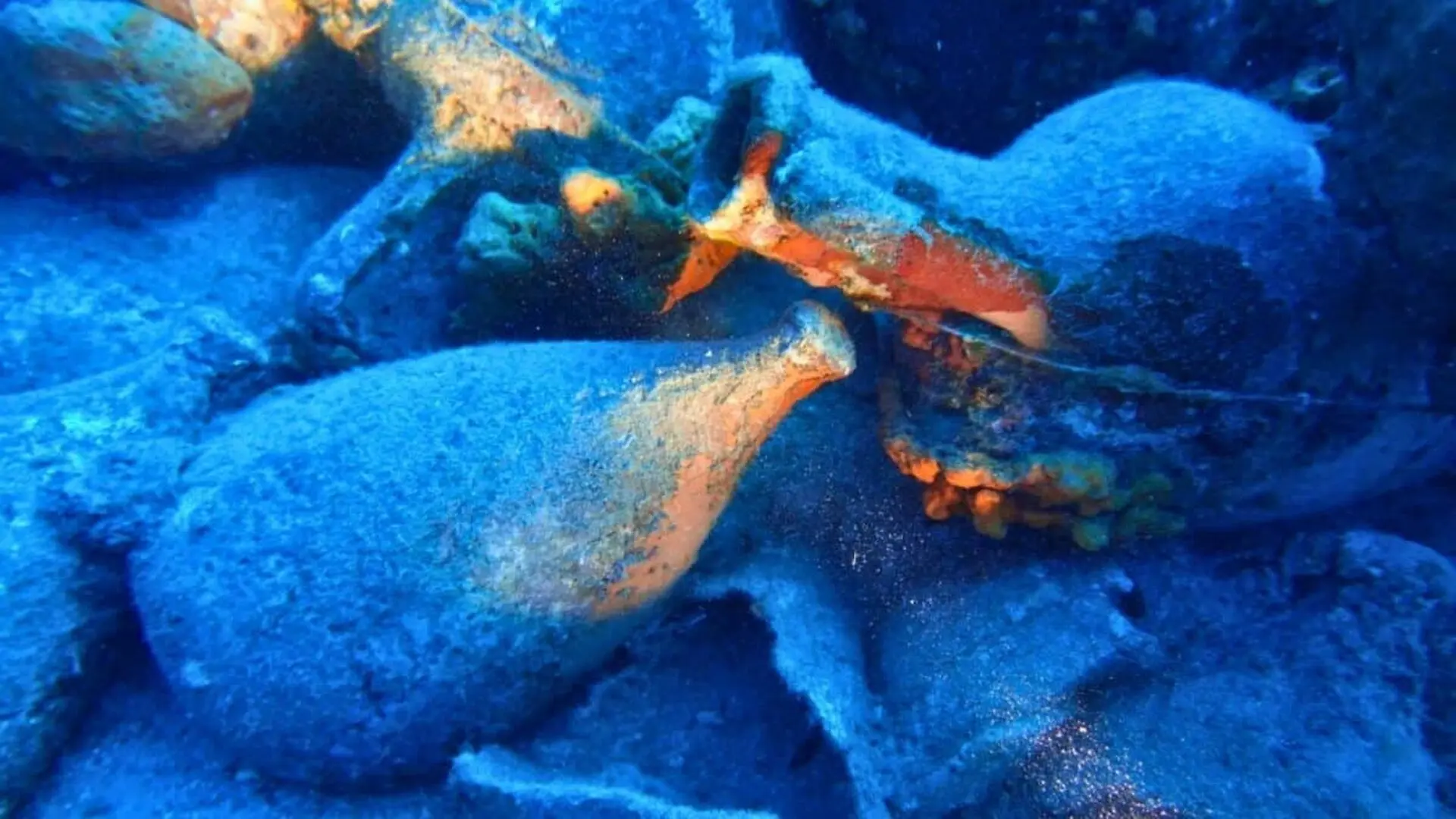
A team of Greek underwater archaeologists has uncovered a massive cargo of ancient trade jars near the island of Andros, estimating that between 600 and 650 amphorae rest on the seafloor at depths ranging from 39 to 44 metres.
The site was examined after a private diver alerted authorities, prompting the Ephorate of Underwater Antiquities to conduct an inspection. The Greek Ministry of Culture confirmed the discovery on 31 July 2026, describing the find as a collection of pointed‑bottom amphorae from a late Classical‑era vessel. The exact count remains provisional.
Stylistic analysis dates the jars to the late fifth and early fourth centuries BCE, situating the cargo firmly within the late Classical period. No definitive information has yet emerged regarding the ship’s construction date or the circumstances of its sinking.
Three Distinct Amphora Forms Identified
Surveyors recorded at least three varieties of commercial jars: vessels originating from Mende, from Peparethos, and the so‑called Solokha 2 type. One specimen of each form was recovered for laboratory analysis. The remaining containers have not been classified by type in the initial report.

These pointed‑bottom ceramic containers were the standard freight vessels of the ancient Mediterranean, typically transporting wine, olive oil and other agricultural goods. While the exact contents of the Andros cargo remain unknown, the presence of such amphorae underscores the island’s role in long‑distance trade networks.
Although the three identified types provide clues about the origins of the cargo, the announcement does not specify the ship’s point of departure, its intended destination, or the precise trade route it followed.
Seafloor Distribution and Depth Range
The wreck rests between 39 and 44 metres below the surface (approximately 128–144 feet). A photo mosaic and underwater footage released by the Ministry show clusters of amphorae settled on the seabed, including a dense assemblage at the 44‑metre level. Additional images document the retrieval of one of the sample jars.
The provisional estimate of 600–650 jars derives from the initial visual assessment; a comprehensive inventory has yet to be completed. No dimensions of the hull, the size of the wreck site, or a detailed breakdown of cargo types have been disclosed.

Among the artefacts recovered was a fragment of a lead anchor stock, indicating the presence of anchoring equipment on the vessel. No complete anchor was found. A handful of stones were also noted on the site; they may represent ballast material, though the Ministry has not confirmed this interpretation.
Focus on Trade Origins and Future Research
The Ministry emphasized that the find offers fresh evidence for understanding commercial exchange and navigation in the late Classical era. Ongoing investigations will prioritize the analysis of the amphorae themselves and the identification of their production locales, rather than reconstructing the ship’s itinerary.
Independent coverage has already begun to contextualize the wreck as an ancient merchant vessel, suggesting that further study could illuminate its broader trade connections. However, the official statement remains limited to the cargo and its provenance.

The underwater survey was carried out by a three‑person team from the Ephorate of Underwater Antiquities, comprising diving archaeologist Dionysios Evangelistis, diving conservator Angelos Tsombanidis, and seabed technician Louis Mercenier (also spelled Tsompanidis and Mersenier in some English reports).
At present, no schedule for excavation, laboratory analysis, or publication of the sample results has been announced. The next phase will involve detailed study of the retrieved amphorae and a broader assessment of the cargo assemblage.
This article has been fact checked for accuracy, with information verified against reputable sources. Learn more about us and our editorial process.
Last reviewed on .
Article history
- Latest version
Reference(s)
- “Merchant Ship Off Andros Island 3.” <https://archaeologymag.com/wp-content/uploads/merchant-ship-off-andros-island-3.jpg>.
- “Merchant Ship Off Andros Island 1.” <https://archaeologymag.com/wp-content/uploads/merchant-ship-off-andros-island-1.jpg>.
- “Merchant Ship Off Andros Island 2.” <https://archaeologymag.com/wp-content/uploads/merchant-ship-off-andros-island-2.jpg>.
Cite this page:
- Posted by Vikram Desai