A Secret Triangle in Leonardo’s Vitruvian Man Links Human Anatomy to Modern Dental Geometry
Study finds hidden triangle in da Vinci’s Vitruvian Man could solve centuries-old mystery, revealing new geometric insight.
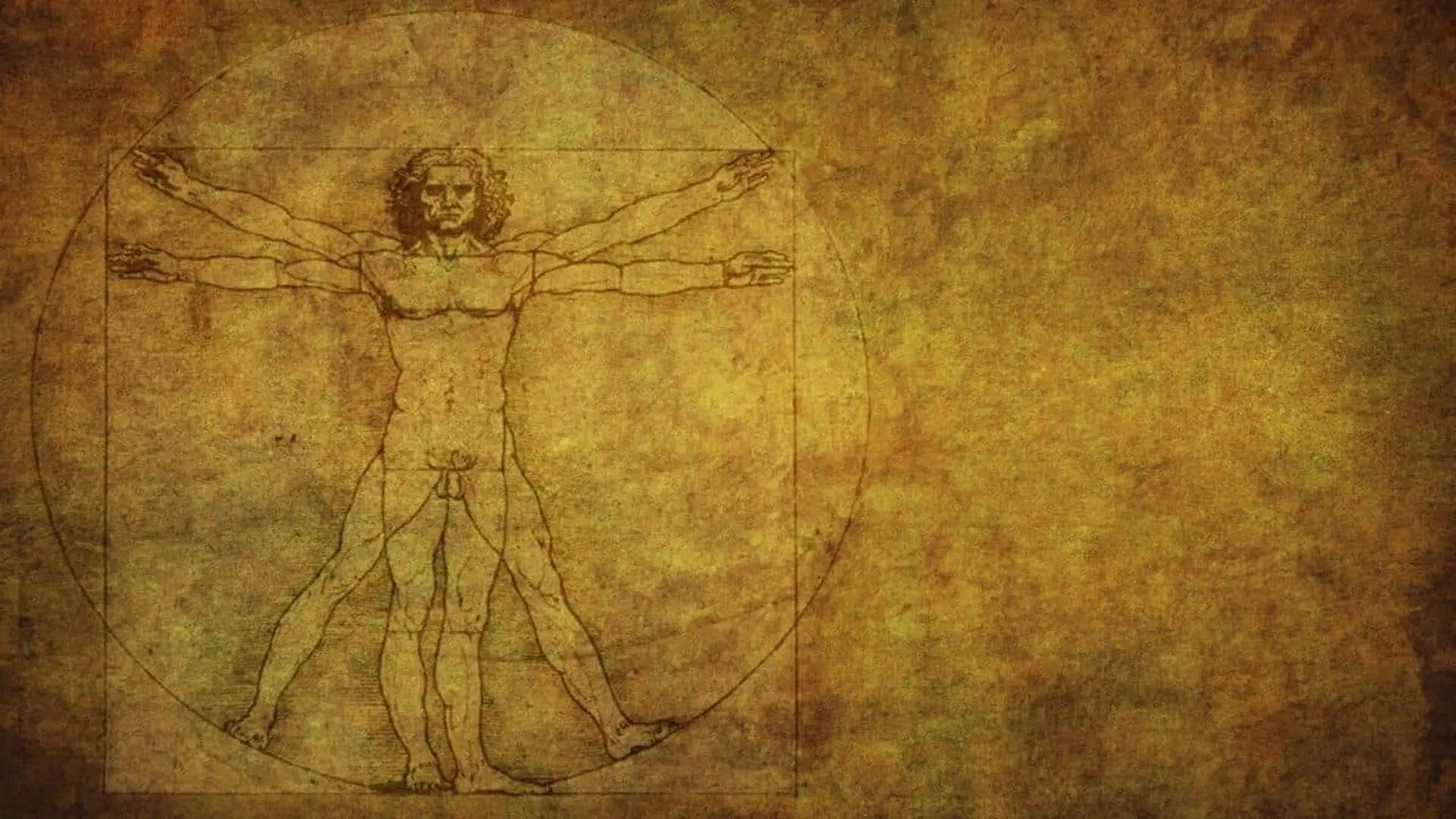
A recent paper in the Journal of Mathematics and the Arts argues that Leonardo da Vinci’s famous Vitruvian Man may hide an equilateral triangle that links the drawing’s proportions to both human anatomy and longstanding geometric principles. The hypothesis, advanced by London‑based dentist and independent scholar Rory Mac Sweeney, is based on a brief remark in Leonardo’s own notes about the “space between the legs.”
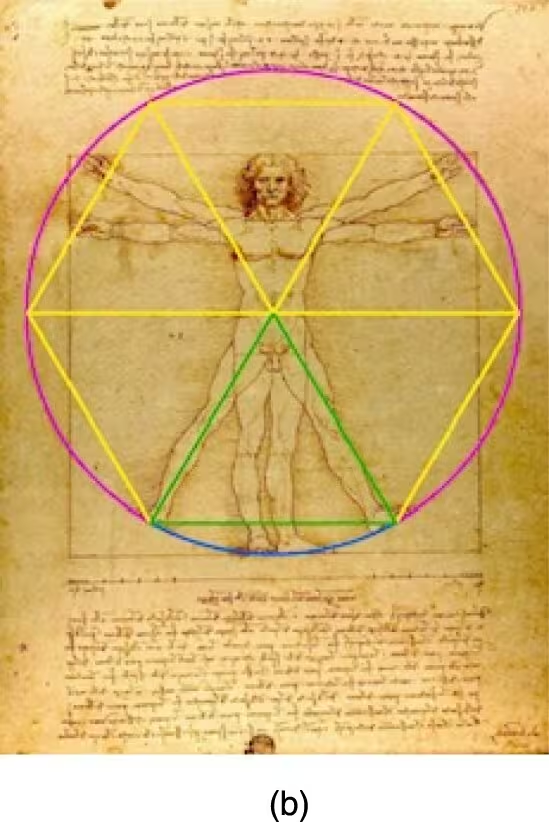
For generations, scholars have wondered how the Renaissance master managed to place a single figure inside a perfect circle and a square at the same time. Mac Sweeney’s analysis suggests the answer lies in a triangle formed by the legs, an element that would keep the arms and legs aligned with the two shapes without requiring complex adjustments.
Leonardo’s Subtle Geometric Cue
Created around 1490, the Vitruvian Man was inspired by the Roman architect Vitruvius, who saw the human body as a model of proportional harmony for architecture. Leonardo took the concept further, shifting the circle’s center to the navel and rotating the square’s axis toward the groin so that the limbs touch both outlines.
Leonardo recorded in his own marginalia that “the space between the legs will be an equilateral triangle.” Mac Sweeney interprets this comment as a practical instruction rather than a decorative observation.
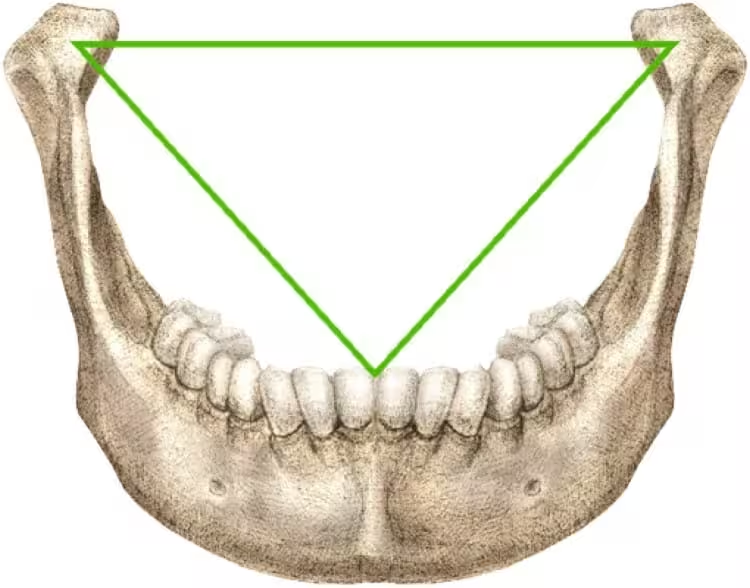
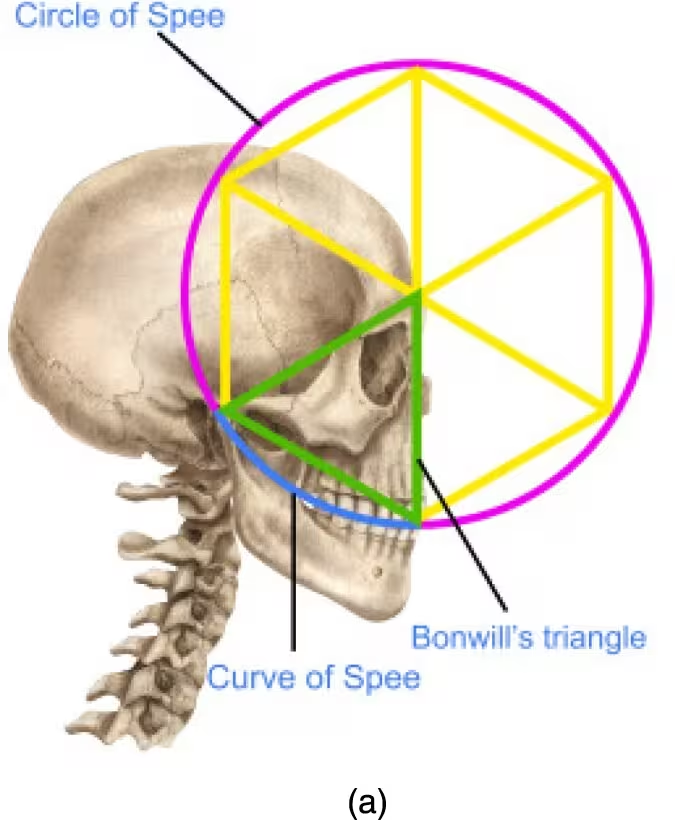
In an interview with The Independent, Mac Sweeney noted, “The clue was in Leonardo’s own words; he was pointing to this triangle all along.” The same triangle, he argues, corresponds to Bonwill’s Triangle, a construct identified in 1864 by American dentist William Bonwill while studying mandibular mechanics.
Bonwill’s Triangle connects the two rotation points of the lower jaw with the midpoint of the lower incisors, a relationship still used today to analyze bite dynamics and design dental prosthetics.
A Ratio That Mirrors Natural Geometry
Mac Sweeney’s calculations indicate that the side of the square divided by the circle’s radius yields a value close to 1.64. This figure approximates the tetrahedral ratio of 1.633, a constant that governs the geometry of a regular tetrahedron—a shape composed of four identical equilateral triangles.
The same proportion appears in various natural phenomena, from sphere packing to crystal lattices. The study’s authors contend that Leonardo’s construction may reflect a universal pattern that recurs in biology. “Leonardo’s systematic construction yields a ratio… matching both published measurements of the original drawing and the tetrahedral ratio of 1.633,” the paper states.
A 2019 examination of 100 human skulls reported a cranial proportion of 1.64 ± 0.04, a range that aligns closely with the figure derived from the Vitruvian Man. While Leonardo could not have known modern anatomical data, the overlap suggests that certain geometric relationships emerge naturally from human form.
Next Steps for Verification
The proposed geometry remains a hypothesis. Researchers suggest that high‑resolution scans of the original sketch could be compared with the triangle model to assess alignment. Further analysis of Leonardo’s notebooks might also reveal whether he employed similar constructions elsewhere.
Over the years, the Vitruvian Man has inspired numerous mathematical interpretations, from the golden ratio to complex polygonal analyses. The current proposal adds a fresh perspective by linking Renaissance art to a dental geometry discovered centuries later, offering a potential bridge between artistic intuition and natural proportion.
This article has been fact checked for accuracy, with information verified against reputable sources. Learn more about us and our editorial process.
Last reviewed on .
Article history
- Latest version
Reference(s)
- <https://www.britannica.com/biography/Vitruvius>.
- Sankaran, Vishwam. “Dentist cracks centuries-old puzzle hidden in Da Vinci’s famous Vitruvian Man drawing.”, July 2, 2025 The Independent <https://www.independent.co.uk/news/science/archaeology/leonardo-da-vinci-paintings-vitruvian-man-maths-puzzle-b2780903.html>.
- <https://en.wikipedia.org/wiki/William_G._A._Bonwill>.
- “Mammalian Skull Dimensions and the Golden Ratio (Φ) - PubMed.”, vol. 30, no. 6 PubMed, doi: 10.1097/SCS.0000000000005610. <https://pubmed.ncbi.nlm.nih.gov/31107389/>.
Cite this page:
- Posted by Vikram Desai