Asteroid Bennu Reveals How Jupiter Created a Cosmic Melting Pot in the Early Solar System
NASA’s analysis of asteroid Bennu samples has uncovered a surprising clue about the early history and formation of our solar system.
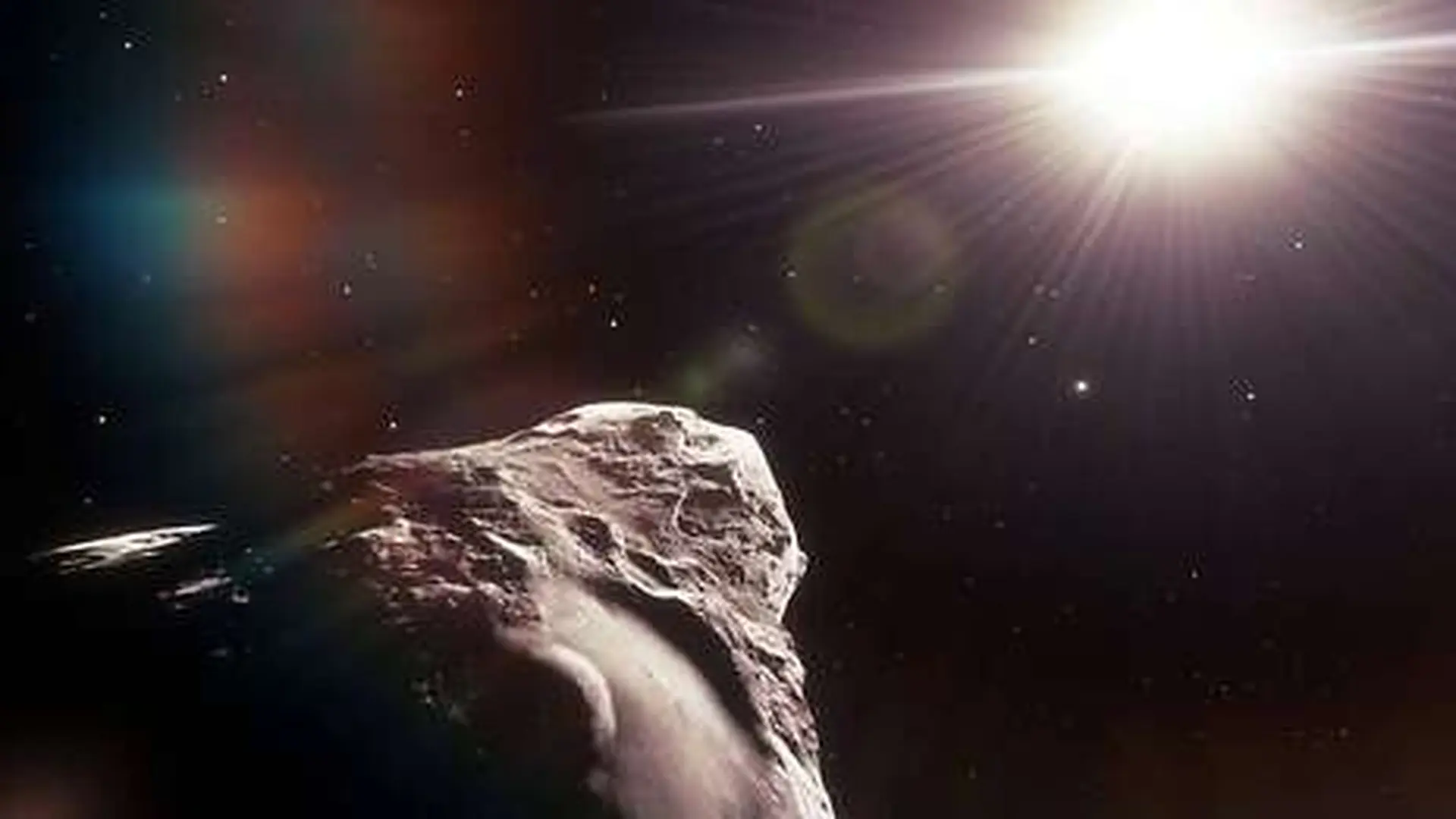
The asteroid Bennu, a relic of the solar system’s violent infancy, is revealing secrets about the architecture of our cosmic neighborhood that have remained hidden for 4.5 billion years. New analysis of surface samples returned by NASA’s OSIRIS-REx mission suggests the space rock is not a simple chunk of outer-system debris, but a complex mosaic of materials forged through the gravitational influence of a growing Jupiter.
When the OSIRIS-REx capsule touched down in the Utah desert on September 23, 2023, it brought with it approximately 120 grams of extraterrestrial material. This sample offered researchers a pristine look at the chemical conditions that predated the formation of Earth. A team at ETH Zurich, led by professor Maria Schönbächler, analyzed a mere half-gram of this dust to uncover an isotopic signature that is rewriting the history of planetary migration.
Deciphering the Isotopic Fingerprint
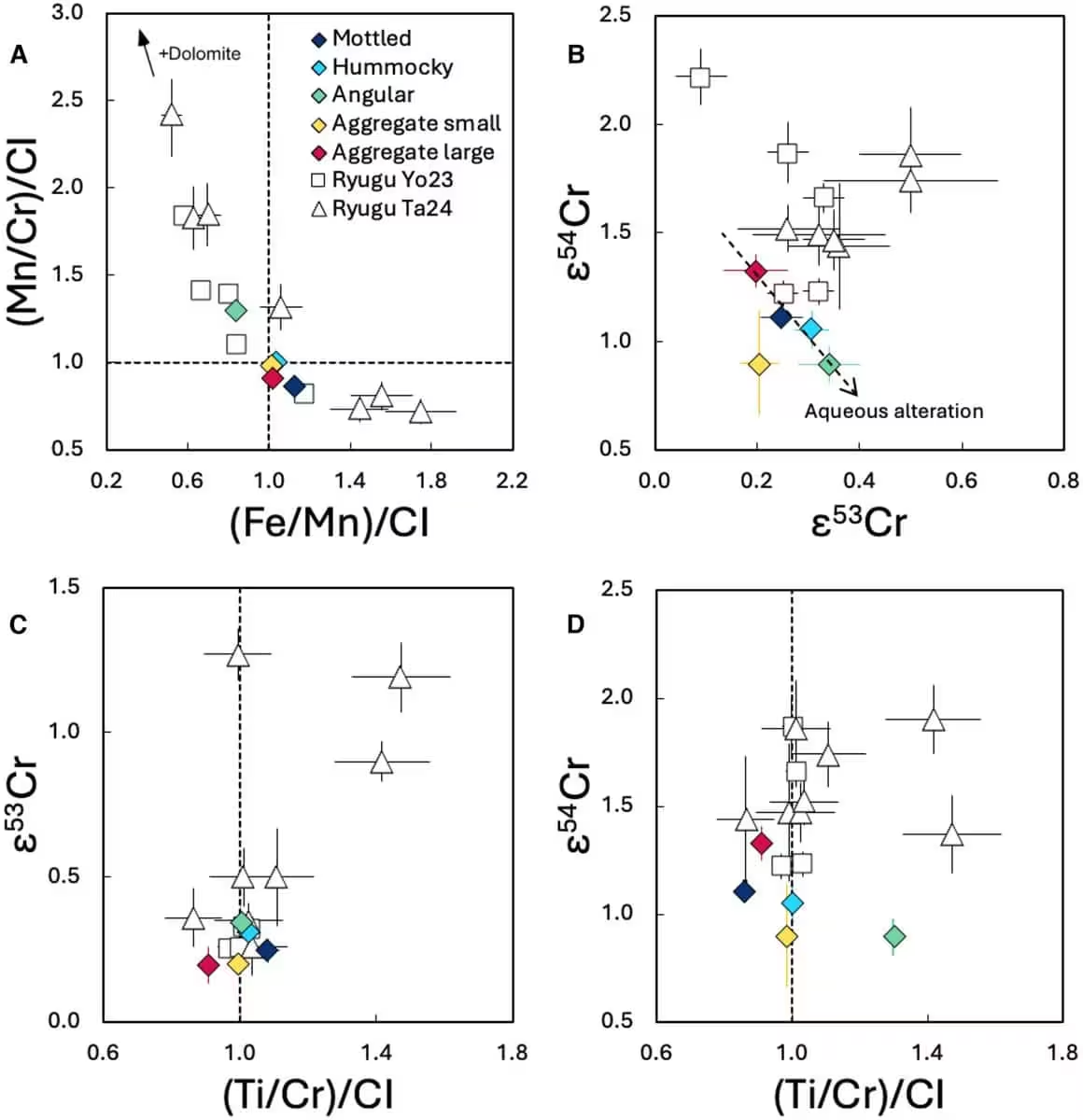
To trace the origins of the asteroid’s building blocks, the researchers focused on the isotopes of iron, titanium, and chromium. These atomic variants act as stable chemical barcodes, allowing scientists to pinpoint where raw materials originated in the protoplanetary disk. The results, published in Science Advances, demonstrate that Bennu possesses a strikingly uniform chemical distribution that mirrors both the asteroid Ryugu and the rare class of carbon-rich CI meteorites.
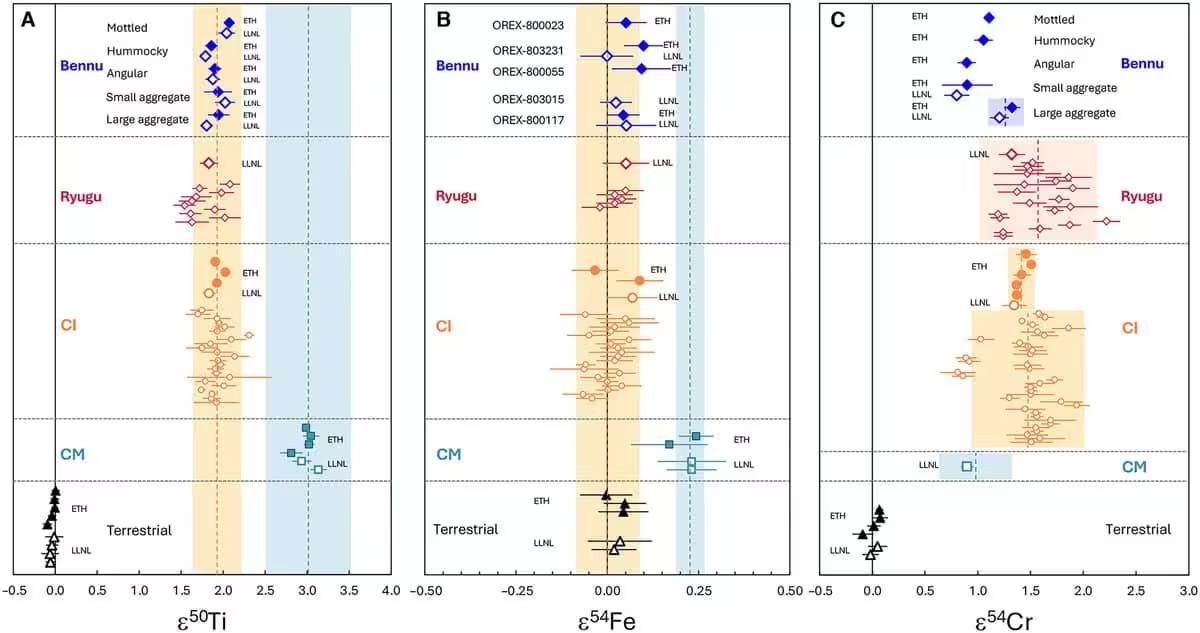
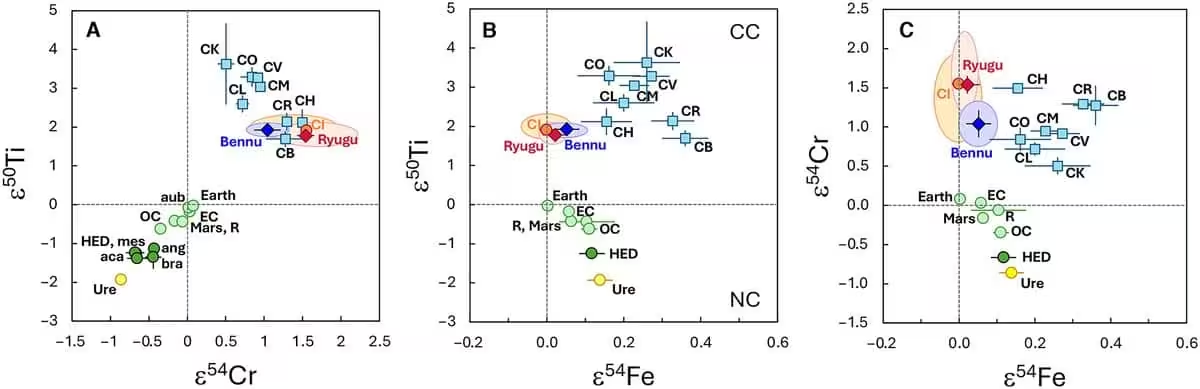
This shared ancestry suggests these objects were born from a common reservoir of cosmic dust. While earlier theories posited that primitive asteroids like Bennu formed exclusively in the frigid outer reaches of the solar system, this new chemical evidence indicates a hybrid origin, incorporating matter from both inner and outer regions.
Jupiter’s Role as a Cosmic Gatekeeper
The mechanism behind this mixing likely centers on the water-ice line, a boundary where temperatures allowed water vapor to transition into solid ice. As the early solar system evolved, the emergence of Jupiter acted as a massive gravitational barrier. The gas giant, forming within the first million years of solar history, effectively filtered incoming matter, blocking larger debris while permitting finer dust particles to drift through its orbital neighborhood.
“Bennu is a hybrid: the material does not clearly match either the inner or the outer Solar System,” explains Schönbächler. This finding reveals how a chaotic, swirling disk of material was organized into specific regions where chemical interaction could occur.
Implications for Earth’s Building Blocks
Bennu’s chemical profile is particularly compelling because it contains water-bearing minerals and maintains a composition strikingly similar to the Sun itself. This suggests that the processes occurring near the water-ice line—where evaporation and condensation dictated the survival of minerals—might be the same processes that provided the foundational materials for the terrestrial planets.
“Bennu may offer our best glimpse of the original mix of chemical elements from which the terrestrial planets were ultimately built,” adds Schönbächler. Beyond the minerals, the presence of organic compounds in the sample provides a new avenue for exploring the delivery of life-essential ingredients to the early Earth.
Researchers are now looking toward upcoming missions to verify these findings. Of particular interest is the Martian moon Phobos. JAXA, the Japanese space agency, intends to launch a sample-return mission to the moon in October 2026, with scientists anticipating the arrival of that extraterrestrial cargo back on Earth by 2031.
This article has been fact checked for accuracy, with information verified against reputable sources. Learn more about us and our editorial process.
Last reviewed on .
Article history
- Latest version
Reference(s)
- “Prof. Dr. Maria Schönbächler | ETH Zurich.” <https://eaps.ethz.ch/en/people/profile.maria-schoenbaechler.html>.
- Schönbächler, Maria., et al. “Nucleosynthetic constraints on the origin of Bennu and CI-like asteroids.” Science Advances, vol. 12, no. 39, September 25, 2026 American Association for the Advancement of Science (AAAS), doi: 10.1126/sciadv.aei9107. <https://www.science.org/doi/10.1126/sciadv.aei9107>.
Cite this page:
- Posted by Bilal Abbasi